

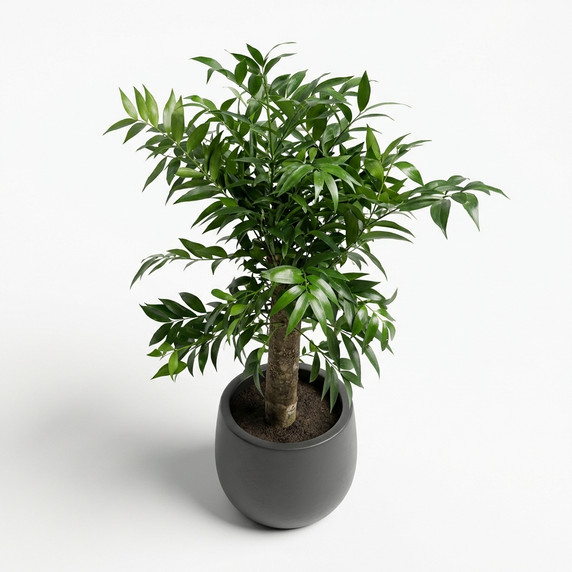





Bring instant, upscale greenery to your space with Alii Ficus—an elegant, narrow-leaf ficus that looks curated and architectural without feeling heavy. Perfect as a floor statement plant for living rooms, reception areas, and meeting rooms, it rewards simple routines: bright filtered light and smart watering. A premium choice for modern interiors that want a calm, professional look year-round.
Common Name: Alii Ficus, Banana Leaf Fig
Botanical Name: Ficus maclellandii
Arabic Name: فيكس علي
Family: Moraceae
The Alii Ficus belongs to the genus Ficus within the Moraceae (mulberry/fig) family. It is classified as Ficus maclellandii, often specifically the 'Alii' cultivar, which was developed to be a hardier indoor specimen compared to its relatives like the Ficus benjamina.
Native to Southeast Asia, including regions of India, China, and Thailand, where it grows in tropical forest environments as a large evergreen tree.
This plant is distinguished by its long, narrow, willow-like leaves that taper to a point and curve downward. The foliage is a deep, glossy olive green. It typically grows with an upright, slender habit, making it an excellent choice for corners or narrow spaces.
Indoors, the Alii Ficus generally reaches a height of 6 to 10 feet with a spread of approximately 2 to 3 feet. It can be pruned easily to maintain a specific height or shape.
Prefers bright, indirect or filtered sunlight. While it is more tolerant of medium light levels than other Ficus varieties, it performs best when placed near a large window with plenty of diffused light.
Water when the top 1–2 inches of the soil feel dry to the touch. It is sensitive to overwatering, so ensure the pot has excellent drainage and never let the plant sit in standing water. Reduce watering during the winter months.
Requires a high-quality, well-draining potting mix. A blend of peat moss, pine bark, and perlite or coarse sand is ideal to ensure proper aeration for the root system.
Prefers consistent temperatures between 60°F and 75°F (15°C - 24°C). It is sensitive to cold drafts and sudden temperature fluctuations. While it appreciates moderate humidity, it adapts well to average household humidity levels.
Apply a balanced, water-soluble fertilizer monthly during the active growing season (spring and summer). Do not fertilize during the fall or winter.
Low to Moderate. It is considered much easier to care for than the Ficus benjamina because it is less likely to drop its leaves when moved. Regular dusting of the long leaves is recommended to keep the pores clear.
Growth is moderate. It can be propagated through stem-tip cuttings or air layering, although these methods require patience and consistent warmth/humidity to be successful.
Susceptible to common houseplant pests such as scale, mealybugs, and spider mites. Overwatering can lead to root rot, which may manifest as yellowing leaves or leaf drop.
An excellent air-purifying plant that helps remove indoor pollutants like formaldehyde, benzene, and trichloroethylene. Its architectural form makes it a favorite for interior designers in both residential and corporate settings.
Like most Ficus species, it is toxic to cats, dogs, and humans if ingested. The milky sap can also cause skin irritation or allergic reactions in sensitive individuals.
Bring instant, upscale greenery to your space with Alii Ficus—an elegant, narrow-leaf ficus that looks curated and architectural without feeling heavy. Perfect as a floor statement plant for living rooms, reception areas, and meeting rooms, it rewards simple routines: bright filtered light and smart watering. A premium choice for modern interiors that want a calm, professional look year-round.
Common Name: Alii Ficus, Banana Leaf Fig
Botanical Name: Ficus maclellandii
Arabic Name: فيكس علي
Family: Moraceae
The Alii Ficus belongs to the genus Ficus within the Moraceae (mulberry/fig) family. It is classified as Ficus maclellandii, often specifically the 'Alii' cultivar, which was developed to be a hardier indoor specimen compared to its relatives like the Ficus benjamina.
Native to Southeast Asia, including regions of India, China, and Thailand, where it grows in tropical forest environments as a large evergreen tree.
This plant is distinguished by its long, narrow, willow-like leaves that taper to a point and curve downward. The foliage is a deep, glossy olive green. It typically grows with an upright, slender habit, making it an excellent choice for corners or narrow spaces.
Indoors, the Alii Ficus generally reaches a height of 6 to 10 feet with a spread of approximately 2 to 3 feet. It can be pruned easily to maintain a specific height or shape.
Prefers bright, indirect or filtered sunlight. While it is more tolerant of medium light levels than other Ficus varieties, it performs best when placed near a large window with plenty of diffused light.
Water when the top 1–2 inches of the soil feel dry to the touch. It is sensitive to overwatering, so ensure the pot has excellent drainage and never let the plant sit in standing water. Reduce watering during the winter months.
Requires a high-quality, well-draining potting mix. A blend of peat moss, pine bark, and perlite or coarse sand is ideal to ensure proper aeration for the root system.
Prefers consistent temperatures between 60°F and 75°F (15°C - 24°C). It is sensitive to cold drafts and sudden temperature fluctuations. While it appreciates moderate humidity, it adapts well to average household humidity levels.
Apply a balanced, water-soluble fertilizer monthly during the active growing season (spring and summer). Do not fertilize during the fall or winter.
Low to Moderate. It is considered much easier to care for than the Ficus benjamina because it is less likely to drop its leaves when moved. Regular dusting of the long leaves is recommended to keep the pores clear.
Growth is moderate. It can be propagated through stem-tip cuttings or air layering, although these methods require patience and consistent warmth/humidity to be successful.
Susceptible to common houseplant pests such as scale, mealybugs, and spider mites. Overwatering can lead to root rot, which may manifest as yellowing leaves or leaf drop.
An excellent air-purifying plant that helps remove indoor pollutants like formaldehyde, benzene, and trichloroethylene. Its architectural form makes it a favorite for interior designers in both residential and corporate settings.
Like most Ficus species, it is toxic to cats, dogs, and humans if ingested. The milky sap can also cause skin irritation or allergic reactions in sensitive individuals.



Take 20% off your first order
Enter the code below at checkout to get 20% off your first order