


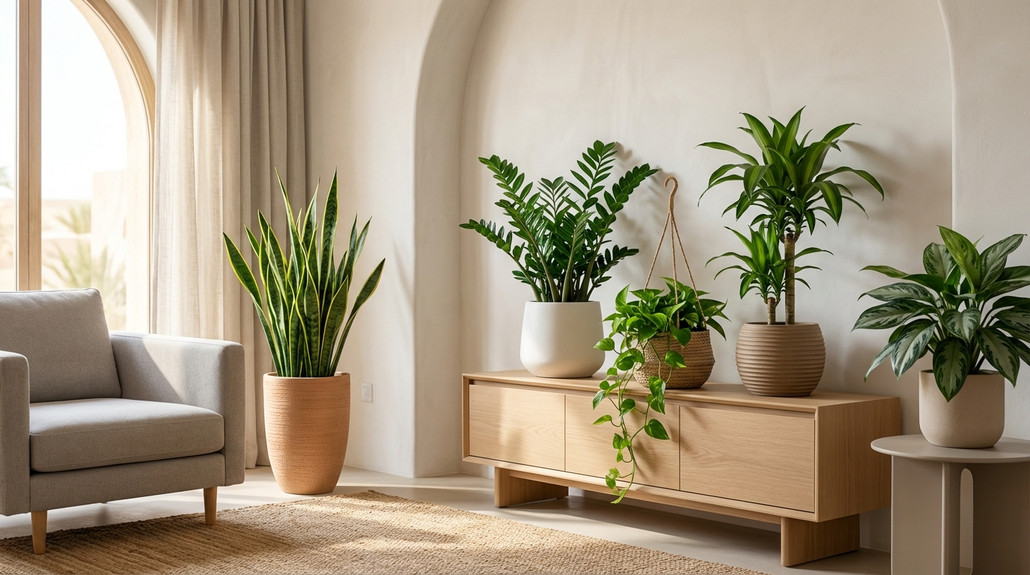
Best Indoor Plants for Offices in Hot Countries in Iraq Homes
Posted by Mozher Experts on 21.02.26
Why offices in Iraq are different: heat outside, AC inside
Choosing the best indoor plants for offices in Iraq is not the same as choosing plants in mild climates. Outside temperatures regularly exceed 45°C in summer. Inside, continuous AC from split units creates cool but extremely dry air. This combination stresses plants in two opposite ways: heat shock during transport or near windows, and dehydration from constant airflow.
In many offices, light levels are also misleading. Large glass façades look bright, yet UV-filtered glass and deep floor plans create low light conditions away from the windows. Add long working hours, irregular watering schedules, and cleaning staff who may overwater, and plant losses become common.
For indoor plants Iraq offices need varieties that tolerate:
- Low to medium light for most of the day
- Dry AC airflow
- Inconsistent watering frequency
- Dust accumulation from urban environments
- Occasional weekend neglect
Not every beautiful plant fits this environment. Some tropical species collapse under AC drafts within weeks. Others rot because their pots hold water too long. The goal is not just survival, but stable growth with minimal drama.
Selection criteria that actually matter in hot-country offices
When comparing the best indoor plants, appearance is only one factor. In Iraq, resilience matters more than leaf size or trend value. I evaluate office plants based on five practical criteria.
Light tolerance and adaptability
Most offices provide low light beyond three meters from windows. Plants must handle low light without stretching excessively. Species categorized under low light plant options are typically safer for interior desks and meeting rooms.
Heat and AC tolerance
Plants positioned under AC vents dry quickly. Thin-leaf tropical species suffer first. Thicker leaves or waxy foliage handle airflow better. Some plants can adapt to artificial lighting; see artificial light tolerant varieties for deeper office interiors.
Watering forgiveness
In offices, watering frequency is rarely precise. A plant that tolerates slight underwatering is safer than one that collapses after one missed cycle. Root rot from overwatering is more common than drought damage.
Growth rate and maintenance load
Fast growers require pruning and repotting. Slow to moderate growth is preferable for corporate settings. Fewer falling leaves mean less cleaning.
Toxicity and safety
For shared environments, especially where visitors or children may be present, consider human-safe or low-toxicity species. Mozher curates indoor plants Iraq clients can review by safety profile and care level, reducing risk of inappropriate choices.
Top performers for offices and apartments in Iraq
Based on climate behavior, delivery resilience, and long-term stability, the following groups consistently perform well in hot-country offices.
Snake Plant (Sansevieria)
One of the best indoor plants for extreme AC exposure. It tolerates low light, survives missed watering, and handles temperature fluctuations. Growth is slow, making it ideal for reception areas and corridors. Overwatering is the main risk.
ZZ Plant (Zamioculcas zamiifolia)
Excellent for low light and artificial lighting. Thick rhizomes store water, reducing watering frequency. It tolerates dry indoor air but dislikes constant soggy soil. Suitable for executive offices and boardrooms.
Pothos (Epipremnum aureum)
Adaptable and forgiving. Works well in hanging displays or shelves. In brighter indirect light, growth is faster. In lower light, it remains stable but slower. It is a practical choice for office desk plant setups where visual softness is desired.
Dracaena varieties
Many dracaenas tolerate medium to low light and dry air. They provide height without excessive width. However, they are sensitive to overwatering and fluoride buildup, so filtered water is preferable.
Aglaonema (Chinese Evergreen)
Reliable in low to medium light with moderate watering. It adds color without high maintenance. Avoid placing directly under AC vents to prevent leaf edge browning.
These species consistently appear among curated best selling indoor plant collections because they balance aesthetics with durability in regional climates.
Comparison table: practical performance in Iraq offices
| Plant | Light Tolerance | Watering Frequency | AC Tolerance | Growth Rate | Best For |
|---|---|---|---|---|---|
| Snake Plant | Low to Medium | Every 2–4 weeks | High | Slow | Reception, corridors |
| ZZ Plant | Low | Every 2–3 weeks | High | Slow to Moderate | Private offices |
| Pothos | Low to Bright Indirect | Every 1–2 weeks | Moderate | Moderate | Desks, shelves |
| Dracaena | Medium | Every 1–2 weeks | Moderate | Moderate | Corners, meeting rooms |
| Aglaonema | Low to Medium | Every 1–2 weeks | Moderate | Slow | Workstations |
Best choices by scenario
Different office layouts require different solutions. The best indoor plants for one space may fail in another.
For deep interior spaces with no natural light
Use plants proven under artificial lighting. Snake Plant and ZZ Plant perform reliably. Avoid high-light species even if they look attractive in showrooms.
For bright lobbies with filtered sun
Medium-light tolerant plants with upright growth work well. Dracaena and selected Ficus species can succeed if not exposed to direct midday sun.
For small apartments or shared offices
Compact plants reduce clutter and maintenance. Explore plants suited for small spaces and apartments to avoid oversized specimens that outgrow their location quickly.
For air quality focus
Many clients request air-purifying plants. While plants support general well-being, claims should be realistic. See curated air-purifying indoor selections for practical options that tolerate AC conditions.
What to avoid in hot-country offices
Some plants repeatedly fail in Iraq offices despite popularity online.
- Ferns: They require high humidity. AC dries them quickly, causing browning.
- Calatheas: Sensitive to dry air and inconsistent watering.
- Peace Lily in very low light: Survives but rarely flowers and may decline.
- High-light succulents placed far from windows: They stretch and weaken.
Research from university extension services such as the University of Florida IFAS Extension and the Royal Horticultural Society confirms that humidity and correct light levels strongly influence indoor plant performance. These principles become more critical in desert climates.
Care adjustments specific to Iraq
Even the best indoor plants need adaptation strategies in this region.
Manage AC airflow
Never place plants directly under vents. If relocation is impossible, rotate plants monthly to reduce one-sided dehydration.
Adjust watering seasonally
In peak summer with strong AC, soil may dry faster than expected. In winter, watering intervals often extend. Always check soil before watering rather than following a strict calendar.
Control dust
Dust blocks light absorption. Wipe leaves gently every few weeks. This simple step significantly improves plant performance in Baghdad and Basra offices.
Use proper containers and drainage
Well-draining pots reduce root rot risk. Avoid decorative containers without drainage unless using a nursery pot inside. Appropriate soil and tools from a curated soil and fertilizer essentials collection improve long-term health.
Decision guidance: choosing the right plant for your office
If your office has low light and strong AC, start with Snake Plant or ZZ Plant. They offer the highest tolerance margin.
If you have moderate indirect light and want a softer aesthetic, choose Pothos or Aglaonema.
If your reception area receives bright filtered light, consider structured Dracaena varieties for height and presence.
For clients unsure where to begin, reviewing climate-adapted selections within curated indoor plants Iraq collections reduces risk of early plant failure. The best indoor plants are not the trendiest ones; they are the ones that match your specific light levels, watering capacity, and airflow conditions.
Frequently Asked Questions
What is the most low-maintenance plant for an office in Iraq?
Snake Plant is generally the most forgiving. It tolerates low light, irregular watering, and strong AC. ZZ Plant is a close second, especially for artificial lighting conditions.
How often should office plants be watered in hot climates?
Frequency depends on species, pot size, and AC intensity. In most Iraq offices, watering every 1–3 weeks is typical. Always check soil moisture before watering to prevent root rot.
Are air-purifying plants effective in offices?
Plants contribute to overall comfort and visual well-being, but they are not substitutes for ventilation systems. Choose resilient species first, then consider air-purifying characteristics as a secondary benefit.
Which plants grow well under artificial office lighting?
Snake Plant and ZZ Plant adapt well to artificial light. Some Pothos varieties also perform reliably if watering is controlled and light is consistent.