


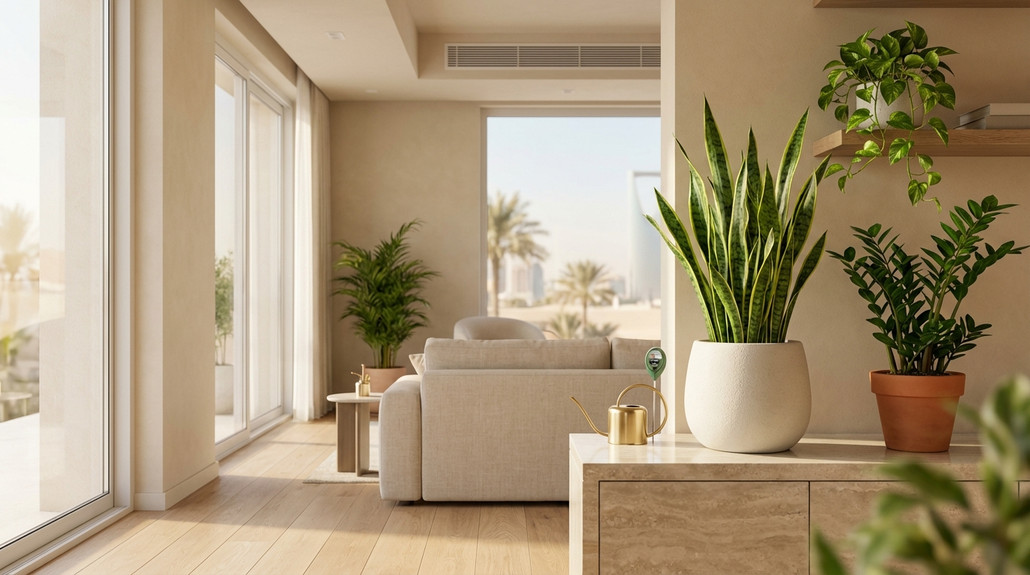
Indoor Plants That Don’t Require Constant Attention in UAE Homes
Posted by Mozher Experts on 20.02.26
Why “Low Maintenance” Means Something Different in UAE Homes
In the UAE, keeping plants alive is less about neglect and more about managing extremes. Outside, heat is intense for most of the year. Inside, air conditioning runs almost constantly. The split AC dries the air, cools rooms quickly, and creates drafts that stress leaves. This combination changes how low maintenance indoor plants behave compared to temperate climates.
Many plant losses I see are not from forgetting to water. They come from overcompensating. Owners assume indoor plants uae need frequent watering because of the desert outside. In reality, the soil inside stays wet longer under AC. Roots sit in moisture, oxygen drops, and rot begins quietly.
True low maintenance indoor plants in this region share three traits:
- Drought tolerant root systems that store water or handle dry cycles.
- Low light tolerance for apartments with filtered windows or artificial light.
- Stable structure that does not react dramatically to minor care mistakes.
If you match plant type to light level and control watering, routine becomes minimal. That is the foundation. Everything else is refinement.
What Actually Makes a Plant Neglect Tolerant
The phrase “hardy plants” is often used loosely. In practice, neglect tolerant species manage stress in predictable ways. They slow growth rather than collapse. Leaves may thicken or reduce transpiration. Roots adapt to periods of dryness. These biological responses are what separate beginner plants from fragile collector varieties.
Research from university extension services such as the University of Florida IFAS Extension and the Royal Horticultural Society confirms that structural traits like waxy leaves, rhizomes, and succulent tissues improve drought resistance and recovery after missed watering.
In UAE interiors, I prioritize plants that:
- Have thick or leathery foliage.
- Tolerate indirect or artificial lighting.
- Do not require high humidity.
- Recover slowly but steadily after stress.
You can explore curated options in the easy-care indoor plant collection, which filters selections by resilience rather than appearance alone. This prevents impulse purchases that struggle under AC.
Low maintenance does not mean zero care. It means predictable behavior under imperfect routines. That distinction prevents disappointment.
Reliable Choices That Rarely Fail Indoors
When clients ask for dependable indoor plants uae homes can sustain year-round, I recommend a short, proven list rather than dozens of options.
Snake Plant
Thick upright leaves store moisture efficiently. It tolerates low light and irregular watering. In AC rooms, watering every two to three weeks is often sufficient. Overwatering is the main risk.
ZZ Plant
Its rhizomes act as water reservoirs. It survives missed watering and low light corners. Growth is slow, which reduces maintenance further.
Pothos
Adaptable and forgiving. It handles artificial light and occasional dryness. Trim occasionally to control length.
Aglaonema
Strong low light tolerance and steady performance in cooled rooms. It prefers moderate watering but handles short dry spells.
These species consistently appear among top-performing indoor plant selections because they match real living conditions rather than ideal greenhouse environments.
If light is extremely limited, review options categorized under plants suited for low-light spaces. Choosing correctly at this stage removes most future problems.
A Minimal Routine That Works Year-Round
Low effort does not mean random care. A simple structured routine keeps hardy plants stable without daily attention.
- Check soil dryness before watering. Insert a finger 3–4 cm deep. If dry, water thoroughly.
- Water slowly until excess drains out. Empty the saucer after ten minutes.
- Rotate pots every month to balance light exposure.
- Wipe leaves occasionally to remove AC dust buildup.
A soil moisture meter for accurate watering can reduce guesswork, especially for beginners. It prevents the most common error: watering on a calendar instead of soil condition.
Fertilizing is minimal. During peak summer, growth slows indoors due to reduced light intensity behind tinted windows. Feeding heavily during slow growth causes salt buildup in soil. Light feeding once every two to three months during active growth is usually enough.
This routine takes minutes, not hours. Consistency matters more than frequency.
Signs You Are Doing Too Much
In this region, plant decline often comes from excessive attention. More water, more fertilizer, more repositioning. Plants prefer stability.
Watch for these red flags:
- Yellowing lower leaves with constantly wet soil.
- Soft stems or a musty smell from the pot.
- White crust on soil surface from fertilizer salts.
- Sudden leaf drop after moving between rooms.
Overwatering reduces oxygen around roots. Under AC, evaporation slows, so soil stays damp longer than expected. Many drought tolerant plants prefer a partial dry cycle.
If unsure, pause watering for several extra days. Most hardy plants recover from mild dryness. Few recover from rot.
Matching Plants to Real-Life Scenarios
Placement determines success more than brand or pot style. Think in terms of environment first.
Desk or Workstation
Choose compact varieties that handle artificial light. Explore options under plants designed for desks and small work areas. ZZ and small snake plants perform well with minimal oversight.
Bedroom
Rooms are cooler and darker. Select species tolerant of low light and stable temperatures. Avoid frequent movement between balcony and bedroom.
Living Room Near Windows
Bright indirect light suits pothos and aglaonema. Avoid direct summer sun through glass, which can scorch leaves quickly.
Office Corners
Corporate environments often maintain strong AC airflow. Use medium-sized hardy plants from resilient medium indoor varieties to anchor corners without daily care.
Matching plant biology to room conditions eliminates most maintenance demands.
Simple Selection Rule to Prevent Plant Loss
If you remember only one principle, use this: choose by light first, water second, aesthetics last.
Start by identifying your dominant light source. Is it low, filtered, artificial, or bright indirect? Then select a plant categorized correctly for that level. This approach aligns expectations with reality.
Next, commit to checking soil before watering. Do not follow a fixed weekly schedule. Under UAE AC systems, watering intervals change with season, room size, and airflow strength.
Finally, avoid rare or collector species if your goal is minimal routine. Proven beginner plants consistently outperform sensitive varieties in busy households.
Low maintenance indoor plants succeed here because they tolerate imperfection, not because they are ignored. When environment and plant are aligned, care becomes occasional and predictable. That is the sustainable path for indoor plants uae homes can maintain long term.
Frequently Asked Questions
How often should I water low maintenance indoor plants in UAE?
There is no fixed schedule. In most AC environments, every two to three weeks is common for drought tolerant plants, but always confirm soil dryness first. Winter intervals may extend further due to slower growth.
Can these plants survive near strong AC vents?
Direct airflow causes leaf edge browning and dehydration. Place plants at least one to two meters away from vents. Stable air improves resilience significantly.
Are low light plants suitable for windowless rooms?
Some tolerate artificial light, but complete darkness will fail. Provide consistent ceiling or lamp lighting daily. Growth will be slower but stable.
What is the biggest mistake beginners make?
Watering too frequently out of concern. In UAE interiors, restraint is often better than action. Let the soil partially dry and observe before intervening.