


Indoor Plants That Survive Neglect and Irregular Care in Saudi Arabia Homes
Posted by Mozher Experts on 23.02.26
Understanding the Saudi Arabian Indoor Environment
Keeping indoor plants alive in Saudi Arabia presents a unique set of challenges not found in more temperate climates. The primary factor is the constant battle between extreme outdoor heat and powerful indoor air conditioning. While the AC provides essential comfort for us, it creates an artificially dry environment that can be harsh for many plants. The constant cool, dry air rapidly pulls moisture from both the soil and the leaves, mimicking drought conditions even when you water regularly. Furthermore, to combat the intense sun and heat, we often keep blinds and curtains closed, significantly reducing the amount of natural light available. This combination of low light and dry air means that standard plant care advice often fails. A plant that thrives on a bright, humid windowsill in Europe will struggle in a cool, dimly lit living room in Riyadh. The key to success is not to fight this environment, but to choose plants that are naturally adapted to tolerate these specific conditions: low water needs, low light tolerance, and resilience to dry air. These are the fundamentals for selecting low maintenance indoor plants that will genuinely thrive with minimal intervention.
The Sansevieria (Snake Plant): An Unbeatable Choice
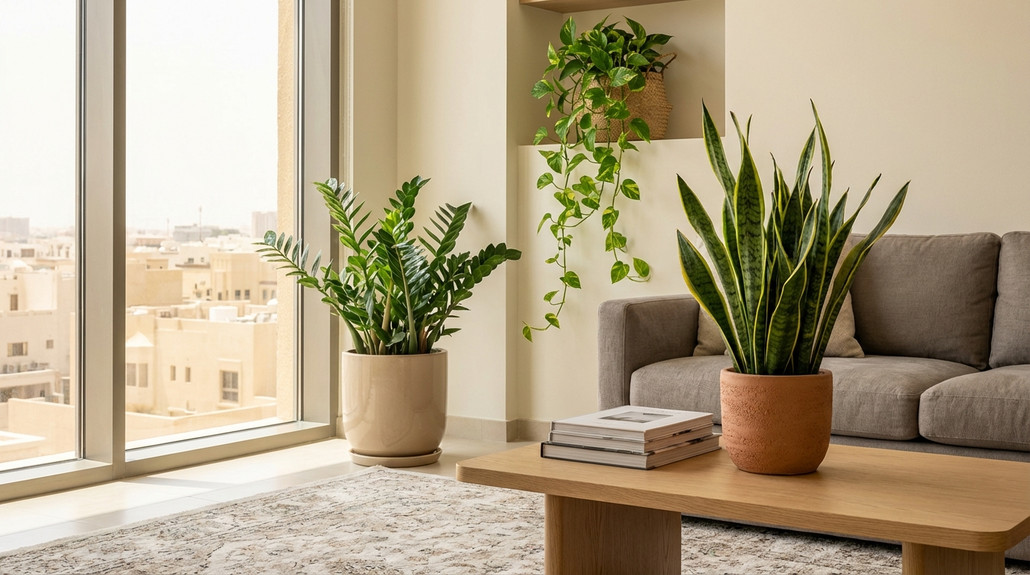
The Sansevieria, commonly known as the Snake Plant or Mother-in-Law's Tongue, is perhaps the most resilient indoor plant available. Its reputation for being nearly indestructible is well-earned, making it an ideal starting point for anyone in Saudi Arabia. The plant's structure is its secret to survival. Its thick, waxy, upright leaves are designed to store water efficiently, allowing it to withstand long periods of neglect. This makes it exceptionally drought-tolerant. You can leave for a two-week holiday and return to find it completely unfazed. In fact, the single most common mistake with a Snake Plant is overwatering, which leads to root rot. It prefers its soil to dry out completely between waterings. Its light requirements are also highly flexible. While it appreciates bright, indirect light, it is one of the few plants that tolerate low-light conditions remarkably well, making it perfect for corners of a room or hallways that don't receive much sun. The dry air produced by the AC is of little concern to the Sansevieria, as it is native to arid regions of Africa. It does not require any special humidity and is not prone to pests, further cementing its status as a top low maintenance indoor plant.
The Zamioculcas Zamiifolia (ZZ Plant): The Camel of Houseplants
The ZZ Plant is another champion of neglect-tolerant greenery. Its ability to survive with minimal care is so profound that it's often mistaken for an artificial plant. The key to its hardiness lies underground in its large, potato-like rhizomes. These rhizomes store water, allowing the plant to endure extended periods of drought without showing signs of stress. Like the Snake Plant, the ZZ Plant is far more likely to suffer from excessive watering than from being forgotten. You should only water it when the soil is bone dry to the touch. Visually, the ZZ Plant is striking, with wide, dark green, glossy leaves that reflect light, brightening up any space. It performs well in a wide range of lighting situations, from the bright indirect light of a living room to the lower light levels of an office. It is one of the best plants known for their hardiness and ability to adapt. Its slow growth means it requires very little maintenance—no frequent pruning or repotting is necessary. It is also highly resistant to pests and diseases and is completely untroubled by the dry indoor air common in Saudi homes. For a busy individual or someone new to plant ownership, the ZZ Plant offers maximum visual reward for minimum effort.
The Epipremnum Aureum (Pothos): The Forgiving Vine
Often called Devil's Ivy, the Pothos is a versatile and forgiving trailing plant that is an excellent choice for beginners. Its heart-shaped leaves come in various shades of green, often variegated with yellow, white, or cream. One of its most appealing features is its clear communication. A Pothos will visibly droop when it is thirsty, removing all the guesswork from your watering schedule. Once watered, it typically perks back up within a few hours. This resilience makes it very difficult to kill through underwatering. It is adaptable to a wide spectrum of light conditions, thriving in bright, indirect light but also tolerating lower light levels, though its variegation may become less pronounced in dimmer spots. Pothos is an excellent choice for hanging baskets or for placing on shelves where its vines can cascade downwards. It can also be trained to climb a small trellis. It is not demanding about humidity and handles the dry air from air conditioning without issue. If the vines become too long, they can be easily trimmed, and the cuttings can be propagated in water to create new plants. This ease of care and propagation makes it a rewarding and enduring presence in any home or office.
A Minimalist Care Routine That Works
Adopting a "less is more" approach is critical for the success of low maintenance indoor plants. The goal is to provide for their basic needs without overwhelming them with attention. Forget rigid weekly watering schedules. The most important tool is your finger. Before you even think about watering, push your finger about two inches into the soil. If you feel any moisture, wait. For plants like the Snake Plant and ZZ Plant, you should wait until the soil is completely dry throughout the pot. For a Pothos, you can water when the top two inches are dry or when you see the leaves begin to droop slightly. Dust is a significant factor in our region. A layer of dust on leaves can block light and hinder photosynthesis. Wipe the leaves with a damp cloth every few weeks to keep them clean and healthy. Most low-maintenance plants are slow growers and do not require frequent feeding. Fertilizing once or twice during the main growing season (spring and summer) with a diluted, balanced fertilizer is more than sufficient. Avoid fertilizing in winter altogether. This simple routine of checking before watering, dusting occasionally, and minimal feeding respects the self-sufficient nature of these hardy plants.
Signs of Over-Care: How Too Much Attention Causes Problems
For hardy, drought-tolerant plants, the most significant threat is often a well-intentioned but overly attentive owner. Overwatering is the number one cause of failure for these species. When the soil is constantly saturated, the roots cannot access oxygen and begin to decay, a condition known as root rot. The earliest signs of overwatering are often mistaken for thirst: yellowing leaves (especially lower ones) and a wilting or drooping appearance. However, unlike an underwatered plant that has dry soil, an overwatered plant will have damp or soggy soil. The stems may also feel soft or mushy at the base. If you suspect overwatering, stop immediately and allow the soil to dry out completely. Another common mistake is excessive fertilizing. Hardy plants are adapted to low-nutrient environments. Giving them too much fertilizer can cause chemical burns on the roots, leading to brown, crispy leaf edges and stunted growth. Similarly, placing a low-light tolerant plant in direct, intense sunlight can scorch its leaves, leaving permanent brown or bleached patches. Understanding these signs is crucial. It helps you recognize that for these specific plants, pulling back and doing less is often the best form of care.
Choosing the Right Plant for Your Space
Matching the plant to its intended location is a simple way to ensure it thrives with little effort. Different areas in a home or office have different light conditions and uses, making certain plants a better fit than others.
For an Office or Desk
Spaces like desks and cubicles often have limited natural light and are dominated by artificial lighting. The ZZ Plant and Snake Plant are excellent choices here. Their upright growth habit takes up minimal desk space, and their tolerance for lower light levels means they will not suffer under fluorescent lights. They add a touch of professional, structured greenery to a work environment. You can explore a curated selection of suitable plants for office and desk settings to find the perfect fit.
For a Living Room Corner
Larger spaces like living rooms often have empty corners that could benefit from a plant. A taller Snake Plant variety can provide a strong vertical accent. A Pothos placed on a high shelf or in a hanging planter can fill the space with cascading foliage. These plants are undemanding and will add life to the room without requiring a prime, sunny spot.
For a Bedroom
Bedrooms are ideal locations for plants, but you want something that requires almost no thought. A small Pothos on a dresser or a compact Snake Plant on a nightstand works well. They will tolerate the typical light levels of a bedroom and require so little water that you can almost forget about them, contributing to a calm and serene atmosphere without adding to your list of chores. For more guidance, exploring fundamental plant care principles will build your confidence.