


Butcher's Broom
Add effortless greenery to your space with Ruscus (Butcher’s Broom). Its glossy, structured foliage stays neat and elegant, even in low-light corners where many plants struggle. A reliable choice for busy homes and professional interiors—just water when partially dry and enjoy a long-lasting, modern look.
1. Basic Identification
Common Name: Ruscus / Butcher's Broom
Botanical Name: Ruscus hypophyllum
Arabic Name: روسكس
Family: Asparagaceae
Location: Indoor
2. Taxonomy & Classification
Kingdom: Plantae
Clade: Angiosperms
Order: Asparagales
Family: Asparagaceae
Genus: Ruscus
Species: Ruscus hypophyllum
3. Origin & Distribution
Native to the Mediterranean Basin, specifically North Africa (Morocco, Algeria, Tunisia) and Southern Europe (Spain, Italy), where it typically grows in shaded woodland environments.
4. Visual Characteristics
Features thick, leathery, glossy dark-green structures called cladodes, which function as leaves. True leaves are reduced to tiny scales. Small, pale-white to greenish flowers emerge directly from the center of the cladodes, occasionally followed by red berries.
5. Size & Dimensions
Usually reaches a height of 45 to 70 cm (18 to 28 inches) and maintains a compact, upright shrub-like habit.
6. Light Requirements
Extremely shade-tolerant. Thrives in low to medium indirect light. Avoid direct sunlight, which can scorch the glossy cladodes.
7. Watering Needs
Water moderately. Allow the top half of the soil to dry out before watering again. It is quite drought-tolerant but sensitive to waterlogging.
8. Soil & Potting
Requires well-draining potting soil. A mix of standard potting soil with perlite or coarse sand is ideal to ensure drainage and prevent root rot.
9. Temperature & Humidity
Prefers temperatures between 15°C and 25°C. It is hardy and adaptable to various humidity levels, though it performs best in average indoor humidity.
10. Fertilization
Apply a balanced liquid fertilizer once a month during the growing season (spring and summer). No fertilization is necessary during the winter months.
11. Maintenance & Care Level
Low maintenance. Care level is easy. Pruning is rarely needed except to remove occasional old or brown stems at the base.
12. Growth & Propagation
A slow-growing evergreen perennial. Propagation is most successful through the division of its underground rhizomes during the spring.
13. Common Problems
Generally resilient to pests. The most common issue is root rot caused by overwatering. Occasionally, scale insects or spider mites may appear if the air is excessively dry.
14. Benefits & Uses
Widely used in the floral industry because the cut stems can stay green for months. As a potted plant, it is excellent for low-light office spaces, lobbies, and hallways where other plants might fail.
15. Toxicity & Safety
Considered mildly toxic if ingested by humans or pets, as it contains saponins that can cause gastrointestinal upset, including vomiting or diarrhea.
Butcher's Broom
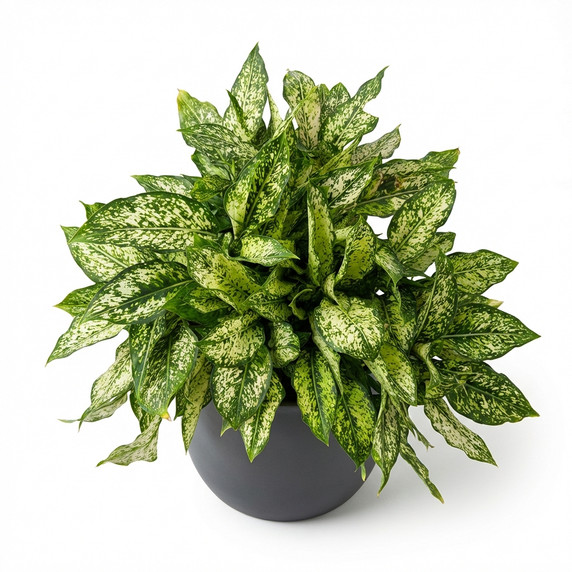
Add effortless greenery to your space with Ruscus (Butcher’s Broom). Its glossy, structured foliage stays neat and elegant, even in low-light corners where many plants struggle. A reliable choice for busy homes and professional interiors—just water when partially dry and enjoy a long-lasting, modern look.
1. Basic Identification
Common Name: Ruscus / Butcher's Broom
Botanical Name: Ruscus hypophyllum
Arabic Name: روسكس
Family: Asparagaceae
Location: Indoor
2. Taxonomy & Classification
Kingdom: Plantae
Clade: Angiosperms
Order: Asparagales
Family: Asparagaceae
Genus: Ruscus
Species: Ruscus hypophyllum
3. Origin & Distribution
Native to the Mediterranean Basin, specifically North Africa (Morocco, Algeria, Tunisia) and Southern Europe (Spain, Italy), where it typically grows in shaded woodland environments.
4. Visual Characteristics
Features thick, leathery, glossy dark-green structures called cladodes, which function as leaves. True leaves are reduced to tiny scales. Small, pale-white to greenish flowers emerge directly from the center of the cladodes, occasionally followed by red berries.
5. Size & Dimensions
Usually reaches a height of 45 to 70 cm (18 to 28 inches) and maintains a compact, upright shrub-like habit.
6. Light Requirements
Extremely shade-tolerant. Thrives in low to medium indirect light. Avoid direct sunlight, which can scorch the glossy cladodes.
7. Watering Needs
Water moderately. Allow the top half of the soil to dry out before watering again. It is quite drought-tolerant but sensitive to waterlogging.
8. Soil & Potting
Requires well-draining potting soil. A mix of standard potting soil with perlite or coarse sand is ideal to ensure drainage and prevent root rot.
9. Temperature & Humidity
Prefers temperatures between 15°C and 25°C. It is hardy and adaptable to various humidity levels, though it performs best in average indoor humidity.
10. Fertilization
Apply a balanced liquid fertilizer once a month during the growing season (spring and summer). No fertilization is necessary during the winter months.
11. Maintenance & Care Level
Low maintenance. Care level is easy. Pruning is rarely needed except to remove occasional old or brown stems at the base.
12. Growth & Propagation
A slow-growing evergreen perennial. Propagation is most successful through the division of its underground rhizomes during the spring.
13. Common Problems
Generally resilient to pests. The most common issue is root rot caused by overwatering. Occasionally, scale insects or spider mites may appear if the air is excessively dry.
14. Benefits & Uses
Widely used in the floral industry because the cut stems can stay green for months. As a potted plant, it is excellent for low-light office spaces, lobbies, and hallways where other plants might fail.
15. Toxicity & Safety
Considered mildly toxic if ingested by humans or pets, as it contains saponins that can cause gastrointestinal upset, including vomiting or diarrhea.