


Chinese Evergreen 'Spotted'
Transform your space with the effortless beauty of the Spotted Chinese Evergreen. Tired of plants that demand constant attention? The Aglaonema is your solution—a hardy, forgiving plant that thrives even in low light, making it perfect for that tricky corner or busy office. Not only does its striking silver-splashed foliage captivate the eye, but it also works silently to purify your air. It’s more than a plant; it’s a low-maintenance, air-cleaning work of art. Add this resilient stunner to your cart today and breathe easier tomorrow.
1. Basic Identification
Common Name: Spotted Chinese Evergreen
Botanical Name: Aglaonema commutatum
Arabic Name: اكلونميا
Variant: Spotted
Color: Multicolor
Country of Origin: Netherlands
Stems: Not available
2. Taxonomy & Classification
Kingdom: Plantae
Clade: Tracheophytes
Order: Alismatales
Family: Araceae
Genus: Aglaonema
Species: Aglaonema commutatum
3. Origin & Distribution
Aglaonema commutatum is native to the subtropical and tropical regions of Asia, specifically the Philippines and northeastern India. It has since been cultivated worldwide as a popular indoor ornamental plant due to its adaptability.
4. Visual Characteristics
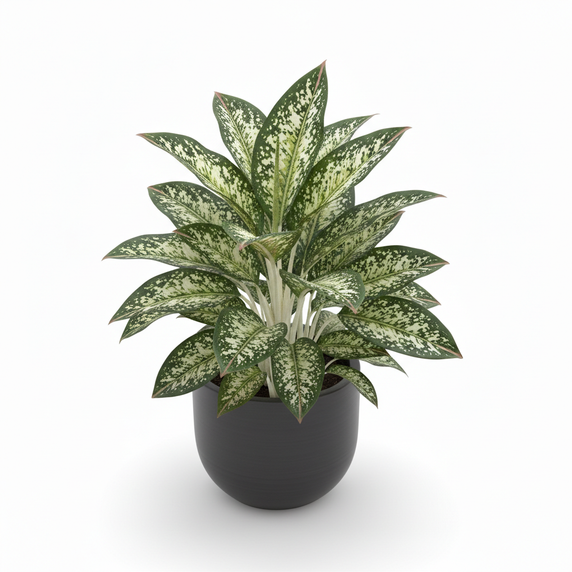
This variety features large, lance-shaped leaves with a deep green base heavily mottled or "spotted" with silvery-grey or light green variegation. The leaves have a glossy texture and grow on short stems, creating a dense, bushy appearance.
5. Size & Dimensions
In indoor settings, it typically reaches a height and spread of 1 to 3 feet (30-90 cm). It maintains a compact, clumping growth habit, making it ideal for tabletops and floor planters alike.
6. Light Requirements
Thrives in low to bright indirect light. It is one of the few plants that can tolerate low-light conditions, though its variegation is most vibrant in medium indirect light. Avoid direct sunlight, which can burn the leaves.
7. Watering Needs
Keep the soil consistently moist but not waterlogged. Allow the top 2-3 inches of soil to dry out before watering again. It is somewhat drought-tolerant but will show drooping leaves when it requires hydration.
8. Soil & Potting
Requires a well-draining potting mix. A peat-based soil with added perlite or sand is ideal to ensure proper aeration and prevent root rot. Prefers slightly acidic to neutral soil pH.
9. Temperature & Humidity
Prefers temperatures between 65°F and 80°F (18°C - 27°C). It is sensitive to cold drafts and should not be exposed to temperatures below 60°F. While it appreciates high humidity, it adapts well to standard indoor humidity levels.
10. Fertilization
Feed with a balanced, water-soluble liquid fertilizer once a month during the growing season (spring and summer). Reduce or stop fertilization during the autumn and winter months.
11. Maintenance & Care Level
Low maintenance. Periodically wipe the leaves with a damp cloth to remove dust and maintain their shine. Remove any yellowing or dead leaves at the base to encourage healthy growth.
12. Growth & Propagation
It has a slow to moderate growth rate. Propagation is most easily achieved through stem cuttings or by dividing the root ball during repotting in the spring.
13. Common Problems
Susceptible to root rot if overwatered. Common pests include mealybugs, scale, and spider mites. Leaf tips may turn brown if the air is too dry or if there is a buildup of salts from tap water.
14. Benefits & Uses
Renowned for its air-purifying qualities, it effectively removes toxins like benzene and formaldehyde from indoor environments. It is a popular choice for offices, bedrooms, and areas with limited natural light.
15. Toxicity & Safety
Toxic to pets (cats and dogs) and humans if ingested. The plant contains calcium oxalate crystals, which cause immediate irritation of the mouth, tongue, and throat, along with potential swelling and digestive upset.
Chinese Evergreen 'Spotted'
Transform your space with the effortless beauty of the Spotted Chinese Evergreen. Tired of plants that demand constant attention? The Aglaonema is your solution—a hardy, forgiving plant that thrives even in low light, making it perfect for that tricky corner or busy office. Not only does its striking silver-splashed foliage captivate the eye, but it also works silently to purify your air. It’s more than a plant; it’s a low-maintenance, air-cleaning work of art. Add this resilient stunner to your cart today and breathe easier tomorrow.
1. Basic Identification
Common Name: Spotted Chinese Evergreen
Botanical Name: Aglaonema commutatum
Arabic Name: اكلونميا
Variant: Spotted
Color: Multicolor
Country of Origin: Netherlands
Stems: Not available
2. Taxonomy & Classification
Kingdom: Plantae
Clade: Tracheophytes
Order: Alismatales
Family: Araceae
Genus: Aglaonema
Species: Aglaonema commutatum
3. Origin & Distribution
Aglaonema commutatum is native to the subtropical and tropical regions of Asia, specifically the Philippines and northeastern India. It has since been cultivated worldwide as a popular indoor ornamental plant due to its adaptability.
4. Visual Characteristics
This variety features large, lance-shaped leaves with a deep green base heavily mottled or "spotted" with silvery-grey or light green variegation. The leaves have a glossy texture and grow on short stems, creating a dense, bushy appearance.
5. Size & Dimensions
In indoor settings, it typically reaches a height and spread of 1 to 3 feet (30-90 cm). It maintains a compact, clumping growth habit, making it ideal for tabletops and floor planters alike.
6. Light Requirements
Thrives in low to bright indirect light. It is one of the few plants that can tolerate low-light conditions, though its variegation is most vibrant in medium indirect light. Avoid direct sunlight, which can burn the leaves.
7. Watering Needs
Keep the soil consistently moist but not waterlogged. Allow the top 2-3 inches of soil to dry out before watering again. It is somewhat drought-tolerant but will show drooping leaves when it requires hydration.
8. Soil & Potting
Requires a well-draining potting mix. A peat-based soil with added perlite or sand is ideal to ensure proper aeration and prevent root rot. Prefers slightly acidic to neutral soil pH.
9. Temperature & Humidity
Prefers temperatures between 65°F and 80°F (18°C - 27°C). It is sensitive to cold drafts and should not be exposed to temperatures below 60°F. While it appreciates high humidity, it adapts well to standard indoor humidity levels.
10. Fertilization
Feed with a balanced, water-soluble liquid fertilizer once a month during the growing season (spring and summer). Reduce or stop fertilization during the autumn and winter months.
11. Maintenance & Care Level
Low maintenance. Periodically wipe the leaves with a damp cloth to remove dust and maintain their shine. Remove any yellowing or dead leaves at the base to encourage healthy growth.
12. Growth & Propagation
It has a slow to moderate growth rate. Propagation is most easily achieved through stem cuttings or by dividing the root ball during repotting in the spring.
13. Common Problems
Susceptible to root rot if overwatered. Common pests include mealybugs, scale, and spider mites. Leaf tips may turn brown if the air is too dry or if there is a buildup of salts from tap water.
14. Benefits & Uses
Renowned for its air-purifying qualities, it effectively removes toxins like benzene and formaldehyde from indoor environments. It is a popular choice for offices, bedrooms, and areas with limited natural light.
15. Toxicity & Safety
Toxic to pets (cats and dogs) and humans if ingested. The plant contains calcium oxalate crystals, which cause immediate irritation of the mouth, tongue, and throat, along with potential swelling and digestive upset.