


Euphorbiaceae
Codiaeum variegatum 'Aucubaefolius / Petra type (assorted)'
Turn any corner into a statement with Croton—nature’s living mosaic. Its glossy, multicolored leaves deliver premium “designer plant” impact in homes, cafés, and offices. Give it bright light, steady warmth, and consistent watering, and it rewards you with richer reds and yellows week after week.
1. Basic Identification
Common Name: Croton
Botanical Name: Codiaeum variegatum
Arabic Name: كروتون
Variety: Aucubaefolius / Petra type (assorted)
Family: Euphorbiaceae
2. Taxonomy & Classification
Kingdom: Plantae
Clade: Tracheophytes
Order: Malpighiales
Genus: Codiaeum
Species: C. variegatum
3. Origin & Distribution
The Croton is native to the tropical regions of Southeast Asia and the Western Pacific, including Indonesia, Malaysia, and Australia.
4. Visual Characteristics
Known for its leathery, glossy leaves that come in a stunning array of colors including yellow, orange, red, green, and purple. Depending on the cultivar, leaves may be oval, linear, or lobed with variegated patterns such as spots, stripes, or veins.
5. Size & Dimensions
In indoor environments, Croton plants typically grow between 3 to 6 feet (0.9 to 1.8 meters) tall. In their natural habitat or warm gardens, they can reach up to 10 feet.
6. Light Requirements
Crotons require bright, indirect light to maintain their vibrant foliage. At least 6 to 8 hours of light is recommended. Insufficient light will cause the new leaves to remain green and lose their variegation.
7. Watering Needs
The soil should be kept consistently moist but not soggy. Water when the top inch of soil feels dry to the touch. It is important to avoid letting the soil dry out completely, as this can lead to leaf drop.
8. Soil & Potting
Requires a rich, well-draining potting mix. A mixture containing peat moss, pine bark, and perlite is ideal for retaining moisture while ensuring proper drainage.
9. Temperature & Humidity
Crotons thrive in temperatures between 60°F and 85°F (15°C–29°C). They are sensitive to cold and should be protected from drafts. High humidity (above 40-50%) is essential for health; frequent misting or the use of a humidifier is recommended.
10. Fertilization
Feed with a balanced, slow-release liquid fertilizer once a month during the growing season (spring and summer). Avoid fertilizing during the dormant winter period.
11. Maintenance & Care Level
Care Level: Moderate to High. Crotons are sensitive to environmental changes and may drop leaves if moved or if there are sudden shifts in temperature or watering schedules.
12. Growth & Propagation
Crotons have a moderate growth rate. They can be propagated through stem cuttings or air layering, preferably during the spring or summer months when the plant is most active.
13. Common Problems
Susceptible to pests like spider mites, mealybugs, and scale, especially in low-humidity environments. Leaf drop is a common reaction to environmental stress, overwatering, or under-watering.
14. Benefits & Uses
Highly valued as an air-purifying plant that filters common indoor toxins. It is a popular ornamental plant used to add dramatic color and a tropical feel to interior spaces, offices, and lobbies.
15. Toxicity & Safety
Toxicity: High. The plant is toxic to humans and pets (dogs and cats) if ingested. The milky sap can also cause skin irritation or allergic reactions in sensitive individuals.

Codiaeum variegatum 'Aucubaefolius / Petra type (assorted)'
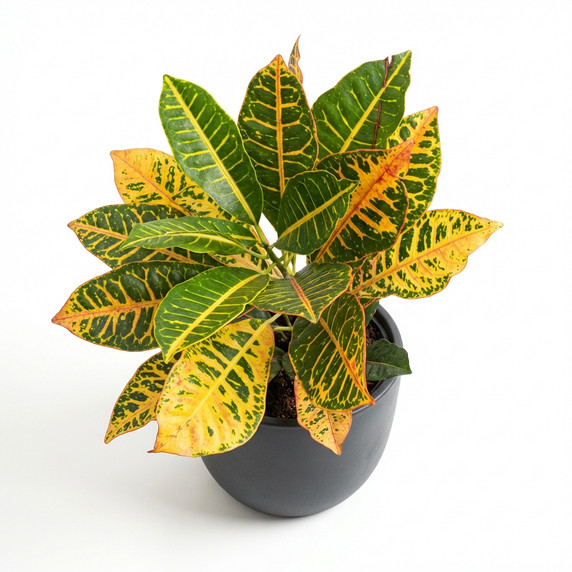
Turn any corner into a statement with Croton—nature’s living mosaic. Its glossy, multicolored leaves deliver premium “designer plant” impact in homes, cafés, and offices. Give it bright light, steady warmth, and consistent watering, and it rewards you with richer reds and yellows week after week.
1. Basic Identification
Common Name: Croton
Botanical Name: Codiaeum variegatum
Arabic Name: كروتون
Variety: Aucubaefolius / Petra type (assorted)
Family: Euphorbiaceae
2. Taxonomy & Classification
Kingdom: Plantae
Clade: Tracheophytes
Order: Malpighiales
Genus: Codiaeum
Species: C. variegatum
3. Origin & Distribution
The Croton is native to the tropical regions of Southeast Asia and the Western Pacific, including Indonesia, Malaysia, and Australia.
4. Visual Characteristics
Known for its leathery, glossy leaves that come in a stunning array of colors including yellow, orange, red, green, and purple. Depending on the cultivar, leaves may be oval, linear, or lobed with variegated patterns such as spots, stripes, or veins.
5. Size & Dimensions
In indoor environments, Croton plants typically grow between 3 to 6 feet (0.9 to 1.8 meters) tall. In their natural habitat or warm gardens, they can reach up to 10 feet.
6. Light Requirements
Crotons require bright, indirect light to maintain their vibrant foliage. At least 6 to 8 hours of light is recommended. Insufficient light will cause the new leaves to remain green and lose their variegation.
7. Watering Needs
The soil should be kept consistently moist but not soggy. Water when the top inch of soil feels dry to the touch. It is important to avoid letting the soil dry out completely, as this can lead to leaf drop.
8. Soil & Potting
Requires a rich, well-draining potting mix. A mixture containing peat moss, pine bark, and perlite is ideal for retaining moisture while ensuring proper drainage.
9. Temperature & Humidity
Crotons thrive in temperatures between 60°F and 85°F (15°C–29°C). They are sensitive to cold and should be protected from drafts. High humidity (above 40-50%) is essential for health; frequent misting or the use of a humidifier is recommended.
10. Fertilization
Feed with a balanced, slow-release liquid fertilizer once a month during the growing season (spring and summer). Avoid fertilizing during the dormant winter period.
11. Maintenance & Care Level
Care Level: Moderate to High. Crotons are sensitive to environmental changes and may drop leaves if moved or if there are sudden shifts in temperature or watering schedules.
12. Growth & Propagation
Crotons have a moderate growth rate. They can be propagated through stem cuttings or air layering, preferably during the spring or summer months when the plant is most active.
13. Common Problems
Susceptible to pests like spider mites, mealybugs, and scale, especially in low-humidity environments. Leaf drop is a common reaction to environmental stress, overwatering, or under-watering.
14. Benefits & Uses
Highly valued as an air-purifying plant that filters common indoor toxins. It is a popular ornamental plant used to add dramatic color and a tropical feel to interior spaces, offices, and lobbies.
15. Toxicity & Safety
Toxicity: High. The plant is toxic to humans and pets (dogs and cats) if ingested. The milky sap can also cause skin irritation or allergic reactions in sensitive individuals.