

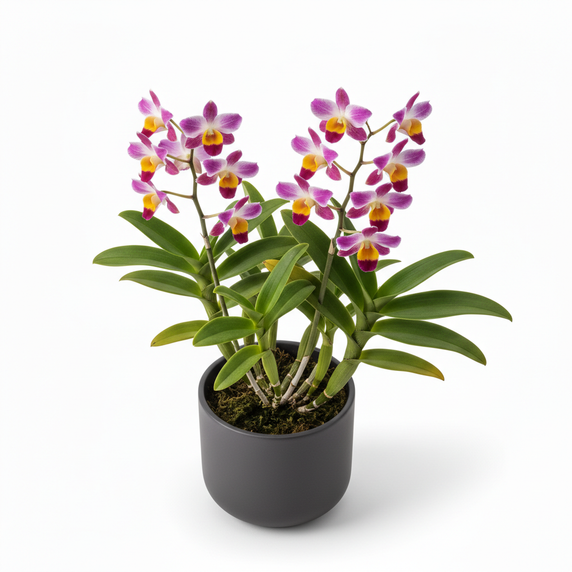





Transform your living space with the breathtaking beauty of the Dendrobium Orchid. Known for its cascades of vibrant, long-lasting flowers, this plant is a living masterpiece. Unlike many exotic plants, it's completely safe for pets. Perfect as a sophisticated gift or a stunning centerpiece for your own home. Order yours today and experience the joy of its spectacular bloom!
Common Name: Dendrobium Orchid
Botanical Name: Dendrobium nobile (Hybrid)
Arabic Name: دندروب
Plant Variant: Hybrid
Plant Color: Multicolor
Plant Country: Netherlands
Family: Orchidaceae
Dendrobium nobile belongs to the Orchidaceae family, one of the largest families of flowering plants. Within the genus Dendrobium, it is classified under the section Dendrobium, characterized by its sympodial growth and pseudobulbs that resemble canes.
While this hybrid was cultivated in the Netherlands, Dendrobium nobile is native to South Asia, including the Himalayas, parts of China, Indochina, and Thailand. They naturally grow as epiphytes on trees or lithophytes on rocks in diverse altitudes.
This orchid features thick, upright, cane-like pseudobulbs that produce leathery leaves along their length. The flowers emerge in clusters of two or three from the nodes of the canes, showcasing ruffled petals with contrasting lip colors, often in shades of white, pink, and deep purple.
The plant typically reaches a height of 30 to 60 cm (12 to 24 inches). The width of the plant is usually compact, ranging from 15 to 30 cm, making it an ideal choice for desks and tabletops.
Dendrobium orchids thrive in bright, indirect light. In the home, an east-facing window is ideal. They can tolerate some direct morning sun, but harsh afternoon sun should be avoided to prevent leaf scorch.
During the active growing season, water the plant thoroughly once the top inch of the potting medium feels dry. Reduce watering in the late autumn and winter during its dormant period to encourage bud development.
This orchid should never be planted in standard potting soil. It requires a specialized orchid bark mix, often containing fir bark, perlite, and charcoal, or high-quality sphagnum moss to ensure excellent drainage and root aeration.
Prefers daytime temperatures between 18°C and 25°C. To trigger blooming, it requires a significant drop in night temperatures (down to 10°C–15°C) during the autumn months. It appreciates humidity levels between 50% and 70%.
Apply a balanced orchid fertilizer (such as 20-20-20) at half-strength every two weeks during the growing season. Flush the pot with clear water once a month to prevent salt buildup.
Moderate. While the plant is hardy, it requires specific seasonal care, including a cooling period and reduced watering in winter, to successfully rebloom in the spring.
Dendrobiums grow sympodially, meaning they produce new canes from the base. Propagation is commonly achieved through the division of large clumps or by removing and potting "keikis" (baby plantlets) that occasionally grow from the nodes of the canes.
The most common issues include root rot from overwatering, lack of flowering due to insufficient light or lack of a winter "cool-down," and occasional pests like mealybugs or spider mites.
In addition to being a world-class decorative plant, the Dendrobium Orchid is known for its air-purifying qualities, helping to remove VOCs from the indoor environment. It is a favorite for corporate gifting and home interior design.
Dendrobium orchids are generally considered non-toxic to cats, dogs, and humans, making them an excellent choice for households with curious pets.
Transform your living space with the breathtaking beauty of the Dendrobium Orchid. Known for its cascades of vibrant, long-lasting flowers, this plant is a living masterpiece. Unlike many exotic plants, it's completely safe for pets. Perfect as a sophisticated gift or a stunning centerpiece for your own home. Order yours today and experience the joy of its spectacular bloom!
Common Name: Dendrobium Orchid
Botanical Name: Dendrobium nobile (Hybrid)
Arabic Name: دندروب
Plant Variant: Hybrid
Plant Color: Multicolor
Plant Country: Netherlands
Family: Orchidaceae
Dendrobium nobile belongs to the Orchidaceae family, one of the largest families of flowering plants. Within the genus Dendrobium, it is classified under the section Dendrobium, characterized by its sympodial growth and pseudobulbs that resemble canes.
While this hybrid was cultivated in the Netherlands, Dendrobium nobile is native to South Asia, including the Himalayas, parts of China, Indochina, and Thailand. They naturally grow as epiphytes on trees or lithophytes on rocks in diverse altitudes.
This orchid features thick, upright, cane-like pseudobulbs that produce leathery leaves along their length. The flowers emerge in clusters of two or three from the nodes of the canes, showcasing ruffled petals with contrasting lip colors, often in shades of white, pink, and deep purple.
The plant typically reaches a height of 30 to 60 cm (12 to 24 inches). The width of the plant is usually compact, ranging from 15 to 30 cm, making it an ideal choice for desks and tabletops.
Dendrobium orchids thrive in bright, indirect light. In the home, an east-facing window is ideal. They can tolerate some direct morning sun, but harsh afternoon sun should be avoided to prevent leaf scorch.
During the active growing season, water the plant thoroughly once the top inch of the potting medium feels dry. Reduce watering in the late autumn and winter during its dormant period to encourage bud development.
This orchid should never be planted in standard potting soil. It requires a specialized orchid bark mix, often containing fir bark, perlite, and charcoal, or high-quality sphagnum moss to ensure excellent drainage and root aeration.
Prefers daytime temperatures between 18°C and 25°C. To trigger blooming, it requires a significant drop in night temperatures (down to 10°C–15°C) during the autumn months. It appreciates humidity levels between 50% and 70%.
Apply a balanced orchid fertilizer (such as 20-20-20) at half-strength every two weeks during the growing season. Flush the pot with clear water once a month to prevent salt buildup.
Moderate. While the plant is hardy, it requires specific seasonal care, including a cooling period and reduced watering in winter, to successfully rebloom in the spring.
Dendrobiums grow sympodially, meaning they produce new canes from the base. Propagation is commonly achieved through the division of large clumps or by removing and potting "keikis" (baby plantlets) that occasionally grow from the nodes of the canes.
The most common issues include root rot from overwatering, lack of flowering due to insufficient light or lack of a winter "cool-down," and occasional pests like mealybugs or spider mites.
In addition to being a world-class decorative plant, the Dendrobium Orchid is known for its air-purifying qualities, helping to remove VOCs from the indoor environment. It is a favorite for corporate gifting and home interior design.
Dendrobium orchids are generally considered non-toxic to cats, dogs, and humans, making them an excellent choice for households with curious pets.
Take 20% off your first order
Enter the code below at checkout to get 20% off your first order