


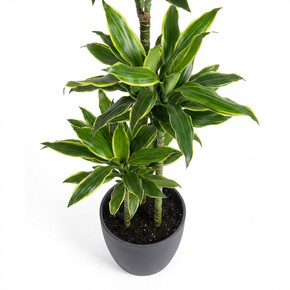




Meet the undisputed champion of easy-care plants: the Dracaena 'Janet Craig'. With its rich, emerald-green leaves and sleek, architectural form, this plant isn't just a decoration—it's a statement. But its best feature is its resilience. Forget to water it? It's forgiving. Have a dim corner? It thrives. The 'Janet Craig' is the perfect green companion for busy professionals, new plant parents, and anyone looking to add effortless style and cleaner air to their space. Stop choosing between beauty and convenience—get the plant that delivers both.
Common Name: Janet Craig, Dracaena
Botanical Name: Dracaena fragrans 'Janet Craig'
Plant Varient: Janet Craig
Plant Color: Green
Plant Country: Netherlands
Arabic Name: دراسينيا
Family: Asparagaceae
Kingdom: Plantae
Clade: Tracheophytes
Clade: Angiosperms
Clade: Monocots
Order: Asparagales
Family: Asparagaceae
Genus: Dracaena
Species: Dracaena fragrans
The Dracaena fragrans is native to tropical Africa, ranging from Sudan south to Mozambique and west to Côte d'Ivoire and Angola. The 'Janet Craig' cultivar is a popular horticultural selection widely cultivated globally as an indoor plant.
The 'Janet Craig' is known for its solid, dark emerald-green leaves that are glossy and lance-shaped. These sword-like leaves grow in tight rosettes along the stems, creating a lush, fountain-like appearance. Unlike many other Dracaena varieties, it does not have variegation, offering a clean and uniform aesthetic.
In indoor environments, the 'Janet Craig' typically reaches a height of 3 to 6 feet, though it can grow taller with age. It usually maintains a spread of about 2 to 3 feet, making it an ideal choice for floor corners or beside desks.
This plant is highly adaptable. It thrives in medium to bright indirect light but is famously tolerant of low-light conditions. Direct sunlight should be avoided as it can scorch the leaves.
Allow the top 50% to 75% of the soil to dry out before watering. It is drought-tolerant and sensitive to overwatering, which can lead to root rot. Using filtered water is recommended as they can be sensitive to fluoride and salts found in tap water.
Use a well-draining, high-quality potting mix. A mixture containing peat moss, pine bark, and perlite works well to ensure adequate aeration and drainage.
Preferred temperatures range between 65°F to 80°F (18°C to 27°C). It tolerates average household humidity but appreciates occasional misting or a humidifier in very dry environments.
Feed with a balanced, water-soluble fertilizer at half strength once a month during the spring and summer growing seasons. No fertilization is necessary during the winter months.
Low maintenance. Care involves wiping the large leaves with a damp cloth periodically to remove dust and maintain the plant's ability to photosynthesize. Pruning is rarely needed except to remove yellowing lower leaves.
It is a slow-growing plant. Propagation is most successful via stem cuttings or air layering, typically performed during the spring or summer.
Brown leaf tips are the most common issue, usually caused by inconsistent watering, low humidity, or tap water chemicals. It can occasionally attract spider mites or mealybugs if the air is too dry.
The 'Janet Craig' is a top-performing air-purifier. It was highlighted in NASA’s Clean Air Study for its ability to remove toxins like formaldehyde, benzene, and trichloroethylene from the air. It is widely used in offices and homes for its architectural beauty and durability.
Dracaena fragrans is toxic to cats and dogs if ingested. It contains saponins, which can cause vomiting, salivation, and dilated pupils in pets. It is generally considered non-toxic to humans but may cause mild distress if consumed.
Meet the undisputed champion of easy-care plants: the Dracaena 'Janet Craig'. With its rich, emerald-green leaves and sleek, architectural form, this plant isn't just a decoration—it's a statement. But its best feature is its resilience. Forget to water it? It's forgiving. Have a dim corner? It thrives. The 'Janet Craig' is the perfect green companion for busy professionals, new plant parents, and anyone looking to add effortless style and cleaner air to their space. Stop choosing between beauty and convenience—get the plant that delivers both.
Common Name: Janet Craig, Dracaena
Botanical Name: Dracaena fragrans 'Janet Craig'
Plant Varient: Janet Craig
Plant Color: Green
Plant Country: Netherlands
Arabic Name: دراسينيا
Family: Asparagaceae
Kingdom: Plantae
Clade: Tracheophytes
Clade: Angiosperms
Clade: Monocots
Order: Asparagales
Family: Asparagaceae
Genus: Dracaena
Species: Dracaena fragrans
The Dracaena fragrans is native to tropical Africa, ranging from Sudan south to Mozambique and west to Côte d'Ivoire and Angola. The 'Janet Craig' cultivar is a popular horticultural selection widely cultivated globally as an indoor plant.
The 'Janet Craig' is known for its solid, dark emerald-green leaves that are glossy and lance-shaped. These sword-like leaves grow in tight rosettes along the stems, creating a lush, fountain-like appearance. Unlike many other Dracaena varieties, it does not have variegation, offering a clean and uniform aesthetic.
In indoor environments, the 'Janet Craig' typically reaches a height of 3 to 6 feet, though it can grow taller with age. It usually maintains a spread of about 2 to 3 feet, making it an ideal choice for floor corners or beside desks.
This plant is highly adaptable. It thrives in medium to bright indirect light but is famously tolerant of low-light conditions. Direct sunlight should be avoided as it can scorch the leaves.
Allow the top 50% to 75% of the soil to dry out before watering. It is drought-tolerant and sensitive to overwatering, which can lead to root rot. Using filtered water is recommended as they can be sensitive to fluoride and salts found in tap water.
Use a well-draining, high-quality potting mix. A mixture containing peat moss, pine bark, and perlite works well to ensure adequate aeration and drainage.
Preferred temperatures range between 65°F to 80°F (18°C to 27°C). It tolerates average household humidity but appreciates occasional misting or a humidifier in very dry environments.
Feed with a balanced, water-soluble fertilizer at half strength once a month during the spring and summer growing seasons. No fertilization is necessary during the winter months.
Low maintenance. Care involves wiping the large leaves with a damp cloth periodically to remove dust and maintain the plant's ability to photosynthesize. Pruning is rarely needed except to remove yellowing lower leaves.
It is a slow-growing plant. Propagation is most successful via stem cuttings or air layering, typically performed during the spring or summer.
Brown leaf tips are the most common issue, usually caused by inconsistent watering, low humidity, or tap water chemicals. It can occasionally attract spider mites or mealybugs if the air is too dry.
The 'Janet Craig' is a top-performing air-purifier. It was highlighted in NASA’s Clean Air Study for its ability to remove toxins like formaldehyde, benzene, and trichloroethylene from the air. It is widely used in offices and homes for its architectural beauty and durability.
Dracaena fragrans is toxic to cats and dogs if ingested. It contains saponins, which can cause vomiting, salivation, and dilated pupils in pets. It is generally considered non-toxic to humans but may cause mild distress if consumed.





Take 20% off your first order
Enter the code below at checkout to get 20% off your first order