

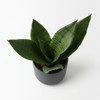





Add a bold, architectural look to any space with the compact Snake Plant 'Hahnii'. This dwarf, bird’s-nest form stays neat and tidy, thrives on minimal watering, and fits perfectly on desks, countertops, and reception areas. A top choice for beginners and busy offices—stylish, resilient, and ready to grow with you.
Common Name: Snake Plant 'Hahnii', Bird’s Nest Snake Plant, Sansevieria Hahnii
Botanical Name: Dracaena trifasciata 'Hahnii'
Plant Variant: Hahnii (Dwarf/Bird’s Nest type)
Plant Color: Green
Plant Country: Turkmenistan
Arabic Name: جلد النمر
Stems: Not available
Family: Asparagaceae
The Snake Plant 'Hahnii' belongs to the Kingdom Plantae, Order Asparagales, and the Family Asparagaceae. Formerly classified under the genus Sansevieria, it has recently been reclassified into the genus Dracaena. The 'Hahnii' variety is a specific dwarf cultivar of the species Dracaena trifasciata.
While the parent species Dracaena trifasciata is native to tropical West Africa (from Nigeria east to the Congo), the 'Hahnii' cultivar was actually discovered in 1939 by Sylvan Frank Hahn in a nursery in New Orleans, USA. It is now cultivated globally, including in regions like Turkmenistan, for the ornamental plant trade.
This cultivar features a distinctive low-growing rosette form, often referred to as a "bird's nest." The leaves are short, wide, and tapered, arranged in a funnel-like shape. They are dark green with attractive silver-green or greyish-white horizontal banding and a glossy texture.
Snake Plant 'Hahnii' is a dwarf variety, typically reaching a maximum height of 6 to 10 inches (15–25 cm). Its spread is usually similar to its height, making it one of the most compact snake plant varieties available.
Extremely adaptable to various lighting conditions. It thrives in bright, indirect light but is famously tolerant of low-light environments. It should be kept away from intense, direct midday sun, which can scorch the foliage.
As a succulent-like plant, it has low watering needs. It is crucial to allow the soil to dry out completely between waterings. During winter, watering should be reduced even further, as the plant is susceptible to root rot if kept in soggy soil.
Requires a well-draining potting medium. A commercial cactus or succulent mix is ideal. It prefers to be slightly root-bound and should be planted in a container with drainage holes to prevent water accumulation at the roots.
Prefers average room temperatures between 15°C and 29°C (60°F–85°F). It can tolerate dry indoor air very well and does not require high humidity, making it an excellent choice for air-conditioned or heated offices.
Needs very little feeding. You can apply a balanced liquid fertilizer diluted to half-strength once or twice during the active growing season (spring and summer). Avoid fertilizing in the autumn and winter.
Maintenance is minimal, classified as a very easy care level. Occasional wiping of the leaves with a damp cloth to remove dust will keep the plant looking healthy and improve its air-purifying efficiency.
This is a slow-growing plant. Propagation is most easily achieved through the removal of "pups" or offsets that emerge from the base of the parent plant. It can also be propagated via leaf cuttings, though the variegation may be lost in new growth from cuttings.
The most common issue is root rot caused by overwatering. Other potential problems include leaf spot or fungal issues if the foliage remains wet. It is generally pest-resistant but can occasionally attract mealybugs or spider mites if conditions are extremely dry.
Known for its exceptional air-purifying qualities, it filters toxins like formaldehyde, benzene, and xylene from the air. Uniquely, it also converts CO2 into oxygen at night, making it an ideal bedroom plant. Its compact size makes it perfect for office desks and small apartments.
The plant contains saponins, which make it mildly toxic to cats, dogs, and humans if ingested. Ingestion may cause nausea, vomiting, or salivation. It should be kept out of reach of pets and small children.
Add a bold, architectural look to any space with the compact Snake Plant 'Hahnii'. This dwarf, bird’s-nest form stays neat and tidy, thrives on minimal watering, and fits perfectly on desks, countertops, and reception areas. A top choice for beginners and busy offices—stylish, resilient, and ready to grow with you.
Common Name: Snake Plant 'Hahnii', Bird’s Nest Snake Plant, Sansevieria Hahnii
Botanical Name: Dracaena trifasciata 'Hahnii'
Plant Variant: Hahnii (Dwarf/Bird’s Nest type)
Plant Color: Green
Plant Country: Turkmenistan
Arabic Name: جلد النمر
Stems: Not available
Family: Asparagaceae
The Snake Plant 'Hahnii' belongs to the Kingdom Plantae, Order Asparagales, and the Family Asparagaceae. Formerly classified under the genus Sansevieria, it has recently been reclassified into the genus Dracaena. The 'Hahnii' variety is a specific dwarf cultivar of the species Dracaena trifasciata.
While the parent species Dracaena trifasciata is native to tropical West Africa (from Nigeria east to the Congo), the 'Hahnii' cultivar was actually discovered in 1939 by Sylvan Frank Hahn in a nursery in New Orleans, USA. It is now cultivated globally, including in regions like Turkmenistan, for the ornamental plant trade.
This cultivar features a distinctive low-growing rosette form, often referred to as a "bird's nest." The leaves are short, wide, and tapered, arranged in a funnel-like shape. They are dark green with attractive silver-green or greyish-white horizontal banding and a glossy texture.
Snake Plant 'Hahnii' is a dwarf variety, typically reaching a maximum height of 6 to 10 inches (15–25 cm). Its spread is usually similar to its height, making it one of the most compact snake plant varieties available.
Extremely adaptable to various lighting conditions. It thrives in bright, indirect light but is famously tolerant of low-light environments. It should be kept away from intense, direct midday sun, which can scorch the foliage.
As a succulent-like plant, it has low watering needs. It is crucial to allow the soil to dry out completely between waterings. During winter, watering should be reduced even further, as the plant is susceptible to root rot if kept in soggy soil.
Requires a well-draining potting medium. A commercial cactus or succulent mix is ideal. It prefers to be slightly root-bound and should be planted in a container with drainage holes to prevent water accumulation at the roots.
Prefers average room temperatures between 15°C and 29°C (60°F–85°F). It can tolerate dry indoor air very well and does not require high humidity, making it an excellent choice for air-conditioned or heated offices.
Needs very little feeding. You can apply a balanced liquid fertilizer diluted to half-strength once or twice during the active growing season (spring and summer). Avoid fertilizing in the autumn and winter.
Maintenance is minimal, classified as a very easy care level. Occasional wiping of the leaves with a damp cloth to remove dust will keep the plant looking healthy and improve its air-purifying efficiency.
This is a slow-growing plant. Propagation is most easily achieved through the removal of "pups" or offsets that emerge from the base of the parent plant. It can also be propagated via leaf cuttings, though the variegation may be lost in new growth from cuttings.
The most common issue is root rot caused by overwatering. Other potential problems include leaf spot or fungal issues if the foliage remains wet. It is generally pest-resistant but can occasionally attract mealybugs or spider mites if conditions are extremely dry.
Known for its exceptional air-purifying qualities, it filters toxins like formaldehyde, benzene, and xylene from the air. Uniquely, it also converts CO2 into oxygen at night, making it an ideal bedroom plant. Its compact size makes it perfect for office desks and small apartments.
The plant contains saponins, which make it mildly toxic to cats, dogs, and humans if ingested. Ingestion may cause nausea, vomiting, or salivation. It should be kept out of reach of pets and small children.




Take 20% off your first order
Enter the code below at checkout to get 20% off your first order