


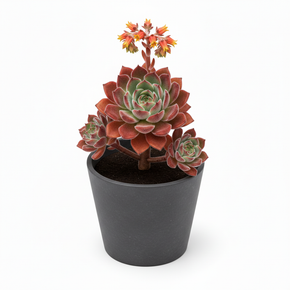



Transform your space with the effortless beauty of the Echeveria elegans. Its perfect, sculptural rosette adds a touch of modern sophistication to any desk, shelf, or sunny corner. Forgetful about watering? No problem. This drought-tolerant gem thrives on neglect, making it the ideal green companion for busy lives. Pet-safe and stunningly simple, the Mexican Snowball isn't just a plant—it's a living piece of art. Order yours today and bring home desert chic.
Common Name: Mexican Snowball, Mexican Gem, White Rose
Botanical Name: Echeveria elegans
Variant: Standard
Color: Natural
Country of Origin: Netherlands
Arabic Name: ايكيريا
Stems: Typically stemless or very short-stemmed rosettes
Family: Crassulaceae
Kingdom: Plantae
Clade: Tracheophytes
Order: Saxifragales
Family: Crassulaceae
Genus: Echeveria
Species: Echeveria elegans
Echeveria elegans is native to the semi-desert habitats of Mexico, specifically the state of Hidalgo. It has been widely naturalized in many subtropical regions and is a staple in ornamental succulent collections worldwide.
This plant forms tight, symmetrical rosettes of thick, fleshy, spoon-shaped leaves. The foliage is a striking pale blue-green or silvery-gray, often featuring translucent margins. The leaves are covered in a fine, powdery waxy coating known as farina, which helps protect the plant from intense sun.
Individual rosettes typically reach 5–10 cm (2–4 inches) in height and 10–15 cm (4–6 inches) in width. Over time, the plant produces numerous offsets that spread to form a dense, low-growing carpet.
Thrives in bright, direct light. It requires at least six hours of sunlight daily to maintain its compact rosette shape and vibrant color. If grown indoors, a south-facing window is ideal; insufficient light will cause the plant to stretch (etiolate).
Low watering needs. Follow the "soak and dry" method: water the soil deeply only when it is completely dry to the touch. Avoid pouring water directly into the center of the rosette, as trapped moisture can cause rot.
Requires a well-draining cactus or succulent potting mix. Using a terracotta pot is highly recommended as the porous material allows excess moisture to evaporate. Ensure the pot has adequate drainage holes.
Prefers warm temperatures ranging from 18°C to 27°C (65°F–80°F). It is not frost-hardy and should be protected or moved indoors if temperatures drop below 4°C (40°F). It thrives in low to average humidity environments.
Feed sparingly during the active growing season (spring and summer) with a balanced, water-soluble succulent fertilizer diluted to half-strength. Do not fertilize during the winter dormant period.
Care Level: Easy. Maintenance is minimal; simply remove dead or dried leaves from the base of the plant to prevent pests and maintain a clean appearance.
Growth rate is slow to moderate. It is very easy to propagate via offsets (often called "chicks") that grow at the base of the "mother" plant. It can also be propagated from leaf cuttings or seeds.
The most common issue is root rot caused by overwatering. It can also be susceptible to mealybugs and aphids. A lack of sufficient light will cause the plant to lose its tight shape and stretch toward the light source.
Excellent for rock gardens, xeriscaping, and container gardening. It is a popular choice for modern interior decor, desk arrangements, and wedding favors due to its sculptural beauty and resilience. It is also effective at surviving in drought-prone environments.
Echeveria elegans is considered non-toxic to cats, dogs, and horses. It is also safe for humans, making it an excellent choice for households with pets or children.
Transform your space with the effortless beauty of the Echeveria elegans. Its perfect, sculptural rosette adds a touch of modern sophistication to any desk, shelf, or sunny corner. Forgetful about watering? No problem. This drought-tolerant gem thrives on neglect, making it the ideal green companion for busy lives. Pet-safe and stunningly simple, the Mexican Snowball isn't just a plant—it's a living piece of art. Order yours today and bring home desert chic.
Common Name: Mexican Snowball, Mexican Gem, White Rose
Botanical Name: Echeveria elegans
Variant: Standard
Color: Natural
Country of Origin: Netherlands
Arabic Name: ايكيريا
Stems: Typically stemless or very short-stemmed rosettes
Family: Crassulaceae
Kingdom: Plantae
Clade: Tracheophytes
Order: Saxifragales
Family: Crassulaceae
Genus: Echeveria
Species: Echeveria elegans
Echeveria elegans is native to the semi-desert habitats of Mexico, specifically the state of Hidalgo. It has been widely naturalized in many subtropical regions and is a staple in ornamental succulent collections worldwide.
This plant forms tight, symmetrical rosettes of thick, fleshy, spoon-shaped leaves. The foliage is a striking pale blue-green or silvery-gray, often featuring translucent margins. The leaves are covered in a fine, powdery waxy coating known as farina, which helps protect the plant from intense sun.
Individual rosettes typically reach 5–10 cm (2–4 inches) in height and 10–15 cm (4–6 inches) in width. Over time, the plant produces numerous offsets that spread to form a dense, low-growing carpet.
Thrives in bright, direct light. It requires at least six hours of sunlight daily to maintain its compact rosette shape and vibrant color. If grown indoors, a south-facing window is ideal; insufficient light will cause the plant to stretch (etiolate).
Low watering needs. Follow the "soak and dry" method: water the soil deeply only when it is completely dry to the touch. Avoid pouring water directly into the center of the rosette, as trapped moisture can cause rot.
Requires a well-draining cactus or succulent potting mix. Using a terracotta pot is highly recommended as the porous material allows excess moisture to evaporate. Ensure the pot has adequate drainage holes.
Prefers warm temperatures ranging from 18°C to 27°C (65°F–80°F). It is not frost-hardy and should be protected or moved indoors if temperatures drop below 4°C (40°F). It thrives in low to average humidity environments.
Feed sparingly during the active growing season (spring and summer) with a balanced, water-soluble succulent fertilizer diluted to half-strength. Do not fertilize during the winter dormant period.
Care Level: Easy. Maintenance is minimal; simply remove dead or dried leaves from the base of the plant to prevent pests and maintain a clean appearance.
Growth rate is slow to moderate. It is very easy to propagate via offsets (often called "chicks") that grow at the base of the "mother" plant. It can also be propagated from leaf cuttings or seeds.
The most common issue is root rot caused by overwatering. It can also be susceptible to mealybugs and aphids. A lack of sufficient light will cause the plant to lose its tight shape and stretch toward the light source.
Excellent for rock gardens, xeriscaping, and container gardening. It is a popular choice for modern interior decor, desk arrangements, and wedding favors due to its sculptural beauty and resilience. It is also effective at surviving in drought-prone environments.
Echeveria elegans is considered non-toxic to cats, dogs, and horses. It is also safe for humans, making it an excellent choice for households with pets or children.
Take 20% off your first order
Enter the code below at checkout to get 20% off your first order