

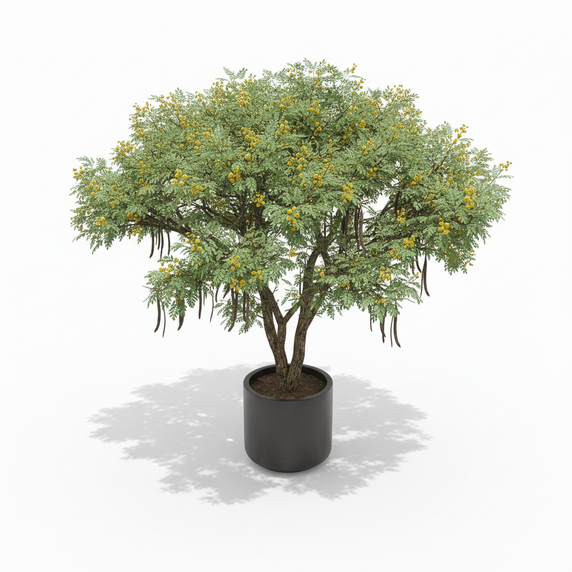





Transform your landscape with the timeless elegance of the Egyptian Thorn Acacia. This hardy, fast-growing tree is the perfect centerpiece for a sun-soaked garden, demanding little water while offering so much in return: from its delicate, fern-like foliage to the burst of fragrant yellow blossoms. Create a resilient, low-maintenance oasis that provides shade, beauty, and a touch of the exotic. Plant a legacy of strength and beauty today.
Common Name: Egyptian Thorn Acacia / Gum Arabic Tree
Botanical Name: Vachellia nilotica
Arabic Name: اكاسيا
Plant Variant: Standard
Plant Color: Natural (Green foliage, yellow flowers)
Plant Country: Egypt
Kingdom: Plantae
Order: Fabales
Family: Fabaceae
Subfamily: Mimosoideae
Genus: Vachellia
Species: Vachellia nilotica (syn. Acacia nilotica)
Native to Africa, the Middle East, and the Indian subcontinent. It is widely naturalized in many tropical and subtropical regions around the globe, often thriving in dry, arid landscapes.
A medium-sized tree featuring a dense, spreading, or flat-topped crown. It has dark, fissured bark and delicate grey-green bipinnate leaves. During the blooming season, it produces bright yellow, ball-shaped, fragrant flowers followed by distinctive grey-white beaded seed pods.
Typically reaches heights of 5 to 20 meters, with a spread that often matches its height, providing significant shade once matured.
Full sun. This tree requires high light intensity and thrives in positions with direct sunlight for most of the day.
Low to moderate. It is exceptionally drought-tolerant once established. Young trees require regular watering to develop a strong root system, but mature specimens can survive long periods of dry weather.
Highly adaptable to various soil types, including sandy, loamy, and heavy clay soils. It is particularly valued for its ability to grow in saline and alkaline conditions. Not typically suitable for long-term potting unless as a bonsai or in very large landscape containers.
Thrives in hot, dry climates. It is heat-tolerant but can be sensitive to severe frosts, preferring temperatures that stay above 5°C (41°F).
Minimal requirements. Young trees may benefit from a balanced, slow-release fertilizer in early spring. As a legume, it has the ability to fix nitrogen in the soil, often improving soil quality on its own.
Low maintenance. It is a hardy species that requires minimal intervention. Occasional pruning may be needed to shape the canopy or remove dead wood, though caution must be taken due to its sharp thorns.
Fast-growing tree. Propagation is primarily achieved through seeds. To improve germination, seeds are typically scarified or soaked in hot water before planting.
Generally pest and disease resistant. However, it can be susceptible to root rot if planted in waterlogged soils. Seed beetles (bruchids) may sometimes infest the pods.
Primarily used for landscape shade, erosion control, and soil improvement. It is a source of gum arabic and high-quality timber. Its fragrant blossoms also support local pollinators and honey production.
The tree features sharp thorns that can cause physical injury. While parts of the tree have traditional medicinal uses, it is not considered safe for general human consumption. Thorns pose a physical hazard to pets and livestock.
Transform your landscape with the timeless elegance of the Egyptian Thorn Acacia. This hardy, fast-growing tree is the perfect centerpiece for a sun-soaked garden, demanding little water while offering so much in return: from its delicate, fern-like foliage to the burst of fragrant yellow blossoms. Create a resilient, low-maintenance oasis that provides shade, beauty, and a touch of the exotic. Plant a legacy of strength and beauty today.
Common Name: Egyptian Thorn Acacia / Gum Arabic Tree
Botanical Name: Vachellia nilotica
Arabic Name: اكاسيا
Plant Variant: Standard
Plant Color: Natural (Green foliage, yellow flowers)
Plant Country: Egypt
Kingdom: Plantae
Order: Fabales
Family: Fabaceae
Subfamily: Mimosoideae
Genus: Vachellia
Species: Vachellia nilotica (syn. Acacia nilotica)
Native to Africa, the Middle East, and the Indian subcontinent. It is widely naturalized in many tropical and subtropical regions around the globe, often thriving in dry, arid landscapes.
A medium-sized tree featuring a dense, spreading, or flat-topped crown. It has dark, fissured bark and delicate grey-green bipinnate leaves. During the blooming season, it produces bright yellow, ball-shaped, fragrant flowers followed by distinctive grey-white beaded seed pods.
Typically reaches heights of 5 to 20 meters, with a spread that often matches its height, providing significant shade once matured.
Full sun. This tree requires high light intensity and thrives in positions with direct sunlight for most of the day.
Low to moderate. It is exceptionally drought-tolerant once established. Young trees require regular watering to develop a strong root system, but mature specimens can survive long periods of dry weather.
Highly adaptable to various soil types, including sandy, loamy, and heavy clay soils. It is particularly valued for its ability to grow in saline and alkaline conditions. Not typically suitable for long-term potting unless as a bonsai or in very large landscape containers.
Thrives in hot, dry climates. It is heat-tolerant but can be sensitive to severe frosts, preferring temperatures that stay above 5°C (41°F).
Minimal requirements. Young trees may benefit from a balanced, slow-release fertilizer in early spring. As a legume, it has the ability to fix nitrogen in the soil, often improving soil quality on its own.
Low maintenance. It is a hardy species that requires minimal intervention. Occasional pruning may be needed to shape the canopy or remove dead wood, though caution must be taken due to its sharp thorns.
Fast-growing tree. Propagation is primarily achieved through seeds. To improve germination, seeds are typically scarified or soaked in hot water before planting.
Generally pest and disease resistant. However, it can be susceptible to root rot if planted in waterlogged soils. Seed beetles (bruchids) may sometimes infest the pods.
Primarily used for landscape shade, erosion control, and soil improvement. It is a source of gum arabic and high-quality timber. Its fragrant blossoms also support local pollinators and honey production.
The tree features sharp thorns that can cause physical injury. While parts of the tree have traditional medicinal uses, it is not considered safe for general human consumption. Thorns pose a physical hazard to pets and livestock.
Take 20% off your first order
Enter the code below at checkout to get 20% off your first order