


Araceae
Epipremnum aureum 'Aureum (Golden)'
Bring effortless greenery to any space with Golden Pothos—one of the toughest, most rewarding indoor plants. Its trailing vines and golden-speckled leaves instantly elevate shelves, desks, and hanging baskets, while thriving in everyday home or office conditions. Perfect for beginners: just give it indirect light, water when partly dry, and watch it grow.
1. Basic Identification
Common Name: Golden Pothos
Botanical Name: Epipremnum aureum
Arabic Name: فيكس بنجامينا
Variant: Aureum (Golden)
Color: Multicolor
Stems: 3
Family: Araceae
2. Taxonomy & Classification
Kingdom: Plantae
Clade: Tracheophytes
Order: Alismatales
Family: Araceae
Genus: Epipremnum
Species: E. aureum
3. Origin & Distribution
Golden Pothos is native to the island of Moorea in French Polynesia. However, it has become naturalized in many tropical and sub-tropical regions worldwide, including Southeast Asia, Australia, and the West Indies.
4. Visual Characteristics
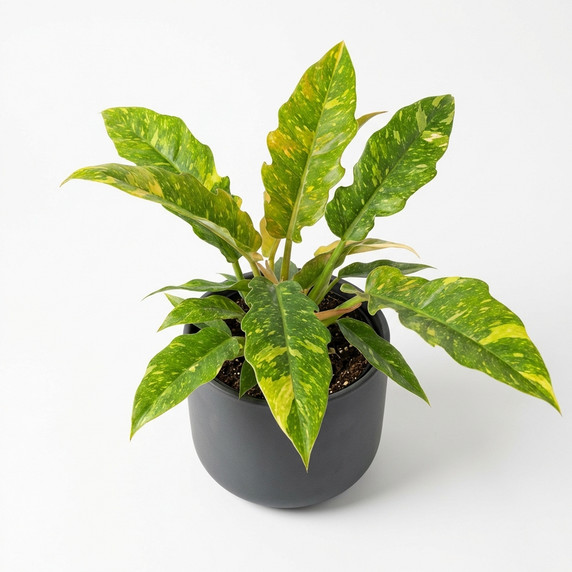
This plant is characterized by its waxy, heart-shaped leaves that feature distinct yellow or golden-cream variegation against a deep green background. As a vining plant, it produces long, trailing stems that can climb using aerial roots.
5. Size & Dimensions
In indoor environments, vines typically reach 6 to 10 feet in length. The leaves usually grow to about 2 to 4 inches wide in domestic settings, though they can grow much larger in their natural tropical habitat.
6. Light Requirements
Golden Pothos thrives in bright, indirect sunlight but is famous for its ability to tolerate low-light conditions. To maintain its golden variegation, brighter indirect light is recommended; otherwise, the leaves may revert to solid green.
7. Watering Needs
Water when the top 1 to 2 inches of soil feel dry to the touch. It is relatively drought-tolerant and prefers being underwatered rather than overwatered. Yellow leaves are often a sign of overwatering.
8. Soil & Potting
Requires a well-draining potting mix. A standard high-quality indoor potting soil containing peat moss and perlite is ideal for moisture retention without waterlogging.
9. Temperature & Humidity
Ideal temperatures range between 60°F and 85°F (15°C - 29°C). While it enjoys higher humidity, it adapts exceptionally well to the average humidity levels found in homes and offices.
10. Fertilization
Feed with a balanced, water-soluble fertilizer once a month during the spring and summer growing seasons. Fertilization is generally not required during the dormant winter months.
11. Maintenance & Care Level
Maintenance level is low. Care includes occasional pruning to maintain size and shape, and wiping the leaves with a damp cloth to remove dust, which helps the plant breathe and photosynthesize efficiently.
12. Growth & Propagation
This is a fast-growing plant. It is very easy to propagate through stem cuttings placed in either water or soil, provided the cutting includes at least one node.
13. Common Problems
Susceptible to root rot if overwatered. Occasional pests include mealybugs and spider mites. Brown leaf tips may indicate that the air is too dry or that the plant is receiving too much direct sun.
14. Benefits & Uses
Widely recognized as an excellent air-purifying plant, it helps remove indoor toxins such as formaldehyde, xylene, and benzene. It is perfect for hanging baskets, office desks, or as a climbing plant on a moss pole.
15. Toxicity & Safety
Contains calcium oxalate crystals, making it toxic to dogs, cats, and humans if ingested. It can cause oral irritation, swelling, and digestive upset.
Epipremnum aureum 'Aureum (Golden)'
Bring effortless greenery to any space with Golden Pothos—one of the toughest, most rewarding indoor plants. Its trailing vines and golden-speckled leaves instantly elevate shelves, desks, and hanging baskets, while thriving in everyday home or office conditions. Perfect for beginners: just give it indirect light, water when partly dry, and watch it grow.
1. Basic Identification
Common Name: Golden Pothos
Botanical Name: Epipremnum aureum
Arabic Name: فيكس بنجامينا
Variant: Aureum (Golden)
Color: Multicolor
Stems: 3
Family: Araceae
2. Taxonomy & Classification
Kingdom: Plantae
Clade: Tracheophytes
Order: Alismatales
Family: Araceae
Genus: Epipremnum
Species: E. aureum
3. Origin & Distribution
Golden Pothos is native to the island of Moorea in French Polynesia. However, it has become naturalized in many tropical and sub-tropical regions worldwide, including Southeast Asia, Australia, and the West Indies.
4. Visual Characteristics
This plant is characterized by its waxy, heart-shaped leaves that feature distinct yellow or golden-cream variegation against a deep green background. As a vining plant, it produces long, trailing stems that can climb using aerial roots.
5. Size & Dimensions
In indoor environments, vines typically reach 6 to 10 feet in length. The leaves usually grow to about 2 to 4 inches wide in domestic settings, though they can grow much larger in their natural tropical habitat.
6. Light Requirements
Golden Pothos thrives in bright, indirect sunlight but is famous for its ability to tolerate low-light conditions. To maintain its golden variegation, brighter indirect light is recommended; otherwise, the leaves may revert to solid green.
7. Watering Needs
Water when the top 1 to 2 inches of soil feel dry to the touch. It is relatively drought-tolerant and prefers being underwatered rather than overwatered. Yellow leaves are often a sign of overwatering.
8. Soil & Potting
Requires a well-draining potting mix. A standard high-quality indoor potting soil containing peat moss and perlite is ideal for moisture retention without waterlogging.
9. Temperature & Humidity
Ideal temperatures range between 60°F and 85°F (15°C - 29°C). While it enjoys higher humidity, it adapts exceptionally well to the average humidity levels found in homes and offices.
10. Fertilization
Feed with a balanced, water-soluble fertilizer once a month during the spring and summer growing seasons. Fertilization is generally not required during the dormant winter months.
11. Maintenance & Care Level
Maintenance level is low. Care includes occasional pruning to maintain size and shape, and wiping the leaves with a damp cloth to remove dust, which helps the plant breathe and photosynthesize efficiently.
12. Growth & Propagation
This is a fast-growing plant. It is very easy to propagate through stem cuttings placed in either water or soil, provided the cutting includes at least one node.
13. Common Problems
Susceptible to root rot if overwatered. Occasional pests include mealybugs and spider mites. Brown leaf tips may indicate that the air is too dry or that the plant is receiving too much direct sun.
14. Benefits & Uses
Widely recognized as an excellent air-purifying plant, it helps remove indoor toxins such as formaldehyde, xylene, and benzene. It is perfect for hanging baskets, office desks, or as a climbing plant on a moss pole.
15. Toxicity & Safety
Contains calcium oxalate crystals, making it toxic to dogs, cats, and humans if ingested. It can cause oral irritation, swelling, and digestive upset.