


Euonymus japonicus 'Half Standard (Lollipop Topiary)'
Instantly elevate your entrance with a premium lollipop topiary. This variegated Euonymus stays green year-round, holds its rounded shape with simple trims, and brings a bright, tidy look to patios, balconies, and reception areas. A reliable choice for elegant, low-maintenance structure in any space.
1. Basic Identification
Common Name: Japanese Spindle (Lollipop Topiary)
Botanical Name: Euonymus japonicus
Arabic Name: شمشار
Variant: Half Standard (Lollipop Topiary)
Color: Variegated/Colored foliage
Country of Origin: Iran
2. Taxonomy & Classification
Kingdom: Plantae
Order: Celastrales
Family: Celastraceae
Genus: Euonymus
Species: E. japonicus
3. Origin & Distribution
Euonymus japonicus is native to East Asia, including Japan, Korea, and China. It has been widely cultivated globally and is highly valued in the Middle East and Europe for its resilience and ornamental versatility.
4. Visual Characteristics
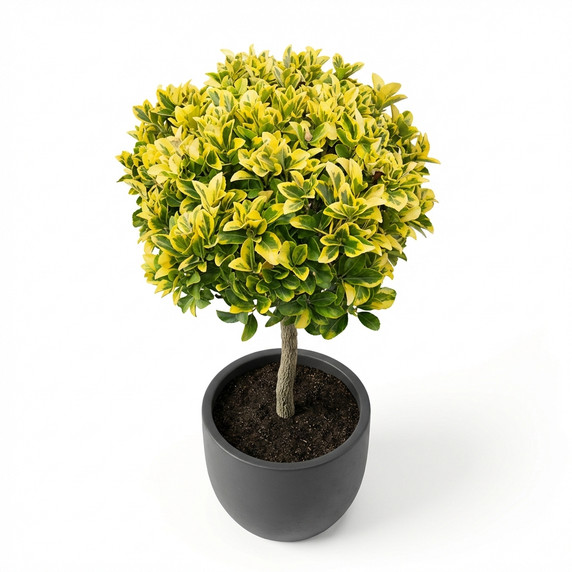
This variety features leathery, oval leaves with a glossy finish and creamy-white or yellow variegated margins. As a lollipop topiary (half-standard), it consists of a straight, bare central stem topped with a dense, rounded ball of evergreen foliage.
5. Size & Dimensions
The "Half Standard" usually features a clear stem of 50-80cm with a total height reaching approximately 1.2 to 1.5 meters including the crown. The crown is typically maintained at a diameter of 40-60cm through pruning.
6. Light Requirements
This plant is highly adaptable; it thrives in full sun to partial shade. In indoor or reception settings, it requires bright, indirect light to maintain the vibrant variegation of its leaves.
7. Watering Needs
Requires moderate watering. The soil should be kept consistently moist but well-drained. Once established, it has moderate drought tolerance, but topiary forms in pots require more frequent checks to ensure the root ball doesn't dry out completely.
8. Soil & Potting
Grows best in well-draining, fertile soil. A mix of potting soil with added perlite or grit is ideal for container-grown topiary to prevent waterlogging.
9. Temperature & Humidity
Very hardy and adaptable. It can withstand frost and cold temperatures (down to USDA Zone 6) and handles the heat of summer well. It does not have specific humidity requirements, making it suitable for both humid and dry environments.
10. Fertilization
Feed with a balanced, slow-release fertilizer during the growing season (spring and summer) to support lush foliage growth and maintain color intensity.
11. Maintenance & Care Level
Care Level: Easy/Low Maintenance. The primary maintenance involves light pruning 2-3 times a year to keep the "lollipop" shape tidy and spherical.
12. Growth & Propagation
A slow to moderate grower, which helps it retain its topiary shape for longer. Propagation is typically achieved through semi-hardwood cuttings taken in late summer or autumn.
13. Common Problems
Generally robust, but can occasionally be affected by Euonymus scale (a tiny white insect) or powdery mildew if air circulation is poor or the plant is excessively shaded.
14. Benefits & Uses
Excellent for architectural structure in gardens. Used widely for flanking entrances, decorating balconies, or adding a formal touch to reception areas. It is a highly effective air-purifying plant in larger spaces.
15. Toxicity & Safety
All parts of the plant are toxic if ingested by humans or pets, potentially causing nausea, vomiting, and other gastrointestinal distress. It should be handled with care in homes with curious pets or small children.

Euonymus japonicus 'Half Standard (Lollipop Topiary)'
Instantly elevate your entrance with a premium lollipop topiary. This variegated Euonymus stays green year-round, holds its rounded shape with simple trims, and brings a bright, tidy look to patios, balconies, and reception areas. A reliable choice for elegant, low-maintenance structure in any space.
1. Basic Identification
Common Name: Japanese Spindle (Lollipop Topiary)
Botanical Name: Euonymus japonicus
Arabic Name: شمشار
Variant: Half Standard (Lollipop Topiary)
Color: Variegated/Colored foliage
Country of Origin: Iran
2. Taxonomy & Classification
Kingdom: Plantae
Order: Celastrales
Family: Celastraceae
Genus: Euonymus
Species: E. japonicus
3. Origin & Distribution
Euonymus japonicus is native to East Asia, including Japan, Korea, and China. It has been widely cultivated globally and is highly valued in the Middle East and Europe for its resilience and ornamental versatility.
4. Visual Characteristics
This variety features leathery, oval leaves with a glossy finish and creamy-white or yellow variegated margins. As a lollipop topiary (half-standard), it consists of a straight, bare central stem topped with a dense, rounded ball of evergreen foliage.
5. Size & Dimensions
The "Half Standard" usually features a clear stem of 50-80cm with a total height reaching approximately 1.2 to 1.5 meters including the crown. The crown is typically maintained at a diameter of 40-60cm through pruning.
6. Light Requirements
This plant is highly adaptable; it thrives in full sun to partial shade. In indoor or reception settings, it requires bright, indirect light to maintain the vibrant variegation of its leaves.
7. Watering Needs
Requires moderate watering. The soil should be kept consistently moist but well-drained. Once established, it has moderate drought tolerance, but topiary forms in pots require more frequent checks to ensure the root ball doesn't dry out completely.
8. Soil & Potting
Grows best in well-draining, fertile soil. A mix of potting soil with added perlite or grit is ideal for container-grown topiary to prevent waterlogging.
9. Temperature & Humidity
Very hardy and adaptable. It can withstand frost and cold temperatures (down to USDA Zone 6) and handles the heat of summer well. It does not have specific humidity requirements, making it suitable for both humid and dry environments.
10. Fertilization
Feed with a balanced, slow-release fertilizer during the growing season (spring and summer) to support lush foliage growth and maintain color intensity.
11. Maintenance & Care Level
Care Level: Easy/Low Maintenance. The primary maintenance involves light pruning 2-3 times a year to keep the "lollipop" shape tidy and spherical.
12. Growth & Propagation
A slow to moderate grower, which helps it retain its topiary shape for longer. Propagation is typically achieved through semi-hardwood cuttings taken in late summer or autumn.
13. Common Problems
Generally robust, but can occasionally be affected by Euonymus scale (a tiny white insect) or powdery mildew if air circulation is poor or the plant is excessively shaded.
14. Benefits & Uses
Excellent for architectural structure in gardens. Used widely for flanking entrances, decorating balconies, or adding a formal touch to reception areas. It is a highly effective air-purifying plant in larger spaces.
15. Toxicity & Safety
All parts of the plant are toxic if ingested by humans or pets, potentially causing nausea, vomiting, and other gastrointestinal distress. It should be handled with care in homes with curious pets or small children.