


Cactaceae
Ferocactus latispinus
Bring bold desert character to your space with Ferocactus latispinus. Its ribbed barrel form and vivid red spines create instant impact in modern interiors, offices, and sunny patios—without demanding care. Just give it bright sun and occasional deep watering, and it will reward you with years of sculptural beauty. A standout collector cactus and a memorable gift for plant lovers who want something truly striking.
1. Basic Identification
Common Name: Devil’s Tongue Barrel Cactus
Botanical Name: Ferocactus latispinus
Former Name: Echinocactus latispinus
Plant Type: Cactus (Succulent)
Plant Code / SKU: PLT-0459
Alternative Names:
Echinocactus latispinus
Arabic: صبار فيروكاكتس لاتي سباينوس
2. Taxonomy & Classification
Order: Caryophyllales
Family: Cactaceae
Genus: Ferocactus
3. Origin & Distribution
Native to central Mexico (Hidalgo, Puebla, San Luis Potosí and Veracruz). Occurs on rocky slopes and semi-arid scrublands at elevations of 400–1 000 m.
4. Visual Characteristics
Solitary or lightly clustering barrel cactus with a globose to short-cylindrical stem bearing 10–30 prominent ribs. Areoles produce stout, hooked or straight spines that emerge bright red, fading to yellow or brown with age. Stem color is gray-green. In summer it bears funnel-shaped yellow flowers with a reddish throat from woolly apical areoles.
5. Size & Dimensions
Height: 25–60 cm (occasionally up to 1 m over decades).
Diameter: 30–50 cm when mature. Slow growth rate—only a few centimetres per year.
6. Light Requirements
Full sun to very bright light. Requires at least 6 hours of direct sunlight daily to maintain spine coloration and compact form. Tolerates light shade but may etiolate.
7. Watering Needs
Drought-tolerant. Water deeply only when soil is completely dry—about every 2–4 weeks in spring and summer. Reduce to once every 6–8 weeks in autumn and winter to avoid root rot.
8. Soil & Potting
Use a well-draining cactus or succulent potting mix amended with coarse sand or perlite. Ideal pH 6.0–7.5. Plant in terracotta containers with drainage holes to promote rapid soil drying.
9. Temperature & Humidity
Optimal daytime 20–30 °C. Minimum winter temperature 5–10 °C; avoid frost. Prefers low humidity and good air circulation.
10. Fertilization
Apply a balanced (10-10-10) or low-nitrogen (5-10-10) cactus fertilizer at half strength once a month during active growth (spring–summer). Do not fertilize during dormancy (winter).
11. Maintenance & Care Level
Low maintenance. Protect from overwatering and prolonged cold. Remove dead spines or debris from the crown. Minimal pruning required.
12. Growth & Propagation
Slow-growing species. Propagate by seed sown in spring at 20–25 °C in a well-drained medium. Seedlings require bright light and careful watering. Offsets are rare.
13. Common Problems
Overwatering leads to root and crown rot. Susceptible to mealybugs and scale insects—inspect areoles regularly. Sudden exposure to intense sun may cause sunburn spots. Cold, wet conditions can trigger stem collapse.
14. Benefits & Uses
Excellent sculptural specimen for xeriscaping, rock gardens, and container displays. Adds architectural interest to modern interiors and outdoor patios. Ideal low-care gift for cactus enthusiasts.
15. Toxicity & Safety
Non-toxic to humans and pets. Spines are sharp and can cause injury; handle with protective gloves and tongs.

Ferocactus latispinus
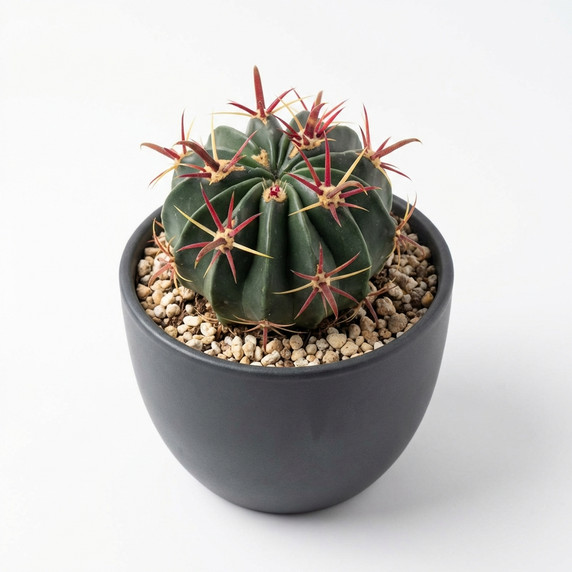
Bring bold desert character to your space with Ferocactus latispinus. Its ribbed barrel form and vivid red spines create instant impact in modern interiors, offices, and sunny patios—without demanding care. Just give it bright sun and occasional deep watering, and it will reward you with years of sculptural beauty. A standout collector cactus and a memorable gift for plant lovers who want something truly striking.
1. Basic Identification
Common Name: Devil’s Tongue Barrel Cactus
Botanical Name: Ferocactus latispinus
Former Name: Echinocactus latispinus
Plant Type: Cactus (Succulent)
Plant Code / SKU: PLT-0459
Alternative Names:
Echinocactus latispinus
Arabic: صبار فيروكاكتس لاتي سباينوس
2. Taxonomy & Classification
Order: Caryophyllales
Family: Cactaceae
Genus: Ferocactus
3. Origin & Distribution
Native to central Mexico (Hidalgo, Puebla, San Luis Potosí and Veracruz). Occurs on rocky slopes and semi-arid scrublands at elevations of 400–1 000 m.
4. Visual Characteristics
Solitary or lightly clustering barrel cactus with a globose to short-cylindrical stem bearing 10–30 prominent ribs. Areoles produce stout, hooked or straight spines that emerge bright red, fading to yellow or brown with age. Stem color is gray-green. In summer it bears funnel-shaped yellow flowers with a reddish throat from woolly apical areoles.
5. Size & Dimensions
Height: 25–60 cm (occasionally up to 1 m over decades).
Diameter: 30–50 cm when mature. Slow growth rate—only a few centimetres per year.
6. Light Requirements
Full sun to very bright light. Requires at least 6 hours of direct sunlight daily to maintain spine coloration and compact form. Tolerates light shade but may etiolate.
7. Watering Needs
Drought-tolerant. Water deeply only when soil is completely dry—about every 2–4 weeks in spring and summer. Reduce to once every 6–8 weeks in autumn and winter to avoid root rot.
8. Soil & Potting
Use a well-draining cactus or succulent potting mix amended with coarse sand or perlite. Ideal pH 6.0–7.5. Plant in terracotta containers with drainage holes to promote rapid soil drying.
9. Temperature & Humidity
Optimal daytime 20–30 °C. Minimum winter temperature 5–10 °C; avoid frost. Prefers low humidity and good air circulation.
10. Fertilization
Apply a balanced (10-10-10) or low-nitrogen (5-10-10) cactus fertilizer at half strength once a month during active growth (spring–summer). Do not fertilize during dormancy (winter).
11. Maintenance & Care Level
Low maintenance. Protect from overwatering and prolonged cold. Remove dead spines or debris from the crown. Minimal pruning required.
12. Growth & Propagation
Slow-growing species. Propagate by seed sown in spring at 20–25 °C in a well-drained medium. Seedlings require bright light and careful watering. Offsets are rare.
13. Common Problems
Overwatering leads to root and crown rot. Susceptible to mealybugs and scale insects—inspect areoles regularly. Sudden exposure to intense sun may cause sunburn spots. Cold, wet conditions can trigger stem collapse.
14. Benefits & Uses
Excellent sculptural specimen for xeriscaping, rock gardens, and container displays. Adds architectural interest to modern interiors and outdoor patios. Ideal low-care gift for cactus enthusiasts.
15. Toxicity & Safety
Non-toxic to humans and pets. Spines are sharp and can cause injury; handle with protective gloves and tongs.