


Indian Mulberry
Embrace the exotic with the Indian Mulberry, also known as the legendary Noni tree. With its magnificent, large, glossy green leaves, this plant brings a lush, tropical vibe to any space. More than just a beautiful plant, the *Morinda citrifolia* is famed for its unique, bumpy fruit, a cornerstone of traditional wellness practices for centuries. It's a fast-growing, resilient plant that makes a bold statement in your home or garden. Own a piece of botanical history and a stunning natural specimen.
1. Basic Identification
Common Name: Indian Mulberry, Noni
Botanical Name: Morinda citrifolia
Arabic Name: توت هندي
Plant Variant: Standard
Plant Color: Green
Plant Country: Thailand
Family: Rubiaceae
2. Taxonomy & Classification
Kingdom: Plantae
Clade: Tracheophytes
Order: Gentianales
Family: Rubiaceae
Genus: Morinda
Species: Morinda citrifolia
3. Origin & Distribution
The Indian Mulberry is native to Southeast Asia, Australasia, and the Pacific Islands. Due to its adaptability and medicinal value, it has been naturalized throughout the tropics, including the Caribbean, Africa, and parts of the Americas.
4. Visual Characteristics
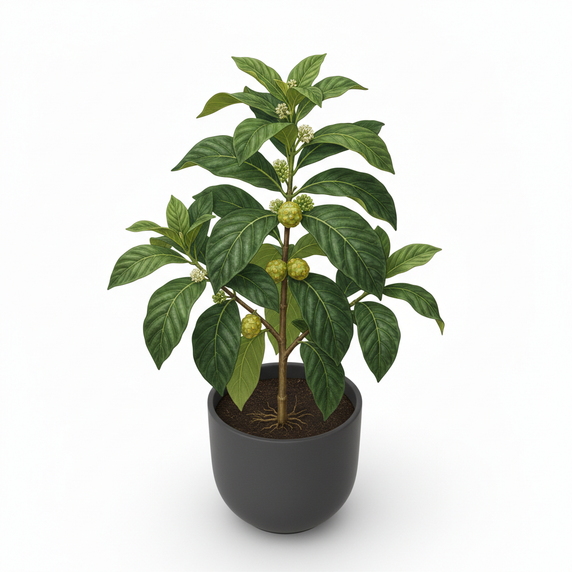
This plant features large, simple, elliptical leaves that are dark green and glossy with prominent veins. It produces small, white, tubular flowers that grow from a fleshy head. The most distinct feature is its syncarp fruit, which is oval, bumpy, and transitions from green to a translucent yellowish-white when ripe, emitting a strong, characteristic odor.
5. Size & Dimensions
In its natural habitat, Morinda citrifolia can grow into a small tree or large shrub reaching 3 to 9 meters (10-30 feet) in height. When grown in containers or indoor settings, it is typically maintained as a medium-sized plant through pruning.
6. Light Requirements
Prefers full sun to partial shade. While it can tolerate lower light levels indoors, bright indirect light or direct sunlight is necessary for the plant to flower and produce its iconic fruit.
7. Watering Needs
Noni trees prefer consistent moisture but are relatively resilient. Water when the top inch of soil feels dry. Ensure excellent drainage to prevent root rot, though the plant can tolerate brief periods of drought once established.
8. Soil & Potting
Highly adaptable to various soil types, including sandy, volcanic, and calcareous soils. For home cultivation, a well-draining, nutrient-rich potting mix with a slightly acidic to neutral pH is ideal.
9. Temperature & Humidity
As a tropical species, it thrives in warm temperatures between 18°C and 35°C (64°F - 95°F). It is sensitive to frost and should be protected from cold drafts. High humidity levels mimic its natural environment and promote lush leaf growth.
10. Fertilization
Apply a balanced, water-soluble fertilizer every 4 to 6 weeks during the active growing season (spring and summer). Reduce fertilization during the winter months.
11. Maintenance & Care Level
Care Level: Easy/Low Maintenance. It is a hardy and fast-growing plant. Regular pruning is recommended to manage its size and encourage a bushier growth habit.
12. Growth & Propagation
Morinda citrifolia is a fast-growing plant. It can be easily propagated through seeds (which may take several months to germinate) or via stem cuttings for faster establishment.
13. Common Problems
Generally pest-resistant, but can occasionally be affected by aphids, scale, or spider mites if kept in very dry indoor conditions. Overwatering can lead to root rot.
14. Benefits & Uses
Widely used in traditional medicine, particularly for Noni juice derived from the fruit. Ornamentally, it provides a bold tropical aesthetic. In some cultures, the leaves are used as food wrappers or cooked as vegetables, and the roots are used to create natural dyes.
15. Toxicity & Safety
The fruit is edible and used for wellness, though it has a very pungent taste and smell. The plant is generally considered safe for humans and pets, though ingestion of any ornamental foliage by pets should be discouraged to avoid mild digestive upset.

Indian Mulberry
Embrace the exotic with the Indian Mulberry, also known as the legendary Noni tree. With its magnificent, large, glossy green leaves, this plant brings a lush, tropical vibe to any space. More than just a beautiful plant, the *Morinda citrifolia* is famed for its unique, bumpy fruit, a cornerstone of traditional wellness practices for centuries. It's a fast-growing, resilient plant that makes a bold statement in your home or garden. Own a piece of botanical history and a stunning natural specimen.
1. Basic Identification
Common Name: Indian Mulberry, Noni
Botanical Name: Morinda citrifolia
Arabic Name: توت هندي
Plant Variant: Standard
Plant Color: Green
Plant Country: Thailand
Family: Rubiaceae
2. Taxonomy & Classification
Kingdom: Plantae
Clade: Tracheophytes
Order: Gentianales
Family: Rubiaceae
Genus: Morinda
Species: Morinda citrifolia
3. Origin & Distribution
The Indian Mulberry is native to Southeast Asia, Australasia, and the Pacific Islands. Due to its adaptability and medicinal value, it has been naturalized throughout the tropics, including the Caribbean, Africa, and parts of the Americas.
4. Visual Characteristics
This plant features large, simple, elliptical leaves that are dark green and glossy with prominent veins. It produces small, white, tubular flowers that grow from a fleshy head. The most distinct feature is its syncarp fruit, which is oval, bumpy, and transitions from green to a translucent yellowish-white when ripe, emitting a strong, characteristic odor.
5. Size & Dimensions
In its natural habitat, Morinda citrifolia can grow into a small tree or large shrub reaching 3 to 9 meters (10-30 feet) in height. When grown in containers or indoor settings, it is typically maintained as a medium-sized plant through pruning.
6. Light Requirements
Prefers full sun to partial shade. While it can tolerate lower light levels indoors, bright indirect light or direct sunlight is necessary for the plant to flower and produce its iconic fruit.
7. Watering Needs
Noni trees prefer consistent moisture but are relatively resilient. Water when the top inch of soil feels dry. Ensure excellent drainage to prevent root rot, though the plant can tolerate brief periods of drought once established.
8. Soil & Potting
Highly adaptable to various soil types, including sandy, volcanic, and calcareous soils. For home cultivation, a well-draining, nutrient-rich potting mix with a slightly acidic to neutral pH is ideal.
9. Temperature & Humidity
As a tropical species, it thrives in warm temperatures between 18°C and 35°C (64°F - 95°F). It is sensitive to frost and should be protected from cold drafts. High humidity levels mimic its natural environment and promote lush leaf growth.
10. Fertilization
Apply a balanced, water-soluble fertilizer every 4 to 6 weeks during the active growing season (spring and summer). Reduce fertilization during the winter months.
11. Maintenance & Care Level
Care Level: Easy/Low Maintenance. It is a hardy and fast-growing plant. Regular pruning is recommended to manage its size and encourage a bushier growth habit.
12. Growth & Propagation
Morinda citrifolia is a fast-growing plant. It can be easily propagated through seeds (which may take several months to germinate) or via stem cuttings for faster establishment.
13. Common Problems
Generally pest-resistant, but can occasionally be affected by aphids, scale, or spider mites if kept in very dry indoor conditions. Overwatering can lead to root rot.
14. Benefits & Uses
Widely used in traditional medicine, particularly for Noni juice derived from the fruit. Ornamentally, it provides a bold tropical aesthetic. In some cultures, the leaves are used as food wrappers or cooked as vegetables, and the roots are used to create natural dyes.
15. Toxicity & Safety
The fruit is edible and used for wellness, though it has a very pungent taste and smell. The plant is generally considered safe for humans and pets, though ingestion of any ornamental foliage by pets should be discouraged to avoid mild digestive upset.