


Japanese Privet
Give your space an instant “designed” look with Japanese Privet topiary. Its glossy evergreen foliage and naturally dense branching make it perfect for crisp cone shapes, elegant entrances, and premium patio styling. Tough, adaptable, and forgiving, it stays neat with simple periodic trims—an excellent choice for both home gardens and business frontages.
1. Basic Identification
Common Name: Japanese Privet / Waxleaf Privet
Botanical Name: Ligustrum japonicum
Arabic Name: ليغستروم
Stems: 1
Family: Oleaceae
2. Taxonomy & Classification
Kingdom: Plantae; Division: Magnoliophyta; Class: Magnoliopsida; Order: Lamiales; Family: Oleaceae; Genus: Ligustrum; Species: Ligustrum japonicum.
3. Origin & Distribution
Native to central and southern Japan and Korea. It has been widely introduced and naturalized in various warm-temperate regions globally, including parts of North America and Europe.
4. Visual Characteristics
This plant features thick, leathery, and glossy evergreen leaves that are dark green on top and paler underneath. It produces panicles of small, creamy-white flowers that are highly fragrant, followed by small, round, blackish-purple berries.
5. Size & Dimensions
Typically grows as a shrub or small tree reaching 6 to 12 feet in height and 6 to 8 feet in spread. When cultivated as a topiary, its size is maintained by regular pruning to desired shapes like cones or standards.
6. Light Requirements
Thrives in full sun to partial shade. While it can tolerate deeper shade, the foliage will be significantly less dense.
7. Watering Needs
Requires moderate watering. It is relatively drought-tolerant once established but performs best with regular moisture in well-drained soil. Always avoid waterlogging to prevent root issues.
8. Soil & Potting
Very adaptable to various soil types, including clay, loam, and sand. It prefers moist, well-drained, slightly acidic to neutral soil. If kept in pots, ensure high-quality potting mix and excellent drainage.
9. Temperature & Humidity
Hardy in USDA zones 7-10. It prefers warm temperate climates and can tolerate heat and humidity well. It is moderately frost-tolerant but may need protection in extreme cold.
10. Fertilization
Feed with a balanced, slow-release fertilizer in the spring before new growth starts. A second light application can be done in late summer for sustained health.
11. Maintenance & Care Level
Maintenance Level: Easy. The primary task is periodic pruning to maintain its specific shape, especially when grown as a topiary or formal hedge.
12. Growth & Propagation
Fast to moderate growth rate. Propagation is commonly achieved through semi-hardwood cuttings taken in summer or by sowing seeds.
13. Common Problems
Susceptible to whiteflies, aphids, and scale insects. It can also be affected by leaf spot or root rot if soil drainage is poor or if it is overwatered.
14. Benefits & Uses
Ideal for topiary, formal hedges, privacy screens, and specimen plants. Its glossy foliage adds a sophisticated, structured touch to entrances, patios, and business landscapes.
15. Toxicity & Safety
The leaves and berries of Ligustrum japonicum are toxic to humans and pets (dogs, cats, horses) if ingested. They contain terpenoid glycosides which can cause gastrointestinal distress, vomiting, or diarrhea.

Japanese Privet
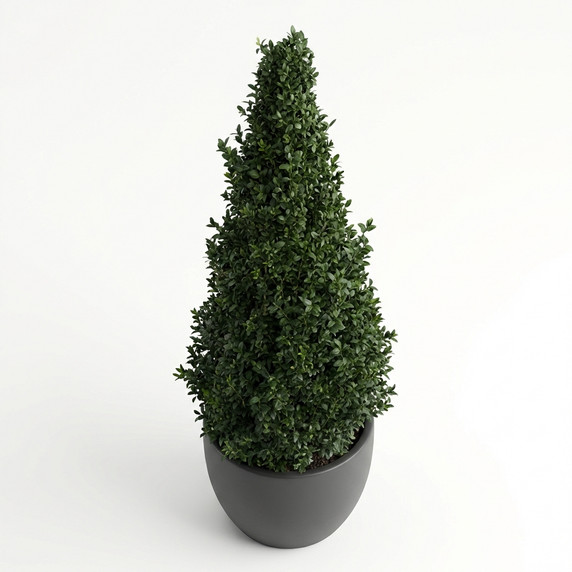
Give your space an instant “designed” look with Japanese Privet topiary. Its glossy evergreen foliage and naturally dense branching make it perfect for crisp cone shapes, elegant entrances, and premium patio styling. Tough, adaptable, and forgiving, it stays neat with simple periodic trims—an excellent choice for both home gardens and business frontages.
1. Basic Identification
Common Name: Japanese Privet / Waxleaf Privet
Botanical Name: Ligustrum japonicum
Arabic Name: ليغستروم
Stems: 1
Family: Oleaceae
2. Taxonomy & Classification
Kingdom: Plantae; Division: Magnoliophyta; Class: Magnoliopsida; Order: Lamiales; Family: Oleaceae; Genus: Ligustrum; Species: Ligustrum japonicum.
3. Origin & Distribution
Native to central and southern Japan and Korea. It has been widely introduced and naturalized in various warm-temperate regions globally, including parts of North America and Europe.
4. Visual Characteristics
This plant features thick, leathery, and glossy evergreen leaves that are dark green on top and paler underneath. It produces panicles of small, creamy-white flowers that are highly fragrant, followed by small, round, blackish-purple berries.
5. Size & Dimensions
Typically grows as a shrub or small tree reaching 6 to 12 feet in height and 6 to 8 feet in spread. When cultivated as a topiary, its size is maintained by regular pruning to desired shapes like cones or standards.
6. Light Requirements
Thrives in full sun to partial shade. While it can tolerate deeper shade, the foliage will be significantly less dense.
7. Watering Needs
Requires moderate watering. It is relatively drought-tolerant once established but performs best with regular moisture in well-drained soil. Always avoid waterlogging to prevent root issues.
8. Soil & Potting
Very adaptable to various soil types, including clay, loam, and sand. It prefers moist, well-drained, slightly acidic to neutral soil. If kept in pots, ensure high-quality potting mix and excellent drainage.
9. Temperature & Humidity
Hardy in USDA zones 7-10. It prefers warm temperate climates and can tolerate heat and humidity well. It is moderately frost-tolerant but may need protection in extreme cold.
10. Fertilization
Feed with a balanced, slow-release fertilizer in the spring before new growth starts. A second light application can be done in late summer for sustained health.
11. Maintenance & Care Level
Maintenance Level: Easy. The primary task is periodic pruning to maintain its specific shape, especially when grown as a topiary or formal hedge.
12. Growth & Propagation
Fast to moderate growth rate. Propagation is commonly achieved through semi-hardwood cuttings taken in summer or by sowing seeds.
13. Common Problems
Susceptible to whiteflies, aphids, and scale insects. It can also be affected by leaf spot or root rot if soil drainage is poor or if it is overwatered.
14. Benefits & Uses
Ideal for topiary, formal hedges, privacy screens, and specimen plants. Its glossy foliage adds a sophisticated, structured touch to entrances, patios, and business landscapes.
15. Toxicity & Safety
The leaves and berries of Ligustrum japonicum are toxic to humans and pets (dogs, cats, horses) if ingested. They contain terpenoid glycosides which can cause gastrointestinal distress, vomiting, or diarrhea.