


Japanese Skimmia
Bring instant seasonal elegance to your space with Japanese Skimmia. Its deep green, glossy leaves and abundant red berry clusters create a premium festive look that lasts for weeks—perfect for entrances, patios, and shaded balconies. Compact, tidy, and easy to maintain, Skimmia is a standout gifting plant and a reliable evergreen accent for homes and businesses alike.
1. Basic Identification
Common Name: Japanese Skimmia
Botanical Name: Skimmia japonica
Arabic Name: سكيميا
Plant Variant: Standard
Plant Color: Natural
Plant Country: Japan
Family: Rutaceae
Stems: 1
2. Taxonomy & Classification
Kingdom: Plantae
Clade: Tracheophytes
Order: Sapindales
Family: Rutaceae
Genus: Skimmia
Species: Skimmia japonica
3. Origin & Distribution
Native to Japan, China, and Southeast Asia. It is widely cultivated throughout temperate regions of the world for its ornamental winter berries and evergreen foliage.
4. Visual Characteristics
A compact, rounded evergreen shrub featuring leathery, lance-shaped leaves that are a deep, glossy green. In spring, it produces panicles of fragrant white or pink-tinted flowers. On female plants, these are followed by bright, long-lasting red berries during the autumn and winter months, provided a male plant is nearby for pollination.
5. Size & Dimensions
Typically grows to a height and spread of 3 to 4 feet (0.9 to 1.2 meters). It is a slow-growing shrub that maintains a neat, globular form without excessive pruning.
6. Light Requirements
Prefers partial to full shade. It is an excellent choice for northern exposures or shaded corners. Avoid direct afternoon sun, which can cause the leaves to yellow or scorch.
7. Watering Needs
Requires regular watering to keep the soil consistently moist, especially during the first growing season. Once established, it is moderately drought-tolerant but performs best when the soil does not dry out completely.
8. Soil & Potting
Thrives in moist, well-draining, humus-rich soil. It is an acid-loving plant (calcifuge) and prefers a pH that is slightly acidic to neutral. If grown in pots, use an ericaceous (acidic) potting mix.
9. Temperature & Humidity
Cold hardy in USDA zones 6-8. It prefers cool to temperate climates and can struggle in extreme tropical heat. It enjoys moderate humidity levels typical of woodland environments.
10. Fertilization
Apply a balanced slow-release fertilizer designed for acid-loving plants in early spring before new growth appears. Avoid over-fertilizing, which can damage the roots.
11. Maintenance & Care Level
Easy to care for. Maintenance is minimal; only light pruning is required to remove dead wood or to slightly reshape the plant after flowering.
12. Growth & Propagation
Growth rate is slow. Propagation is usually achieved through semi-hardwood cuttings taken in late summer or by sowing seeds in a cold frame during the autumn.
13. Common Problems
Susceptible to horse chestnut scale, aphids, and spider mites in dry conditions. Leaf chlorosis (yellowing) may occur if the soil is too alkaline.
14. Benefits & Uses
Highly valued for winter interest due to its bright berries and evergreen leaves. It is widely used in shaded border gardens, woodland gardens, and as a decorative container plant for patios and entrances.
15. Toxicity & Safety
The berries and leaves are considered mildly toxic if ingested by humans, cats, or dogs, potentially causing gastrointestinal upset.
Japanese Skimmia
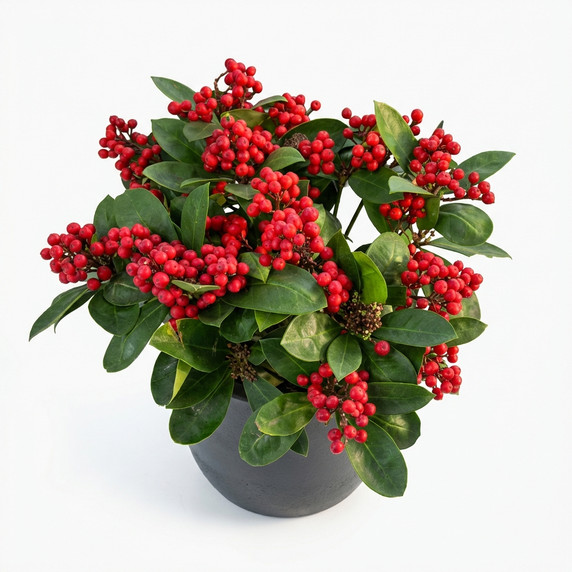
Bring instant seasonal elegance to your space with Japanese Skimmia. Its deep green, glossy leaves and abundant red berry clusters create a premium festive look that lasts for weeks—perfect for entrances, patios, and shaded balconies. Compact, tidy, and easy to maintain, Skimmia is a standout gifting plant and a reliable evergreen accent for homes and businesses alike.
1. Basic Identification
Common Name: Japanese Skimmia
Botanical Name: Skimmia japonica
Arabic Name: سكيميا
Plant Variant: Standard
Plant Color: Natural
Plant Country: Japan
Family: Rutaceae
Stems: 1
2. Taxonomy & Classification
Kingdom: Plantae
Clade: Tracheophytes
Order: Sapindales
Family: Rutaceae
Genus: Skimmia
Species: Skimmia japonica
3. Origin & Distribution
Native to Japan, China, and Southeast Asia. It is widely cultivated throughout temperate regions of the world for its ornamental winter berries and evergreen foliage.
4. Visual Characteristics
A compact, rounded evergreen shrub featuring leathery, lance-shaped leaves that are a deep, glossy green. In spring, it produces panicles of fragrant white or pink-tinted flowers. On female plants, these are followed by bright, long-lasting red berries during the autumn and winter months, provided a male plant is nearby for pollination.
5. Size & Dimensions
Typically grows to a height and spread of 3 to 4 feet (0.9 to 1.2 meters). It is a slow-growing shrub that maintains a neat, globular form without excessive pruning.
6. Light Requirements
Prefers partial to full shade. It is an excellent choice for northern exposures or shaded corners. Avoid direct afternoon sun, which can cause the leaves to yellow or scorch.
7. Watering Needs
Requires regular watering to keep the soil consistently moist, especially during the first growing season. Once established, it is moderately drought-tolerant but performs best when the soil does not dry out completely.
8. Soil & Potting
Thrives in moist, well-draining, humus-rich soil. It is an acid-loving plant (calcifuge) and prefers a pH that is slightly acidic to neutral. If grown in pots, use an ericaceous (acidic) potting mix.
9. Temperature & Humidity
Cold hardy in USDA zones 6-8. It prefers cool to temperate climates and can struggle in extreme tropical heat. It enjoys moderate humidity levels typical of woodland environments.
10. Fertilization
Apply a balanced slow-release fertilizer designed for acid-loving plants in early spring before new growth appears. Avoid over-fertilizing, which can damage the roots.
11. Maintenance & Care Level
Easy to care for. Maintenance is minimal; only light pruning is required to remove dead wood or to slightly reshape the plant after flowering.
12. Growth & Propagation
Growth rate is slow. Propagation is usually achieved through semi-hardwood cuttings taken in late summer or by sowing seeds in a cold frame during the autumn.
13. Common Problems
Susceptible to horse chestnut scale, aphids, and spider mites in dry conditions. Leaf chlorosis (yellowing) may occur if the soil is too alkaline.
14. Benefits & Uses
Highly valued for winter interest due to its bright berries and evergreen leaves. It is widely used in shaded border gardens, woodland gardens, and as a decorative container plant for patios and entrances.
15. Toxicity & Safety
The berries and leaves are considered mildly toxic if ingested by humans, cats, or dogs, potentially causing gastrointestinal upset.