


Juniper Standard Tree 'Standard Form'
Make a statement of pure elegance. Our Juniper Standard Tree is the definitive choice for a sophisticated, structured landscape. Perfectly sculpted into a lush, evergreen globe atop a sturdy, clean trunk, this topiary delivers instant architectural impact and year-round curb appeal. Unlike fleeting seasonal flowers, its rich green presence is a constant, promising enduring beauty with minimal effort. Ideal for flanking doorways, defining patios, or as a standalone specimen, this hardy Juniper is your secret to a timeless, polished garden. Order now and introduce a touch of classic formality to your outdoor space.
1. Basic Identification
Common Name: Juniper Standard Tree / Chinese Juniper
Botanical Name: Juniperus chinensis
Arabic Name: جانبروس
Plant Variant: Standard Form (Topiary Ball)
Plant Color: Green
Plant Country: Netherlands
2. Taxonomy & Classification
Kingdom: Plantae
Division: Pinophyta
Class: Pinopsida
Order: Pinales
Family: Cupressaceae
Genus: Juniperus
Species: J. chinensis
3. Origin & Distribution
The Juniperus chinensis is native to Northeast Asia, spanning China, Mongolia, Japan, Korea, and southeast Russia. It has been cultivated for centuries in temperate regions worldwide for its versatility and ornamental appeal.
4. Visual Characteristics
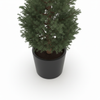
This standard form features a straight, woody trunk topped with a dense, rounded crown of evergreen foliage. The leaves are typically a mix of juvenile needle-like foliage and adult scale-like foliage, maintaining a vibrant deep green hue throughout the seasons.
5. Size & Dimensions
In its standard (topiary) form, the tree is usually maintained at a height of 3 to 5 feet (90-150 cm). The crown or "ball" is typically pruned to a diameter of 12 to 24 inches depending on its maturity.
6. Light Requirements
Requires full sun to thrive. It should be placed in an area that receives at least 6 to 8 hours of direct sunlight daily to maintain dense foliage and its vibrant green color.
7. Watering Needs
Moderate watering needs. Once established, it is relatively drought-tolerant. However, it prefers regular watering when the top 1-2 inches of soil feel dry. Avoid overwatering as it is susceptible to root rot.
8. Soil & Potting
Thrives in well-draining soil. A mix of loamy or sandy soil with good drainage is ideal. It can tolerate various pH levels but prefers slightly acidic to neutral ground. If kept in a pot, ensure the container has adequate drainage holes.
9. Temperature & Humidity
Highly hardy and adaptable. It can withstand significant cold (down to USDA Zone 4) and handles summer heat well. It prefers low to moderate humidity and requires good air circulation.
10. Fertilization
Feed with a balanced, slow-release evergreen fertilizer in early spring before the new growth begins. Do not fertilize in late autumn to avoid soft growth that could be damaged by frost.
11. Maintenance & Care Level
Easy to care for. The primary maintenance involves regular light pruning or "haircuts" once or twice a year to maintain its formal spherical shape and prevent the canopy from becoming too leggy.
12. Growth & Propagation
It has a slow to moderate growth rate. Propagation is typically achieved through semi-hardwood cuttings or grafting, which is how the standard "tree" form is often created.
13. Common Problems
Relatively pest-resistant, but keep an eye out for spider mites or bagworms. Poor drainage can lead to root rot. Ensure the plant is not crowded to prevent fungal blights like Phomopsis.
14. Benefits & Uses
Excellent for formal garden designs, entryways, and patio containers. It provides year-round structure and serves as an effective air-purifier in outdoor environments. Its architectural form makes it a popular choice for corporate entrances and luxury home landscapes.
15. Toxicity & Safety
Junipers are generally considered mildly toxic to cats and dogs if ingested, potentially causing gastrointestinal upset. Some individuals may experience skin irritation (dermatitis) when handling the foliage, so gloves are recommended during pruning.
Juniper Standard Tree 'Standard Form'

Make a statement of pure elegance. Our Juniper Standard Tree is the definitive choice for a sophisticated, structured landscape. Perfectly sculpted into a lush, evergreen globe atop a sturdy, clean trunk, this topiary delivers instant architectural impact and year-round curb appeal. Unlike fleeting seasonal flowers, its rich green presence is a constant, promising enduring beauty with minimal effort. Ideal for flanking doorways, defining patios, or as a standalone specimen, this hardy Juniper is your secret to a timeless, polished garden. Order now and introduce a touch of classic formality to your outdoor space.
1. Basic Identification
Common Name: Juniper Standard Tree / Chinese Juniper
Botanical Name: Juniperus chinensis
Arabic Name: جانبروس
Plant Variant: Standard Form (Topiary Ball)
Plant Color: Green
Plant Country: Netherlands
2. Taxonomy & Classification
Kingdom: Plantae
Division: Pinophyta
Class: Pinopsida
Order: Pinales
Family: Cupressaceae
Genus: Juniperus
Species: J. chinensis
3. Origin & Distribution
The Juniperus chinensis is native to Northeast Asia, spanning China, Mongolia, Japan, Korea, and southeast Russia. It has been cultivated for centuries in temperate regions worldwide for its versatility and ornamental appeal.
4. Visual Characteristics
This standard form features a straight, woody trunk topped with a dense, rounded crown of evergreen foliage. The leaves are typically a mix of juvenile needle-like foliage and adult scale-like foliage, maintaining a vibrant deep green hue throughout the seasons.
5. Size & Dimensions
In its standard (topiary) form, the tree is usually maintained at a height of 3 to 5 feet (90-150 cm). The crown or "ball" is typically pruned to a diameter of 12 to 24 inches depending on its maturity.
6. Light Requirements
Requires full sun to thrive. It should be placed in an area that receives at least 6 to 8 hours of direct sunlight daily to maintain dense foliage and its vibrant green color.
7. Watering Needs
Moderate watering needs. Once established, it is relatively drought-tolerant. However, it prefers regular watering when the top 1-2 inches of soil feel dry. Avoid overwatering as it is susceptible to root rot.
8. Soil & Potting
Thrives in well-draining soil. A mix of loamy or sandy soil with good drainage is ideal. It can tolerate various pH levels but prefers slightly acidic to neutral ground. If kept in a pot, ensure the container has adequate drainage holes.
9. Temperature & Humidity
Highly hardy and adaptable. It can withstand significant cold (down to USDA Zone 4) and handles summer heat well. It prefers low to moderate humidity and requires good air circulation.
10. Fertilization
Feed with a balanced, slow-release evergreen fertilizer in early spring before the new growth begins. Do not fertilize in late autumn to avoid soft growth that could be damaged by frost.
11. Maintenance & Care Level
Easy to care for. The primary maintenance involves regular light pruning or "haircuts" once or twice a year to maintain its formal spherical shape and prevent the canopy from becoming too leggy.
12. Growth & Propagation
It has a slow to moderate growth rate. Propagation is typically achieved through semi-hardwood cuttings or grafting, which is how the standard "tree" form is often created.
13. Common Problems
Relatively pest-resistant, but keep an eye out for spider mites or bagworms. Poor drainage can lead to root rot. Ensure the plant is not crowded to prevent fungal blights like Phomopsis.
14. Benefits & Uses
Excellent for formal garden designs, entryways, and patio containers. It provides year-round structure and serves as an effective air-purifier in outdoor environments. Its architectural form makes it a popular choice for corporate entrances and luxury home landscapes.
15. Toxicity & Safety
Junipers are generally considered mildly toxic to cats and dogs if ingested, potentially causing gastrointestinal upset. Some individuals may experience skin irritation (dermatitis) when handling the foliage, so gloves are recommended during pruning.