


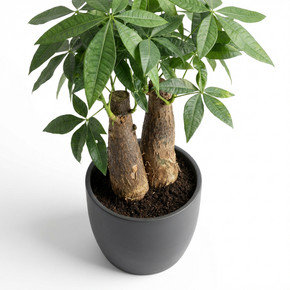


Bring a bold, tropical statement to your space with the Money Tree (Pachira aquatica). Its elegant, hand-shaped leaves and sturdy trunk make it a favorite for modern interiors and professional environments. Easy to care for and highly giftable, it thrives with bright, indirect light and occasional watering—perfect for adding natural style to homes, receptions, and meeting rooms.
Common Name: Money Tree
Botanical Name: Pachira aquatica
Former Name: Bombax glabrum
Plant Type: Indoor tropical houseplant
Plant Code / SKU: PLT-0426
Alternative Names:
Malabar chestnut
French peanut
Guiana chestnut
Arabic: شجرة المال
Order: Malvales
Family: Malvaceae
Genus: Pachira
Native to Central and South America, primarily in Mexico, Panama, and Brazil, where it grows in seasonally flooded forests and along riverbanks; widely cultivated as an ornamental indoor plant worldwide.
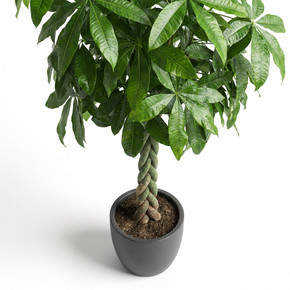
Medium tropical tree with palmately compound leaves of 5–7 glossy lanceolate leaflets, arranged like a hand; smooth, light brown trunk often braided in cultivation; infrequent, showy, creamy-white powderpuff flowers with prominent red stamens; fruits are woody capsules containing edible brown seeds.
In its native habitat, can reach up to 18 m tall; indoors typically 1–2.4 m; trunk diameter up to 6–8 cm; individual leaflets 10–30 cm long; canopy spread up to 1.5 m in cultivation.
Thrives in bright, indirect light; tolerates moderate light; avoid direct midday sun to prevent leaf scorch; low light slows growth and may reduce leaf size.
Water when the top 2–3 cm of soil is dry; maintains evenly moist—but not waterlogged—soil; reduce frequency in winter; avoid letting pot sit in standing water to prevent root rot.
Use well-draining potting mix with peat moss, perlite, or sand; pH preference 6.0–7.5; ensure pots have drainage holes; repot every 2–3 years or when root-bound.
Optimal temperature 18–24 °C (65–75 °F); minimum 10 °C (50 °F); prefers humidity above 50%; mist occasionally or use humidity tray to increase moisture around foliage.
Apply balanced, water-soluble fertilizer (e.g., 10-10-10) every 4–6 weeks during spring and summer; reduce or cease feeding in fall and winter when growth slows.
Easy to moderate care; occasional pruning to maintain shape; dust leaves regularly; braid young trunks for aesthetic if desired; monitor for pests.
Propagate by seeds—soak seeds, sow in moist soil, germinate in 10–14 days; or stem cuttings placed in water or well-draining mix, root in ~4–6 weeks; best propagated in spring or early summer.
Overwatering can cause root rot; brown leaf tips from low humidity or overfertilization; pests include spider mites, mealybugs, scale; yellowing leaves may indicate nutrient deficiency or poor drainage.
Popular ornamental and Feng Shui plant believed to attract prosperity; seeds are edible when roasted; indoor air purification properties; sturdy trunk used in crafts and carving.
Non-toxic to pets and humans; seeds generally edible but can cause mild gastrointestinal upset if consumed raw or in large quantities; handle sap cautiously if sensitive.
Bring a bold, tropical statement to your space with the Money Tree (Pachira aquatica). Its elegant, hand-shaped leaves and sturdy trunk make it a favorite for modern interiors and professional environments. Easy to care for and highly giftable, it thrives with bright, indirect light and occasional watering—perfect for adding natural style to homes, receptions, and meeting rooms.
Common Name: Money Tree
Botanical Name: Pachira aquatica
Former Name: Bombax glabrum
Plant Type: Indoor tropical houseplant
Plant Code / SKU: PLT-0426
Alternative Names:
Malabar chestnut
French peanut
Guiana chestnut
Arabic: شجرة المال
Order: Malvales
Family: Malvaceae
Genus: Pachira
Native to Central and South America, primarily in Mexico, Panama, and Brazil, where it grows in seasonally flooded forests and along riverbanks; widely cultivated as an ornamental indoor plant worldwide.
Medium tropical tree with palmately compound leaves of 5–7 glossy lanceolate leaflets, arranged like a hand; smooth, light brown trunk often braided in cultivation; infrequent, showy, creamy-white powderpuff flowers with prominent red stamens; fruits are woody capsules containing edible brown seeds.
In its native habitat, can reach up to 18 m tall; indoors typically 1–2.4 m; trunk diameter up to 6–8 cm; individual leaflets 10–30 cm long; canopy spread up to 1.5 m in cultivation.
Thrives in bright, indirect light; tolerates moderate light; avoid direct midday sun to prevent leaf scorch; low light slows growth and may reduce leaf size.
Water when the top 2–3 cm of soil is dry; maintains evenly moist—but not waterlogged—soil; reduce frequency in winter; avoid letting pot sit in standing water to prevent root rot.
Use well-draining potting mix with peat moss, perlite, or sand; pH preference 6.0–7.5; ensure pots have drainage holes; repot every 2–3 years or when root-bound.
Optimal temperature 18–24 °C (65–75 °F); minimum 10 °C (50 °F); prefers humidity above 50%; mist occasionally or use humidity tray to increase moisture around foliage.
Apply balanced, water-soluble fertilizer (e.g., 10-10-10) every 4–6 weeks during spring and summer; reduce or cease feeding in fall and winter when growth slows.
Easy to moderate care; occasional pruning to maintain shape; dust leaves regularly; braid young trunks for aesthetic if desired; monitor for pests.
Propagate by seeds—soak seeds, sow in moist soil, germinate in 10–14 days; or stem cuttings placed in water or well-draining mix, root in ~4–6 weeks; best propagated in spring or early summer.
Overwatering can cause root rot; brown leaf tips from low humidity or overfertilization; pests include spider mites, mealybugs, scale; yellowing leaves may indicate nutrient deficiency or poor drainage.
Popular ornamental and Feng Shui plant believed to attract prosperity; seeds are edible when roasted; indoor air purification properties; sturdy trunk used in crafts and carving.
Non-toxic to pets and humans; seeds generally edible but can cause mild gastrointestinal upset if consumed raw or in large quantities; handle sap cautiously if sensitive.


Take 20% off your first order
Enter the code below at checkout to get 20% off your first order