





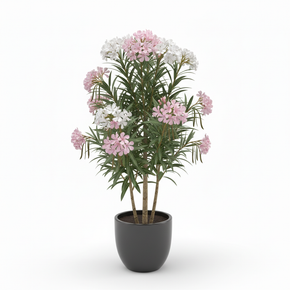
Transform your garden with the timeless beauty of the Oleander. This incredibly hardy evergreen shrub thrives in full sun and rewards you with a profusion of stunning, colorful flowers from spring through fall. Perfect for creating a dense privacy screen or as a dramatic standalone specimen, the Oleander is exceptionally drought-tolerant and low-maintenance, making it an ideal choice for busy gardeners. Its vibrant blooms and rich, dark green foliage bring a touch of the Mediterranean to any landscape. **Important Safety Warning: All parts of the Oleander are extremely toxic if ingested. Keep away from children and pets.**
Common Name: Oleander
Botanical Name: Nerium oleander
Arabic Name: دفلة
Family: Apocynaceae
Country of Origin: Spain
Kingdom: Plantae
Clade: Tracheophytes
Order: Gentianales
Family: Apocynaceae
Genus: Nerium
Species: Nerium oleander
Nerium oleander is native to a broad area ranging from the Mediterranean region to North Africa and Southeast Asia. It is widely cultivated in warm temperate and subtropical regions across the globe, including Spain, where it is a staple of Mediterranean landscaping.
This evergreen shrub features thick, leathery, lanceolate leaves that are typically dark green or grey-green. It produces clusters of funnel-shaped flowers at the ends of each branch, which can be single or double-petaled in shades of white, pink, red, or peach.
The Oleander is a fast-growing shrub that typically reaches heights of 6 to 12 feet (1.8 to 3.6 meters) and a similar spread. Some dwarf varieties stay around 3 to 5 feet, while older specimens can occasionally grow into small trees.
Thrives in full sun. It requires at least 6 to 8 hours of direct sunlight daily to produce the most abundant flowers. While it can tolerate partial shade, the flowering will be significantly reduced.
Oleanders are exceptionally drought-tolerant once established. During the first growing season, they should be watered regularly. In mature stages, they only require supplemental watering during prolonged dry spells. Avoid overwatering as it can lead to root rot.
Highly adaptable to various soil types, including poor, sandy, or salty soils. It prefers well-drained soil with a neutral pH but can tolerate slightly acidic or alkaline conditions. If grown in pots, use a large container with excellent drainage.
Thrives in hot, dry climates and is very heat-tolerant. It is hardy in USDA zones 8-11. It can tolerate light frost and temperatures down to about -5°C (23°F), though foliage damage may occur in sustained freezing temperatures.
Not a heavy feeder. A light application of a balanced, slow-release fertilizer in early spring is usually sufficient to encourage growth and blooming. Avoid excessive nitrogen, which can lead to lush foliage but fewer flowers.
Low maintenance. Pruning is best done in late winter or early spring to maintain its shape or to encourage bushier growth. Deadheading spent flowers can encourage more blooms throughout the season. Always wear gloves when pruning due to its toxic sap.
Fast growth rate. It is easily propagated through semi-hardwood cuttings taken in summer or by seed, though seeds may not produce plants identical to the parent if it is a hybrid cultivar.
Generally pest-resistant, but can be affected by oleander aphids, scale insects, and oleander caterpillars. It is also susceptible to Oleander Leaf Scorch, a bacterial disease transmitted by leafhoppers.
Widely used as a privacy screen, windbreak, or ornamental hedge. Its salt tolerance makes it excellent for coastal gardens. It is also frequently used in urban landscaping along highways due to its resilience and pollution tolerance.
Extremely toxic. All parts of the plant, including the sap and even the smoke from burning the wood, contain cardiac glycosides. Ingestion can be fatal to humans, dogs, cats, and livestock. Always handle with care and keep away from children and pets.
Transform your garden with the timeless beauty of the Oleander. This incredibly hardy evergreen shrub thrives in full sun and rewards you with a profusion of stunning, colorful flowers from spring through fall. Perfect for creating a dense privacy screen or as a dramatic standalone specimen, the Oleander is exceptionally drought-tolerant and low-maintenance, making it an ideal choice for busy gardeners. Its vibrant blooms and rich, dark green foliage bring a touch of the Mediterranean to any landscape. **Important Safety Warning: All parts of the Oleander are extremely toxic if ingested. Keep away from children and pets.**
Common Name: Oleander
Botanical Name: Nerium oleander
Arabic Name: دفلة
Family: Apocynaceae
Country of Origin: Spain
Kingdom: Plantae
Clade: Tracheophytes
Order: Gentianales
Family: Apocynaceae
Genus: Nerium
Species: Nerium oleander
Nerium oleander is native to a broad area ranging from the Mediterranean region to North Africa and Southeast Asia. It is widely cultivated in warm temperate and subtropical regions across the globe, including Spain, where it is a staple of Mediterranean landscaping.
This evergreen shrub features thick, leathery, lanceolate leaves that are typically dark green or grey-green. It produces clusters of funnel-shaped flowers at the ends of each branch, which can be single or double-petaled in shades of white, pink, red, or peach.
The Oleander is a fast-growing shrub that typically reaches heights of 6 to 12 feet (1.8 to 3.6 meters) and a similar spread. Some dwarf varieties stay around 3 to 5 feet, while older specimens can occasionally grow into small trees.
Thrives in full sun. It requires at least 6 to 8 hours of direct sunlight daily to produce the most abundant flowers. While it can tolerate partial shade, the flowering will be significantly reduced.
Oleanders are exceptionally drought-tolerant once established. During the first growing season, they should be watered regularly. In mature stages, they only require supplemental watering during prolonged dry spells. Avoid overwatering as it can lead to root rot.
Highly adaptable to various soil types, including poor, sandy, or salty soils. It prefers well-drained soil with a neutral pH but can tolerate slightly acidic or alkaline conditions. If grown in pots, use a large container with excellent drainage.
Thrives in hot, dry climates and is very heat-tolerant. It is hardy in USDA zones 8-11. It can tolerate light frost and temperatures down to about -5°C (23°F), though foliage damage may occur in sustained freezing temperatures.
Not a heavy feeder. A light application of a balanced, slow-release fertilizer in early spring is usually sufficient to encourage growth and blooming. Avoid excessive nitrogen, which can lead to lush foliage but fewer flowers.
Low maintenance. Pruning is best done in late winter or early spring to maintain its shape or to encourage bushier growth. Deadheading spent flowers can encourage more blooms throughout the season. Always wear gloves when pruning due to its toxic sap.
Fast growth rate. It is easily propagated through semi-hardwood cuttings taken in summer or by seed, though seeds may not produce plants identical to the parent if it is a hybrid cultivar.
Generally pest-resistant, but can be affected by oleander aphids, scale insects, and oleander caterpillars. It is also susceptible to Oleander Leaf Scorch, a bacterial disease transmitted by leafhoppers.
Widely used as a privacy screen, windbreak, or ornamental hedge. Its salt tolerance makes it excellent for coastal gardens. It is also frequently used in urban landscaping along highways due to its resilience and pollution tolerance.
Extremely toxic. All parts of the plant, including the sap and even the smoke from burning the wood, contain cardiac glycosides. Ingestion can be fatal to humans, dogs, cats, and livestock. Always handle with care and keep away from children and pets.


Take 20% off your first order
Enter the code below at checkout to get 20% off your first order