






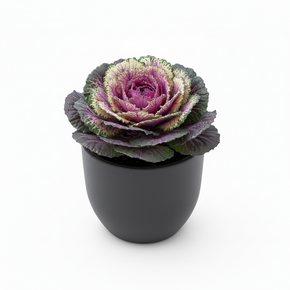
Transform plain winter spaces into a premium display. Ornamental Cabbage delivers rich purple-pink rosettes that look like giant flowers, stays crisp in cool weather, and instantly elevates entrances, patios, and seasonal planters. Easy to maintain, visually dense, and perfect for mass planting or standout statement pots.
Common Name: Ornamental Cabbage / Flowering Kale
Arabic Name: كرنب زينة
Botanical Name: Brassica oleracea var. acephala
Plant Variant: Standard
Plant Color: Multicolor (Purple, Pink, Green, White)
Plant Country: Unknown
Stems: 1
Family: Brassicaceae
Ornamental Cabbage belongs to the Kingdom Plantae, Order Brassicales, and Family Brassicaceae (the mustard family). It is a cultivar of the same species as edible cabbage, broccoli, and kale, specifically categorized under the Acephala group, which translates to "without a head," referring to its open rosette growth habit.
The wild ancestors of Brassica oleracea are native to the coastal regions of southern and western Europe and the Mediterranean. Ornamental varieties were specifically developed through selective breeding in Japan and have since become popular global cool-season decorative plants.
This plant features broad, wavy, or frilled leaves that form a dense, low-growing rosette. While the outer leaves are typically a muted green, the inner "heart" of the plant develops vibrant shades of purple, rose, pink, or creamy white as temperatures drop. Unlike culinary cabbage, it does not form a tight central head.
Typically reaches a height of 12 to 18 inches (30–45 cm) and spreads approximately 12 to 18 inches wide. Its compact, mounding habit makes it ideal for borders and medium-sized containers.
Thrives best in full sun, requiring at least 6 hours of direct sunlight per day to maintain its compact shape and intense coloration. It can tolerate partial shade, but may become "leggy" or lose its vibrant center colors.
Requires consistent moisture. The soil should be kept damp but not waterlogged. It is important to water at the base of the plant to avoid trapping water in the center of the rosette, which can lead to rot.
Prefers rich, well-draining soil with a slightly acidic to neutral pH (6.0 to 7.5). When potting, use a high-quality potting mix that retains some moisture while allowing excess water to drain away freely.
Highly cold-hardy and thrives in temperatures between 40°F and 60°F (5°C to 15°C). The vibrant colors only develop fully after several frosts or consistent night temperatures below 50°F (10°C). It does not tolerate high heat or humidity well, which causes the plant to bolt or fade.
A balanced, slow-release fertilizer applied at the time of planting is usually sufficient. Avoid over-fertilizing with high nitrogen late in the season, as this can interfere with the development of its ornamental colors.
Low maintenance. Care involves removing yellowing or damaged lower leaves to keep the plant looking tidy and preventing pests. It is a seasonal annual that is usually replaced once the weather becomes too hot in the spring.
Generally grown as an annual. It is propagated by seeds, usually sown in mid-to-late summer so they reach maturity just as the cool weather arrives. Growth is moderate, reaching full size within a few months.
Susceptible to common brassica pests such as cabbage loopers, aphids, and slugs. In poorly drained soil or if water sits in the crown, it can suffer from root or stem rot.
Primarily used for seasonal landscape decoration, winter containers, and mass bedding. While technically edible, the leaves are much tougher and more bitter than culinary cabbage, making it best suited for visual appeal.
Considered safe and non-toxic for humans. While generally safe for pets, ingesting large amounts of brassica plants can cause minor digestive upset or gas in cats and dogs, but it is not considered poisonous.
Transform plain winter spaces into a premium display. Ornamental Cabbage delivers rich purple-pink rosettes that look like giant flowers, stays crisp in cool weather, and instantly elevates entrances, patios, and seasonal planters. Easy to maintain, visually dense, and perfect for mass planting or standout statement pots.
Common Name: Ornamental Cabbage / Flowering Kale
Arabic Name: كرنب زينة
Botanical Name: Brassica oleracea var. acephala
Plant Variant: Standard
Plant Color: Multicolor (Purple, Pink, Green, White)
Plant Country: Unknown
Stems: 1
Family: Brassicaceae
Ornamental Cabbage belongs to the Kingdom Plantae, Order Brassicales, and Family Brassicaceae (the mustard family). It is a cultivar of the same species as edible cabbage, broccoli, and kale, specifically categorized under the Acephala group, which translates to "without a head," referring to its open rosette growth habit.
The wild ancestors of Brassica oleracea are native to the coastal regions of southern and western Europe and the Mediterranean. Ornamental varieties were specifically developed through selective breeding in Japan and have since become popular global cool-season decorative plants.
This plant features broad, wavy, or frilled leaves that form a dense, low-growing rosette. While the outer leaves are typically a muted green, the inner "heart" of the plant develops vibrant shades of purple, rose, pink, or creamy white as temperatures drop. Unlike culinary cabbage, it does not form a tight central head.
Typically reaches a height of 12 to 18 inches (30–45 cm) and spreads approximately 12 to 18 inches wide. Its compact, mounding habit makes it ideal for borders and medium-sized containers.
Thrives best in full sun, requiring at least 6 hours of direct sunlight per day to maintain its compact shape and intense coloration. It can tolerate partial shade, but may become "leggy" or lose its vibrant center colors.
Requires consistent moisture. The soil should be kept damp but not waterlogged. It is important to water at the base of the plant to avoid trapping water in the center of the rosette, which can lead to rot.
Prefers rich, well-draining soil with a slightly acidic to neutral pH (6.0 to 7.5). When potting, use a high-quality potting mix that retains some moisture while allowing excess water to drain away freely.
Highly cold-hardy and thrives in temperatures between 40°F and 60°F (5°C to 15°C). The vibrant colors only develop fully after several frosts or consistent night temperatures below 50°F (10°C). It does not tolerate high heat or humidity well, which causes the plant to bolt or fade.
A balanced, slow-release fertilizer applied at the time of planting is usually sufficient. Avoid over-fertilizing with high nitrogen late in the season, as this can interfere with the development of its ornamental colors.
Low maintenance. Care involves removing yellowing or damaged lower leaves to keep the plant looking tidy and preventing pests. It is a seasonal annual that is usually replaced once the weather becomes too hot in the spring.
Generally grown as an annual. It is propagated by seeds, usually sown in mid-to-late summer so they reach maturity just as the cool weather arrives. Growth is moderate, reaching full size within a few months.
Susceptible to common brassica pests such as cabbage loopers, aphids, and slugs. In poorly drained soil or if water sits in the crown, it can suffer from root or stem rot.
Primarily used for seasonal landscape decoration, winter containers, and mass bedding. While technically edible, the leaves are much tougher and more bitter than culinary cabbage, making it best suited for visual appeal.
Considered safe and non-toxic for humans. While generally safe for pets, ingesting large amounts of brassica plants can cause minor digestive upset or gas in cats and dogs, but it is not considered poisonous.




Take 20% off your first order
Enter the code below at checkout to get 20% off your first order