


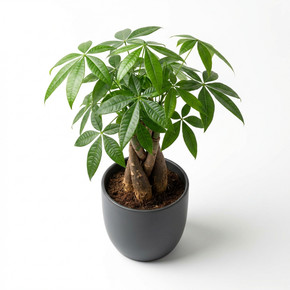


Bring a clean, modern tropical look into your space with the Money Tree (Pachira aquatica). Its distinctive hand-shaped leaves and sturdy trunk make it a statement plant for reception areas, living rooms, and meeting spaces. With bright, indirect light and sensible watering, it stays attractive year-round—an easy, giftable upgrade for any interior.
Common Name: Money Tree
Botanical Name: Pachira aquatica
Former Name: Bombax aquaticum
Plant Type: Indoor houseplant (tropical tree)
Plant Code / SKU: PLT-0424
Alternative Names:
Malabar chestnut
Provision tree
Guiana chestnut
French peanut
Order: Malvales
Family: Malvaceae
Genus: Pachira
Species: P. aquatica
Native to swampy areas of Central and South America, from southern Mexico through Central America to northern Brazil and Ecuador. Widely cultivated as an ornamental indoor plant worldwide.
Leaves: Palmately compound with 5–7 glossy, lanceolate leaflets, each up to 30 cm long
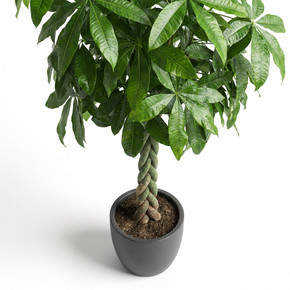
Trunk: Smooth, light brown to green when young; often braided in cultivation
Flowers: Nocturnal, showy creamy-white to pale yellow, 10–15 cm in diameter with prominent stamens
Fruits/Seeds: Large woody pods containing edible nuts
Height: Up to 18 m in the wild; 1.2–2.4 m as a potted houseplant
Spread: 0.6–1.2 m indoors
Growth Rate: Moderate to fast under optimal conditions
Thrives in bright, indirect light; tolerates partial shade. Avoid harsh midday sun to prevent leaf scorch. Can adapt to lower light but growth slows.
Keep soil evenly moist but not waterlogged. Allow the top 2.5 cm of soil to dry between waterings. Reduce frequency in winter months.
Use a well-draining potting mix rich in organic matter (peat, pine bark) with perlite or sand. Ideal pH 6.0–7.5. Repot every 2–3 years or when root-bound.
Optimal temperature range 18–24 °C (65–75 °F); do not expose below 10 °C (50 °F). Prefers moderate to high humidity (50 %+); occasional misting or humidifier recommended.
Feed with a balanced liquid fertilizer (e.g., 10-10-10 or 20-20-20) at half strength every 4–6 weeks during spring and summer. Suspend feeding in fall and winter.
Low to moderate. Prune to maintain shape and remove yellowing leaves. Gently clean foliage to remove dust. Support braided trunks as needed.
Propagation by seed: Sow fresh seeds in warm, moist medium; germination in 7–14 days.
Propagation by stem cuttings: Take semi-hardwood cuttings, root in water or a moist, well-draining mix with rooting hormone.
Overwatering can cause root rot and yellowing leaves. Underwatering leads to leaf drop. Pests include spider mites, mealybugs, and scale. Brown leaf tips often indicate low humidity or fluoride sensitivity.
Popular ornamental indoor plant and feng shui “good luck” symbol. Seeds are edible (taste like peanuts) when roasted. Known to improve indoor air quality by filtering toxins.
Generally non-toxic to humans and pets. Nuts are edible for humans; ingestion of large quantities by pets may cause mild digestive upset.
Bring a clean, modern tropical look into your space with the Money Tree (Pachira aquatica). Its distinctive hand-shaped leaves and sturdy trunk make it a statement plant for reception areas, living rooms, and meeting spaces. With bright, indirect light and sensible watering, it stays attractive year-round—an easy, giftable upgrade for any interior.
Common Name: Money Tree
Botanical Name: Pachira aquatica
Former Name: Bombax aquaticum
Plant Type: Indoor houseplant (tropical tree)
Plant Code / SKU: PLT-0424
Alternative Names:
Malabar chestnut
Provision tree
Guiana chestnut
French peanut
Order: Malvales
Family: Malvaceae
Genus: Pachira
Species: P. aquatica
Native to swampy areas of Central and South America, from southern Mexico through Central America to northern Brazil and Ecuador. Widely cultivated as an ornamental indoor plant worldwide.
Leaves: Palmately compound with 5–7 glossy, lanceolate leaflets, each up to 30 cm long
Trunk: Smooth, light brown to green when young; often braided in cultivation
Flowers: Nocturnal, showy creamy-white to pale yellow, 10–15 cm in diameter with prominent stamens
Fruits/Seeds: Large woody pods containing edible nuts
Height: Up to 18 m in the wild; 1.2–2.4 m as a potted houseplant
Spread: 0.6–1.2 m indoors
Growth Rate: Moderate to fast under optimal conditions
Thrives in bright, indirect light; tolerates partial shade. Avoid harsh midday sun to prevent leaf scorch. Can adapt to lower light but growth slows.
Keep soil evenly moist but not waterlogged. Allow the top 2.5 cm of soil to dry between waterings. Reduce frequency in winter months.
Use a well-draining potting mix rich in organic matter (peat, pine bark) with perlite or sand. Ideal pH 6.0–7.5. Repot every 2–3 years or when root-bound.
Optimal temperature range 18–24 °C (65–75 °F); do not expose below 10 °C (50 °F). Prefers moderate to high humidity (50 %+); occasional misting or humidifier recommended.
Feed with a balanced liquid fertilizer (e.g., 10-10-10 or 20-20-20) at half strength every 4–6 weeks during spring and summer. Suspend feeding in fall and winter.
Low to moderate. Prune to maintain shape and remove yellowing leaves. Gently clean foliage to remove dust. Support braided trunks as needed.
Propagation by seed: Sow fresh seeds in warm, moist medium; germination in 7–14 days.
Propagation by stem cuttings: Take semi-hardwood cuttings, root in water or a moist, well-draining mix with rooting hormone.
Overwatering can cause root rot and yellowing leaves. Underwatering leads to leaf drop. Pests include spider mites, mealybugs, and scale. Brown leaf tips often indicate low humidity or fluoride sensitivity.
Popular ornamental indoor plant and feng shui “good luck” symbol. Seeds are edible (taste like peanuts) when roasted. Known to improve indoor air quality by filtering toxins.
Generally non-toxic to humans and pets. Nuts are edible for humans; ingestion of large quantities by pets may cause mild digestive upset.


Take 20% off your first order
Enter the code below at checkout to get 20% off your first order