


Purslane
Embrace the power of nature with Purslane, the incredible edible succulent! Not just a plant, it's a superfood for your garden and your plate. With its charming, fleshy leaves and resilient nature, Purslane is ridiculously easy to care for—it thrives on sunshine and neglect! Perfect for adding a lush, green carpet to sunny spots or spilling beautifully from a hanging basket. Harvest its tangy, nutrient-rich leaves to elevate your salads with a boost of Omega-3s. Buy now and grow your own health!
1. Basic Identification
Common Name: Purslane / Berbeen / بربين
Botanical Name: Portulaca oleracea
Variant: Standard
Plant Color: Green
Country of Origin: Netherlands
2. Taxonomy & Classification
Kingdom: Plantae
Order: Caryophyllales
Family: Portulacaceae
Genus: Portulaca
Species: Portulaca oleracea
3. Origin & Distribution
Purslane has a widespread distribution throughout the Old World, extending from North Africa through the Middle East and the Indian subcontinent to Australasia. It has naturalized in almost all parts of the world, thriving in various climates as a hardy, resilient succulent.
4. Visual Characteristics
This plant features smooth, reddish-green prostrate stems that grow along the ground. The leaves are thick, fleshy, and succulent, often clustered at stem joints and ends. It produces tiny, five-petaled yellow flowers that typically open only on sunny mornings.
5. Size & Dimensions
Purslane is a low-growing plant, typically reaching a height of 10 to 30 cm. However, it has a significant spreading habit, with individual plants easily reaching a width of 30 to 60 cm, making it an excellent groundcover or trailing plant for baskets.
6. Light Requirements
This plant thrives in full sun. It requires at least 6 to 8 hours of direct sunlight daily to maintain its compact growth and produce flowers. While it can tolerate partial shade, it may become leggy and produce fewer blooms.
7. Watering Needs
Purslane is highly drought-tolerant due to its succulent leaves. It should be watered thoroughly only when the soil has dried out completely. Overwatering or keeping the soil constantly soggy is the most common cause of plant failure.
8. Soil & Potting
It prefers well-draining soil, such as a sandy or gravelly potting mix. It is not picky about soil pH and can thrive even in poor-quality soil, provided it does not retain excess moisture around the roots.
9. Temperature & Humidity
As a heat-loving plant, Purslane performs best in warm temperatures between 20°C and 35°C. It is not frost-tolerant and will die back in freezing conditions. It handles low to high humidity levels well, as long as there is adequate air circulation.
10. Fertilization
Purslane is a light feeder. If grown for edible leaves, a balanced, water-soluble fertilizer can be applied at half-strength once a month during the growing season. In most garden soils, no additional fertilization is required.
11. Maintenance & Care Level
The care level is very low. It is often referred to as a "plant it and forget it" species. Minimal pruning may be required to keep the plant within its desired boundaries if it begins to spread too aggressively.
12. Growth & Propagation
Growth is rapid, especially in warm weather. Purslane propagates easily through seeds or stem cuttings. Stems that touch the ground often develop roots on their own, allowing the plant to colonize an area quickly.
13. Common Problems
The primary issue for Purslane is root rot caused by overwatering. It is generally resistant to most pests, though it may occasionally attract aphids or snails in very damp environments.
14. Benefits & Uses
Purslane is highly valued as a superfood, containing high levels of Omega-3 fatty acids, Vitamin C, and Vitamin E. Culturally, it is used in salads, stews, and soups. Ornamentally, it serves as an excellent groundcover, rock garden plant, or trailing succulent for hanging pots.
15. Toxicity & Safety
Purslane is completely safe for human consumption and is a nutrient-dense vegetable. According to provided product data, this plant is classified as pet-safe.
Purslane
Embrace the power of nature with Purslane, the incredible edible succulent! Not just a plant, it's a superfood for your garden and your plate. With its charming, fleshy leaves and resilient nature, Purslane is ridiculously easy to care for—it thrives on sunshine and neglect! Perfect for adding a lush, green carpet to sunny spots or spilling beautifully from a hanging basket. Harvest its tangy, nutrient-rich leaves to elevate your salads with a boost of Omega-3s. Buy now and grow your own health!
1. Basic Identification
Common Name: Purslane / Berbeen / بربين
Botanical Name: Portulaca oleracea
Variant: Standard
Plant Color: Green
Country of Origin: Netherlands
2. Taxonomy & Classification
Kingdom: Plantae
Order: Caryophyllales
Family: Portulacaceae
Genus: Portulaca
Species: Portulaca oleracea
3. Origin & Distribution
Purslane has a widespread distribution throughout the Old World, extending from North Africa through the Middle East and the Indian subcontinent to Australasia. It has naturalized in almost all parts of the world, thriving in various climates as a hardy, resilient succulent.
4. Visual Characteristics
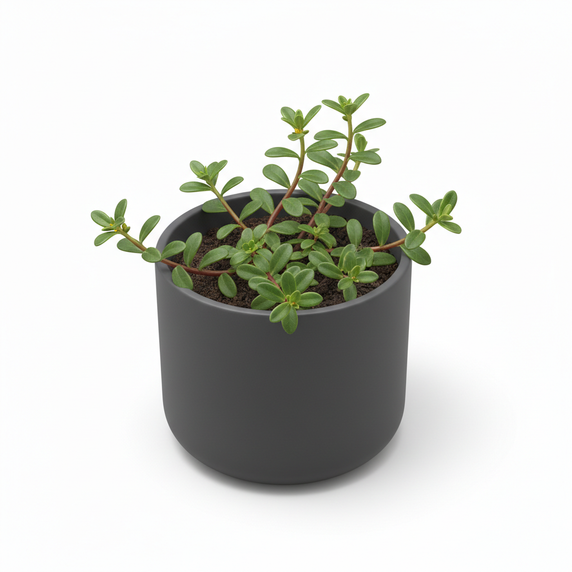
This plant features smooth, reddish-green prostrate stems that grow along the ground. The leaves are thick, fleshy, and succulent, often clustered at stem joints and ends. It produces tiny, five-petaled yellow flowers that typically open only on sunny mornings.
5. Size & Dimensions
Purslane is a low-growing plant, typically reaching a height of 10 to 30 cm. However, it has a significant spreading habit, with individual plants easily reaching a width of 30 to 60 cm, making it an excellent groundcover or trailing plant for baskets.
6. Light Requirements
This plant thrives in full sun. It requires at least 6 to 8 hours of direct sunlight daily to maintain its compact growth and produce flowers. While it can tolerate partial shade, it may become leggy and produce fewer blooms.
7. Watering Needs
Purslane is highly drought-tolerant due to its succulent leaves. It should be watered thoroughly only when the soil has dried out completely. Overwatering or keeping the soil constantly soggy is the most common cause of plant failure.
8. Soil & Potting
It prefers well-draining soil, such as a sandy or gravelly potting mix. It is not picky about soil pH and can thrive even in poor-quality soil, provided it does not retain excess moisture around the roots.
9. Temperature & Humidity
As a heat-loving plant, Purslane performs best in warm temperatures between 20°C and 35°C. It is not frost-tolerant and will die back in freezing conditions. It handles low to high humidity levels well, as long as there is adequate air circulation.
10. Fertilization
Purslane is a light feeder. If grown for edible leaves, a balanced, water-soluble fertilizer can be applied at half-strength once a month during the growing season. In most garden soils, no additional fertilization is required.
11. Maintenance & Care Level
The care level is very low. It is often referred to as a "plant it and forget it" species. Minimal pruning may be required to keep the plant within its desired boundaries if it begins to spread too aggressively.
12. Growth & Propagation
Growth is rapid, especially in warm weather. Purslane propagates easily through seeds or stem cuttings. Stems that touch the ground often develop roots on their own, allowing the plant to colonize an area quickly.
13. Common Problems
The primary issue for Purslane is root rot caused by overwatering. It is generally resistant to most pests, though it may occasionally attract aphids or snails in very damp environments.
14. Benefits & Uses
Purslane is highly valued as a superfood, containing high levels of Omega-3 fatty acids, Vitamin C, and Vitamin E. Culturally, it is used in salads, stews, and soups. Ornamentally, it serves as an excellent groundcover, rock garden plant, or trailing succulent for hanging pots.
15. Toxicity & Safety
Purslane is completely safe for human consumption and is a nutrient-dense vegetable. According to provided product data, this plant is classified as pet-safe.