

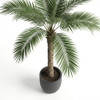





Create an instant resort feel with the Pygmy Date Palm. Its fine, arching fronds add height, softness, and luxury to any corner—ideal for reception areas, living rooms, and covered patios. Easy to maintain with bright filtered light and regular watering, it’s a statement plant that stays stylish year-round in a container.
Common Name: Pygmy Date Palm, Miniature Date Palm
Botanical Name: Phoenix roebelenii
Arabic Name: نخيل روبيليني
Family: Arecaceae
Stems: 1
Color: Natural
The Pygmy Date Palm belongs to the Genus Phoenix within the Arecaceae family. It is a monocotyledonous flowering plant known for its ornamental value and belongs to the same genus as the edible date palm (Phoenix dactylifera), though it remains much smaller in stature.
Native to Southeast Asia, specifically southwestern China (Yunnan Province), northern Laos, and Vietnam. It typically grows in the wild along the banks of the Mekong River, thriving in tropical and subtropical riverine environments.
It is a small to medium-sized, slow-growing palm featuring a slender trunk topped with a dense crown of fine, feathery (pinnate) fronds. The fronds are deep green, arching gracefully, and are approximately 60–120 cm long. The trunk is often covered with the diamond-shaped bases of old leaves, providing a distinct texture.
In a container, the Pygmy Date Palm typically reaches heights of 1.5 to 2 meters (5 to 6.5 feet). When planted in the ground in ideal conditions, it can eventually reach up to 3 meters (10 feet). The frond spread usually spans between 1 and 1.5 meters.
This palm thrives in bright, indirect light or filtered sunlight. While it can tolerate some direct morning sun, harsh afternoon sun can scorch the delicate leaflets. In low-light indoor conditions, growth will slow significantly.
Keep the soil consistently moist but never waterlogged. Water the plant when the top 2–3 cm of soil feels dry to the touch. It is moderately drought-tolerant once established but performs best with a regular watering schedule. Avoid letting the root ball dry out completely.
Requires a well-draining potting medium. A mix of peat moss, leaf mold, and perlite or coarse sand is ideal to ensure drainage while retaining necessary moisture. It prefers slightly acidic to neutral soil pH.
Prefers warm temperatures between 16°C and 27°C. It is sensitive to frost and should be protected or moved indoors if temperatures drop below 10°C. It appreciates moderate to high humidity; misting the fronds or using a pebble tray is beneficial in dry indoor environments.
Feed with a specialized palm fertilizer that includes micronutrients like magnesium, manganese, and iron twice or thrice during the growing season (spring and summer). Avoid over-fertilizing in winter when growth slows.
Maintenance is considered easy to moderate. Care involves pruning dead or yellowing lower fronds to maintain a clean appearance. Caution is required when handling the plant due to sharp, needle-like spines located at the base of the leaf stalks.
The Pygmy Date Palm has a slow growth rate. Propagation is primarily achieved through seeds, which can take several months to germinate. It occasionally produces suckers at the base which can be used for propagation, though this is less common.
Susceptible to spider mites, scale insects, and mealybugs, especially in dry indoor air. Overwatering can lead to root rot. Nutrient deficiencies often manifest as yellow spotting or browning tips on the fronds.
Highly valued as an air-purifying plant, it is effective at removing indoor toxins such as formaldehyde and xylene. Its compact size and elegant appearance make it a favorite for interior design, patios, and tropical landscaping.
The plant is generally considered non-toxic to humans if ingested. However, it is classified as not pet-safe primarily due to the sharp, stiff spines at the base of the fronds which can cause physical injury or skin irritation to curious animals and humans alike.
Create an instant resort feel with the Pygmy Date Palm. Its fine, arching fronds add height, softness, and luxury to any corner—ideal for reception areas, living rooms, and covered patios. Easy to maintain with bright filtered light and regular watering, it’s a statement plant that stays stylish year-round in a container.
Common Name: Pygmy Date Palm, Miniature Date Palm
Botanical Name: Phoenix roebelenii
Arabic Name: نخيل روبيليني
Family: Arecaceae
Stems: 1
Color: Natural
The Pygmy Date Palm belongs to the Genus Phoenix within the Arecaceae family. It is a monocotyledonous flowering plant known for its ornamental value and belongs to the same genus as the edible date palm (Phoenix dactylifera), though it remains much smaller in stature.
Native to Southeast Asia, specifically southwestern China (Yunnan Province), northern Laos, and Vietnam. It typically grows in the wild along the banks of the Mekong River, thriving in tropical and subtropical riverine environments.
It is a small to medium-sized, slow-growing palm featuring a slender trunk topped with a dense crown of fine, feathery (pinnate) fronds. The fronds are deep green, arching gracefully, and are approximately 60–120 cm long. The trunk is often covered with the diamond-shaped bases of old leaves, providing a distinct texture.
In a container, the Pygmy Date Palm typically reaches heights of 1.5 to 2 meters (5 to 6.5 feet). When planted in the ground in ideal conditions, it can eventually reach up to 3 meters (10 feet). The frond spread usually spans between 1 and 1.5 meters.
This palm thrives in bright, indirect light or filtered sunlight. While it can tolerate some direct morning sun, harsh afternoon sun can scorch the delicate leaflets. In low-light indoor conditions, growth will slow significantly.
Keep the soil consistently moist but never waterlogged. Water the plant when the top 2–3 cm of soil feels dry to the touch. It is moderately drought-tolerant once established but performs best with a regular watering schedule. Avoid letting the root ball dry out completely.
Requires a well-draining potting medium. A mix of peat moss, leaf mold, and perlite or coarse sand is ideal to ensure drainage while retaining necessary moisture. It prefers slightly acidic to neutral soil pH.
Prefers warm temperatures between 16°C and 27°C. It is sensitive to frost and should be protected or moved indoors if temperatures drop below 10°C. It appreciates moderate to high humidity; misting the fronds or using a pebble tray is beneficial in dry indoor environments.
Feed with a specialized palm fertilizer that includes micronutrients like magnesium, manganese, and iron twice or thrice during the growing season (spring and summer). Avoid over-fertilizing in winter when growth slows.
Maintenance is considered easy to moderate. Care involves pruning dead or yellowing lower fronds to maintain a clean appearance. Caution is required when handling the plant due to sharp, needle-like spines located at the base of the leaf stalks.
The Pygmy Date Palm has a slow growth rate. Propagation is primarily achieved through seeds, which can take several months to germinate. It occasionally produces suckers at the base which can be used for propagation, though this is less common.
Susceptible to spider mites, scale insects, and mealybugs, especially in dry indoor air. Overwatering can lead to root rot. Nutrient deficiencies often manifest as yellow spotting or browning tips on the fronds.
Highly valued as an air-purifying plant, it is effective at removing indoor toxins such as formaldehyde and xylene. Its compact size and elegant appearance make it a favorite for interior design, patios, and tropical landscaping.
The plant is generally considered non-toxic to humans if ingested. However, it is classified as not pet-safe primarily due to the sharp, stiff spines at the base of the fronds which can cause physical injury or skin irritation to curious animals and humans alike.



Take 20% off your first order
Enter the code below at checkout to get 20% off your first order