


Robinia pseudoacacia
Transform your landscape in record time with the Black Locust tree! Need a tough, beautiful tree that asks for almost nothing in return? The Robinia pseudoacacia is your answer. It skyrockets in growth, providing lush shade faster than you can imagine, and thrives where other trees fail. In spring, it puts on a spectacular show of cascading, honey-scented flowers that will be the envy of your neighborhood. Plus, it’s an eco-warrior—improving your soil for free! Plant a Black Locust for a lifetime of beauty and resilience.
1. Basic Identification
Common Name: Black Locust
Botanical Name: Robinia pseudoacacia
Former Name: Not available
Plant Type: Deciduous Tree
Plant Code / SKU: PLT-1818
Alternative Names:
False Acacia
Yellow Locust
روبينيا (Arabic)
2. Taxonomy & Classification
Order: Fabales
Family: Fabaceae
Genus: Robinia
3. Origin & Distribution
Origin: Native to the southeastern United States, particularly the Appalachian Mountains. It has been widely introduced and naturalized in other regions.
Distribution: Found across temperate North America, Europe, Southern Africa, and parts of Asia. It is considered invasive in some areas due to its rapid growth and adaptability.
4. Visual Characteristics
Leaves: Pinnately compound leaves with 7-21 oval, blue-green leaflets. Leaves turn a pale yellow in the fall.
Flowers: Fragrant, white, pea-like flowers that hang in dense, drooping clusters (racemes) in late spring.
Stem/Trunk: Has a straight trunk with dark, deeply furrowed, grayish-brown bark. Young stems and branches often have sharp thorns.
Fruit/Seeds: Produces flat, smooth, brown-to-black seed pods (legumes) that are 5-10 cm long and persist through winter.
5. Size & Dimensions
Mature Height: Typically 12 to 25 meters (40-80 feet).
Mature Spread: 6 to 15 meters (20-50 feet).
Growth Rate: Fast, often growing more than 1.2 meters (4 feet) per year.
6. Light Requirements
Requires full sun, needing at least 6-8 hours of direct sunlight daily for optimal growth and flowering. It is intolerant of shade.
7. Watering Needs
Highly drought-tolerant once established. Water regularly during the first growing season to establish a deep root system. Mature trees rarely require supplemental watering.
8. Soil & Potting
Soil Type: Extremely adaptable and thrives in poor, compacted, or dry soils. It tolerates a wide range of soil types including clay, loam, and sand, but prefers well-drained conditions.
Soil pH: Prefers a pH range of 4.6 to 8.2.
Special Notes: As a legume, it fixes nitrogen in the soil, improving soil fertility for itself and nearby plants.
9. Temperature & Humidity
Hardiness Zones: USDA Hardiness Zones 4 through 9.
Temperature Tolerance: Very hardy and can withstand a wide range of temperatures, including significant heat and cold.
Humidity: Tolerant of various humidity levels.
10. Fertilization
Generally does not require any fertilizer. Its ability to fix its own nitrogen means it can thrive in nutrient-poor soils. Fertilizing is typically unnecessary and not recommended.
11. Maintenance & Care Level
Low maintenance. It is a resilient and self-sufficient tree. Pruning may be needed to remove dead or damaged wood and to manage its shape. It has a tendency to produce root suckers, which may need to be removed to prevent spreading.
12. Growth & Propagation
Propagation is easily achieved through seeds, which require scarification (nicking the seed coat) or hot water treatment to germinate. It also readily spreads and can be propagated via root suckers and cuttings.
13. Common Problems
Pests: Susceptible to the locust borer, which can cause significant damage and weaken the tree. Also may be affected by locust leaf miners and aphids.
Diseases: Can suffer from heart rot, especially in older or damaged trees. Canker and powdery mildew can also occur.
Other Issues: Can be invasive in some regions. The wood is brittle and may break in high winds or ice storms.
14. Benefits & Uses
Ornamental: A popular landscape tree for its rapid growth, attractive shape, and beautiful, fragrant flowers.
Environmental: Excellent for erosion control, land reclamation, and windbreaks. Improves soil quality through nitrogen fixation.
Wood: The wood is extremely hard, durable, and rot-resistant, making it ideal for fence posts, furniture, flooring, and firewood.
Wildlife: The flowers are a major nectar source for honeybees, producing a highly sought-after, light-colored honey.
15. Toxicity & Safety
Toxicity: The leaves, seeds, bark, and roots are toxic to humans, pets, and livestock (especially horses) if ingested. The flowers are the only part considered non-toxic and are sometimes used in cooking.
Safety Note: The branches are armed with sharp thorns, particularly on young growth. Use caution when handling or planting near high-traffic areas.
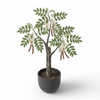
Robinia pseudoacacia

Transform your landscape in record time with the Black Locust tree! Need a tough, beautiful tree that asks for almost nothing in return? The Robinia pseudoacacia is your answer. It skyrockets in growth, providing lush shade faster than you can imagine, and thrives where other trees fail. In spring, it puts on a spectacular show of cascading, honey-scented flowers that will be the envy of your neighborhood. Plus, it’s an eco-warrior—improving your soil for free! Plant a Black Locust for a lifetime of beauty and resilience.
1. Basic Identification
Common Name: Black Locust
Botanical Name: Robinia pseudoacacia
Former Name: Not available
Plant Type: Deciduous Tree
Plant Code / SKU: PLT-1818
Alternative Names:
False Acacia
Yellow Locust
روبينيا (Arabic)
2. Taxonomy & Classification
Order: Fabales
Family: Fabaceae
Genus: Robinia
3. Origin & Distribution
Origin: Native to the southeastern United States, particularly the Appalachian Mountains. It has been widely introduced and naturalized in other regions.
Distribution: Found across temperate North America, Europe, Southern Africa, and parts of Asia. It is considered invasive in some areas due to its rapid growth and adaptability.
4. Visual Characteristics
Leaves: Pinnately compound leaves with 7-21 oval, blue-green leaflets. Leaves turn a pale yellow in the fall.
Flowers: Fragrant, white, pea-like flowers that hang in dense, drooping clusters (racemes) in late spring.
Stem/Trunk: Has a straight trunk with dark, deeply furrowed, grayish-brown bark. Young stems and branches often have sharp thorns.
Fruit/Seeds: Produces flat, smooth, brown-to-black seed pods (legumes) that are 5-10 cm long and persist through winter.
5. Size & Dimensions
Mature Height: Typically 12 to 25 meters (40-80 feet).
Mature Spread: 6 to 15 meters (20-50 feet).
Growth Rate: Fast, often growing more than 1.2 meters (4 feet) per year.
6. Light Requirements
Requires full sun, needing at least 6-8 hours of direct sunlight daily for optimal growth and flowering. It is intolerant of shade.
7. Watering Needs
Highly drought-tolerant once established. Water regularly during the first growing season to establish a deep root system. Mature trees rarely require supplemental watering.
8. Soil & Potting
Soil Type: Extremely adaptable and thrives in poor, compacted, or dry soils. It tolerates a wide range of soil types including clay, loam, and sand, but prefers well-drained conditions.
Soil pH: Prefers a pH range of 4.6 to 8.2.
Special Notes: As a legume, it fixes nitrogen in the soil, improving soil fertility for itself and nearby plants.
9. Temperature & Humidity
Hardiness Zones: USDA Hardiness Zones 4 through 9.
Temperature Tolerance: Very hardy and can withstand a wide range of temperatures, including significant heat and cold.
Humidity: Tolerant of various humidity levels.
10. Fertilization
Generally does not require any fertilizer. Its ability to fix its own nitrogen means it can thrive in nutrient-poor soils. Fertilizing is typically unnecessary and not recommended.
11. Maintenance & Care Level
Low maintenance. It is a resilient and self-sufficient tree. Pruning may be needed to remove dead or damaged wood and to manage its shape. It has a tendency to produce root suckers, which may need to be removed to prevent spreading.
12. Growth & Propagation
Propagation is easily achieved through seeds, which require scarification (nicking the seed coat) or hot water treatment to germinate. It also readily spreads and can be propagated via root suckers and cuttings.
13. Common Problems
Pests: Susceptible to the locust borer, which can cause significant damage and weaken the tree. Also may be affected by locust leaf miners and aphids.
Diseases: Can suffer from heart rot, especially in older or damaged trees. Canker and powdery mildew can also occur.
Other Issues: Can be invasive in some regions. The wood is brittle and may break in high winds or ice storms.
14. Benefits & Uses
Ornamental: A popular landscape tree for its rapid growth, attractive shape, and beautiful, fragrant flowers.
Environmental: Excellent for erosion control, land reclamation, and windbreaks. Improves soil quality through nitrogen fixation.
Wood: The wood is extremely hard, durable, and rot-resistant, making it ideal for fence posts, furniture, flooring, and firewood.
Wildlife: The flowers are a major nectar source for honeybees, producing a highly sought-after, light-colored honey.
15. Toxicity & Safety
Toxicity: The leaves, seeds, bark, and roots are toxic to humans, pets, and livestock (especially horses) if ingested. The flowers are the only part considered non-toxic and are sometimes used in cooking.
Safety Note: The branches are armed with sharp thorns, particularly on young growth. Use caution when handling or planting near high-traffic areas.