





Bring instant tropical impact to any room with Guzmania lingulata. Its bold red star-shaped bracts stay vibrant for weeks, turning desks, shelves, and reception counters into living décor. With bright indirect light and simple cup-watering, it’s an easy-care showpiece that looks premium and gift-ready all year round.
Common Name: Scarlet Star, غوزمانيا
Botanical Name: Guzmania lingulata
Variety: Standard
Plant Color: Multicolor
Plant Country: Unknown
Arabic Name: غوزمانيا
Stems: 11
Family: Bromeliaceae
Air-Purifying: Yes
Care Ease: Yes
Hardiness: No
Best Sellers: Yes
Desk Plants: Yes
Flowering Indoor: Yes
Hanging Plants: No
Low Maintenance: Yes
Medium Plants: Yes
New Arrivals: No
Pet-Safe: No
Human-Safe: No
Rare / Collector: No
Guzmania lingulata belongs to the kingdom Plantae, order Poales, and the family Bromeliaceae. It is a member of the subfamily Tillandsioideae and the genus Guzmania, which contains over 120 species of epiphytic bromeliads.
Native to the tropical rainforests of Central America, the West Indies, and northern and western South America. In its natural environment, it thrives as an epiphyte, growing on tree branches where it absorbs moisture and nutrients from the air and debris.
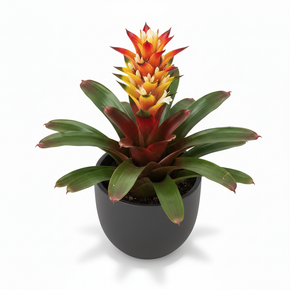
This plant features a basal rosette of smooth, glossy green, strap-like leaves. The centerpiece is a stunning floral spike composed of brilliantly colored bracts—typically red or deep orange—arranged in a star shape. The true flowers are small, tubular, and white, hidden within the center of the colorful bracts.
The Scarlet Star usually reaches a height and spread of approximately 12 to 20 inches (30 to 50 cm), making it an ideal size for indoor surfaces and medium-sized containers.
Thrives in bright, indirect light. It should be shielded from direct, harsh sunlight, which can scorch the foliage and cause the bracts to fade. It can tolerate lower light levels, though this may result in slower growth and less vibrant color.
Water should be directed into the central "cup" or tank of the plant. Keep this reservoir about one-quarter full of clean water (preferably distilled or rainwater) and flush it monthly to prevent bacterial growth. The soil should be kept barely moist but never saturated.
Requires a very well-draining, airy potting medium. A commercial bromeliad or orchid mix containing peat, perlite, and bark is ideal to provide the necessary aeration for its roots.
Prefers warm temperatures between 65°F and 80°F (18°C–27°C). It requires high humidity to mimic its tropical home; misting the leaves or placing the pot on a tray of wet pebbles is highly beneficial in dry indoor environments.
Apply a balanced, water-soluble fertilizer diluted to 25% strength once a month during the spring and summer. Fertilizer can be applied to the soil or misted onto the leaves, but avoid adding concentrated fertilizer directly into the central cup.
Maintenance is low. Once the central flower bract eventually dies (after several months), it should be cut back at the base. The parent plant will eventually die back after blooming, but it will produce "pups" or offsets to continue the cycle.
Propagated through offsets (pups) that grow at the base of the mother plant. These can be carefully removed and repotted once they are about 3 to 5 inches tall or have developed their own root system.
The most common issue is root rot caused by overwatering the soil. Salt buildup in the central cup from tap water can cause brown leaf tips. It may occasionally be susceptible to scale or mealybugs if humidity is consistently too low.
An excellent choice for air purification, as bromeliads are known to remove VOCs like formaldehyde from the air. It is widely used in interior design for homes, offices, and hotels due to its long-lasting, vibrant color.
Guzmania lingulata is considered non-toxic to cats, dogs, and horses according to the ASPCA. It is generally safe for humans, though the provided data indicates a safety warning, so caution is advised around sensitive individuals or small children.
Bring instant tropical impact to any room with Guzmania lingulata. Its bold red star-shaped bracts stay vibrant for weeks, turning desks, shelves, and reception counters into living décor. With bright indirect light and simple cup-watering, it’s an easy-care showpiece that looks premium and gift-ready all year round.
Common Name: Scarlet Star, غوزمانيا
Botanical Name: Guzmania lingulata
Variety: Standard
Plant Color: Multicolor
Plant Country: Unknown
Arabic Name: غوزمانيا
Stems: 11
Family: Bromeliaceae
Air-Purifying: Yes
Care Ease: Yes
Hardiness: No
Best Sellers: Yes
Desk Plants: Yes
Flowering Indoor: Yes
Hanging Plants: No
Low Maintenance: Yes
Medium Plants: Yes
New Arrivals: No
Pet-Safe: No
Human-Safe: No
Rare / Collector: No
Guzmania lingulata belongs to the kingdom Plantae, order Poales, and the family Bromeliaceae. It is a member of the subfamily Tillandsioideae and the genus Guzmania, which contains over 120 species of epiphytic bromeliads.
Native to the tropical rainforests of Central America, the West Indies, and northern and western South America. In its natural environment, it thrives as an epiphyte, growing on tree branches where it absorbs moisture and nutrients from the air and debris.
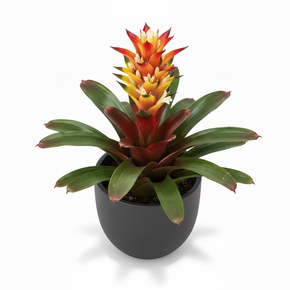
This plant features a basal rosette of smooth, glossy green, strap-like leaves. The centerpiece is a stunning floral spike composed of brilliantly colored bracts—typically red or deep orange—arranged in a star shape. The true flowers are small, tubular, and white, hidden within the center of the colorful bracts.
The Scarlet Star usually reaches a height and spread of approximately 12 to 20 inches (30 to 50 cm), making it an ideal size for indoor surfaces and medium-sized containers.
Thrives in bright, indirect light. It should be shielded from direct, harsh sunlight, which can scorch the foliage and cause the bracts to fade. It can tolerate lower light levels, though this may result in slower growth and less vibrant color.
Water should be directed into the central "cup" or tank of the plant. Keep this reservoir about one-quarter full of clean water (preferably distilled or rainwater) and flush it monthly to prevent bacterial growth. The soil should be kept barely moist but never saturated.
Requires a very well-draining, airy potting medium. A commercial bromeliad or orchid mix containing peat, perlite, and bark is ideal to provide the necessary aeration for its roots.
Prefers warm temperatures between 65°F and 80°F (18°C–27°C). It requires high humidity to mimic its tropical home; misting the leaves or placing the pot on a tray of wet pebbles is highly beneficial in dry indoor environments.
Apply a balanced, water-soluble fertilizer diluted to 25% strength once a month during the spring and summer. Fertilizer can be applied to the soil or misted onto the leaves, but avoid adding concentrated fertilizer directly into the central cup.
Maintenance is low. Once the central flower bract eventually dies (after several months), it should be cut back at the base. The parent plant will eventually die back after blooming, but it will produce "pups" or offsets to continue the cycle.
Propagated through offsets (pups) that grow at the base of the mother plant. These can be carefully removed and repotted once they are about 3 to 5 inches tall or have developed their own root system.
The most common issue is root rot caused by overwatering the soil. Salt buildup in the central cup from tap water can cause brown leaf tips. It may occasionally be susceptible to scale or mealybugs if humidity is consistently too low.
An excellent choice for air purification, as bromeliads are known to remove VOCs like formaldehyde from the air. It is widely used in interior design for homes, offices, and hotels due to its long-lasting, vibrant color.
Guzmania lingulata is considered non-toxic to cats, dogs, and horses according to the ASPCA. It is generally safe for humans, though the provided data indicates a safety warning, so caution is advised around sensitive individuals or small children.



Take 20% off your first order
Enter the code below at checkout to get 20% off your first order