





Transform your garden with the breathtaking elegance of the Weeping Mulberry tree. With its dramatic, ground-sweeping branches and lush green foliage, this tree is a living sculpture that offers year-round beauty. Perfect as a standalone specimen, it creates a magical, shaded sanctuary underneath its canopy. Beyond its stunning looks, the 'Pendula' rewards you with delicious, sweet berries in the summer. It’s a hardy, low-maintenance choice that brings unparalleled grace and a touch of enchantment to any outdoor space. Order now to make this captivating tree the centerpiece of your landscape!
Common Name: Weeping Mulberry
Botanical Name: Morus alba 'Pendula'
Arabic Name: توت متدلي
Plant Variant: Pendula
Plant Color: Natural
Plant Country: Netherlands
Stems: Single trunk (grafted standard)
Family: Moraceae
Kingdom: Plantae
Order: Rosales
Family: Moraceae
Genus: Morus
Species: Morus alba
Cultivar: 'Pendula'
The parent species, Morus alba, is native to Northern China. The 'Pendula' cultivar is an ornamental variety widely cultivated across Europe, North America, and other temperate regions for its unique architectural form.
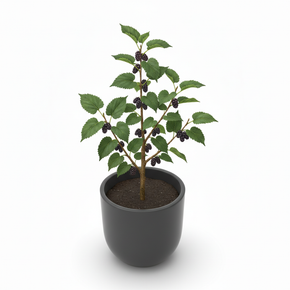
This deciduous tree is characterized by its long, slender branches that grow vertically downward, often reaching the ground to create a tent-like canopy. The leaves are large, heart-shaped, and glossy dark green, sometimes featuring irregular lobes. In autumn, the foliage turns a pleasant yellow. In spring, it produces inconspicuous green catkins followed by edible berries.
The Weeping Mulberry typically grows to a height of 8 to 15 feet (2.4 to 4.5 meters) with a similar spread. Its final height is often determined by the height of the graft on the main trunk.
Performs best in full sun to partial shade. Full sun (at least 6 hours of direct sunlight) ensures the densest foliage and best fruit production.
Requires moderate watering. It prefers consistently moist, well-drained soil. While established trees have some drought tolerance, regular watering during dry spells is recommended to maintain health and fruit quality.
Highly adaptable to various soil types, including clay, loam, and sandy soils. It thrives best in fertile, well-draining soil with a neutral to slightly acidic pH. While typically planted in the ground, young specimens can be kept in large containers.
Very hardy, typically thriving in USDA zones 4 through 8. It can withstand significant freezing temperatures in winter and is well-adapted to typical temperate humidity levels.
Apply a balanced, slow-release fertilizer in early spring as new growth begins. An annual application of compost around the base can also provide necessary nutrients.
Low maintenance. The primary care involves pruning to remove any "upright" shoots that may emerge from the graft, thinning out dead wood, and occasionally trimming the "hemline" of the weeping branches to keep them off the ground.
The Weeping Mulberry has a moderate to fast growth rate. It is primarily propagated through grafting the 'Pendula' scion onto a standard Morus alba rootstock. It can also be propagated via softwood cuttings, though grafted plants are more common in nurseries.
Generally robust, but can occasionally face issues with leaf spot, powdery mildew, or bacterial blight. Watch for pests like scale insects and mealybugs. The falling fruit can be "messy" if planted over driveways or walkways.
Excellent as a focal point or specimen tree in landscape design. Its dense canopy makes it a favorite for creating natural play areas for children. The berries are sweet and edible, rich in vitamins, and attract various bird species.
The ripe berries are safe and edible for humans and pets. However, the milky sap in the stems and leaves, as well as unripe fruit, contains latex which may cause mild skin irritation or stomach upset if ingested in large quantities.
Transform your garden with the breathtaking elegance of the Weeping Mulberry tree. With its dramatic, ground-sweeping branches and lush green foliage, this tree is a living sculpture that offers year-round beauty. Perfect as a standalone specimen, it creates a magical, shaded sanctuary underneath its canopy. Beyond its stunning looks, the 'Pendula' rewards you with delicious, sweet berries in the summer. It’s a hardy, low-maintenance choice that brings unparalleled grace and a touch of enchantment to any outdoor space. Order now to make this captivating tree the centerpiece of your landscape!
Common Name: Weeping Mulberry
Botanical Name: Morus alba 'Pendula'
Arabic Name: توت متدلي
Plant Variant: Pendula
Plant Color: Natural
Plant Country: Netherlands
Stems: Single trunk (grafted standard)
Family: Moraceae
Kingdom: Plantae
Order: Rosales
Family: Moraceae
Genus: Morus
Species: Morus alba
Cultivar: 'Pendula'
The parent species, Morus alba, is native to Northern China. The 'Pendula' cultivar is an ornamental variety widely cultivated across Europe, North America, and other temperate regions for its unique architectural form.
This deciduous tree is characterized by its long, slender branches that grow vertically downward, often reaching the ground to create a tent-like canopy. The leaves are large, heart-shaped, and glossy dark green, sometimes featuring irregular lobes. In autumn, the foliage turns a pleasant yellow. In spring, it produces inconspicuous green catkins followed by edible berries.
The Weeping Mulberry typically grows to a height of 8 to 15 feet (2.4 to 4.5 meters) with a similar spread. Its final height is often determined by the height of the graft on the main trunk.
Performs best in full sun to partial shade. Full sun (at least 6 hours of direct sunlight) ensures the densest foliage and best fruit production.
Requires moderate watering. It prefers consistently moist, well-drained soil. While established trees have some drought tolerance, regular watering during dry spells is recommended to maintain health and fruit quality.
Highly adaptable to various soil types, including clay, loam, and sandy soils. It thrives best in fertile, well-draining soil with a neutral to slightly acidic pH. While typically planted in the ground, young specimens can be kept in large containers.
Very hardy, typically thriving in USDA zones 4 through 8. It can withstand significant freezing temperatures in winter and is well-adapted to typical temperate humidity levels.
Apply a balanced, slow-release fertilizer in early spring as new growth begins. An annual application of compost around the base can also provide necessary nutrients.
Low maintenance. The primary care involves pruning to remove any "upright" shoots that may emerge from the graft, thinning out dead wood, and occasionally trimming the "hemline" of the weeping branches to keep them off the ground.
The Weeping Mulberry has a moderate to fast growth rate. It is primarily propagated through grafting the 'Pendula' scion onto a standard Morus alba rootstock. It can also be propagated via softwood cuttings, though grafted plants are more common in nurseries.
Generally robust, but can occasionally face issues with leaf spot, powdery mildew, or bacterial blight. Watch for pests like scale insects and mealybugs. The falling fruit can be "messy" if planted over driveways or walkways.
Excellent as a focal point or specimen tree in landscape design. Its dense canopy makes it a favorite for creating natural play areas for children. The berries are sweet and edible, rich in vitamins, and attract various bird species.
The ripe berries are safe and edible for humans and pets. However, the milky sap in the stems and leaves, as well as unripe fruit, contains latex which may cause mild skin irritation or stomach upset if ingested in large quantities.




Take 20% off your first order
Enter the code below at checkout to get 20% off your first order