


Winter Heath
Tired of a dull winter garden? The Winter Heath is your answer. Bursting into bloom when everything else is dormant, this tough little shrub delivers a stunning display of color that lasts for months. It's incredibly easy to care for, pet-safe, and perfect for adding life to containers or borders. Order now and bring vibrant, resilient beauty to your outdoor space!
1. Basic Identification
Common Name: Winter Heath
Botanical Name: Erica carnea
Arabic Name: ايريكا
Plant Variant: Standard
Plant Color: Multicolor
Plant Country: Netherlands
Stems: Multiple woody, spreading stems
Family: Ericaceae
2. Taxonomy & Classification
Kingdom: Plantae
Order: Ericales
Family: Ericaceae
Genus: Erica
Species: Erica carnea
3. Origin & Distribution
Native to the mountainous regions of Central, Southern, and Eastern Europe, particularly the Alps and Apennines, where it grows in coniferous forests and on rocky, open slopes.
4. Visual Characteristics
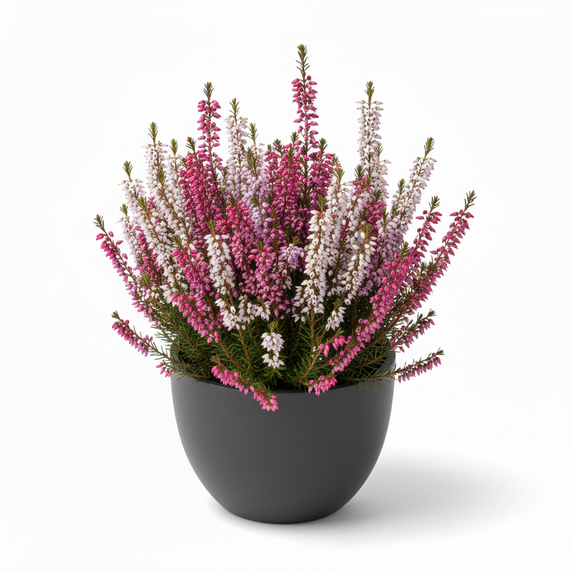
This is a low-growing, evergreen shrub with fine, needle-like foliage that stays green year-round. It produces massed clusters of small, urn-shaped flowers that range in color from white to vibrant pink and deep purple.
5. Size & Dimensions
Winter Heath typically grows to a height of 6 to 12 inches (15–30 cm) and spreads to about 12 to 24 inches (30–60 cm), forming a dense, carpet-like groundcover.
6. Light Requirements
Prefers full sun to partial shade. To achieve the best flowering performance and keep the foliage dense, a location with bright, direct sunlight is ideal.
7. Watering Needs
Maintain consistent moisture in the soil, especially during the first year of growth. Once established, it is moderately drought-tolerant but performs best when the soil does not dry out completely for extended periods.
8. Soil & Potting
Thrives in well-drained, acidic to neutral soil. Unlike many other members of the Ericaceae family, Erica carnea is notable for its tolerance of alkaline (calcareous) soils.
9. Temperature & Humidity
Highly hardy and frost-resistant (capable of surviving in USDA zones 5-7). It is well-adapted to cold winters and does not require high humidity, making it suitable for various temperate climates.
10. Fertilization
Requires minimal fertilization. A light application of a slow-release fertilizer designed for acid-loving plants in early spring after the blooms have faded is sufficient.
11. Maintenance & Care Level
Low maintenance. It is recommended to lightly shear the plant after the flowering season to maintain a compact shape and prevent the stems from becoming woody or leggy.
12. Growth & Propagation
The plant has a slow to moderate growth rate. It can be propagated via semi-hardwood cuttings taken in mid-summer or by layering stems in the spring.
13. Common Problems
Generally pest-free. The most common issue is root rot, which occurs if the soil is poorly drained. It may occasionally be affected by scale insects or spider mites if conditions are excessively dry.
14. Benefits & Uses
Excellent for providing winter color when most other plants are dormant. It serves as an early nectar source for bees and is widely used for groundcover, rock gardens, and container displays.
15. Toxicity & Safety
This plant is considered non-toxic to humans as well as pets, including dogs and cats, making it a safe choice for household gardens.
Winter Heath
Tired of a dull winter garden? The Winter Heath is your answer. Bursting into bloom when everything else is dormant, this tough little shrub delivers a stunning display of color that lasts for months. It's incredibly easy to care for, pet-safe, and perfect for adding life to containers or borders. Order now and bring vibrant, resilient beauty to your outdoor space!
1. Basic Identification
Common Name: Winter Heath
Botanical Name: Erica carnea
Arabic Name: ايريكا
Plant Variant: Standard
Plant Color: Multicolor
Plant Country: Netherlands
Stems: Multiple woody, spreading stems
Family: Ericaceae
2. Taxonomy & Classification
Kingdom: Plantae
Order: Ericales
Family: Ericaceae
Genus: Erica
Species: Erica carnea
3. Origin & Distribution
Native to the mountainous regions of Central, Southern, and Eastern Europe, particularly the Alps and Apennines, where it grows in coniferous forests and on rocky, open slopes.
4. Visual Characteristics
This is a low-growing, evergreen shrub with fine, needle-like foliage that stays green year-round. It produces massed clusters of small, urn-shaped flowers that range in color from white to vibrant pink and deep purple.
5. Size & Dimensions
Winter Heath typically grows to a height of 6 to 12 inches (15–30 cm) and spreads to about 12 to 24 inches (30–60 cm), forming a dense, carpet-like groundcover.
6. Light Requirements
Prefers full sun to partial shade. To achieve the best flowering performance and keep the foliage dense, a location with bright, direct sunlight is ideal.
7. Watering Needs
Maintain consistent moisture in the soil, especially during the first year of growth. Once established, it is moderately drought-tolerant but performs best when the soil does not dry out completely for extended periods.
8. Soil & Potting
Thrives in well-drained, acidic to neutral soil. Unlike many other members of the Ericaceae family, Erica carnea is notable for its tolerance of alkaline (calcareous) soils.
9. Temperature & Humidity
Highly hardy and frost-resistant (capable of surviving in USDA zones 5-7). It is well-adapted to cold winters and does not require high humidity, making it suitable for various temperate climates.
10. Fertilization
Requires minimal fertilization. A light application of a slow-release fertilizer designed for acid-loving plants in early spring after the blooms have faded is sufficient.
11. Maintenance & Care Level
Low maintenance. It is recommended to lightly shear the plant after the flowering season to maintain a compact shape and prevent the stems from becoming woody or leggy.
12. Growth & Propagation
The plant has a slow to moderate growth rate. It can be propagated via semi-hardwood cuttings taken in mid-summer or by layering stems in the spring.
13. Common Problems
Generally pest-free. The most common issue is root rot, which occurs if the soil is poorly drained. It may occasionally be affected by scale insects or spider mites if conditions are excessively dry.
14. Benefits & Uses
Excellent for providing winter color when most other plants are dormant. It serves as an early nectar source for bees and is widely used for groundcover, rock gardens, and container displays.
15. Toxicity & Safety
This plant is considered non-toxic to humans as well as pets, including dogs and cats, making it a safe choice for household gardens.