


Arecaceae
Areca catechu
Bring instant tropical luxury to your space with Areca catechu. Its slim canes and airy fronds fill corners beautifully without feeling heavy, making it perfect for receptions, living rooms, and open-plan offices. With bright filtered light, consistent moisture, and a touch of humidity, it stays vibrant and architectural all year.
1. Basic Identification
Common Name: Areca Palm, Betel Nut Palm
Botanical Name: Areca catechu
Plant Variant: Standard
Plant Color: Natural
Plant Country: تركيا
Arabic Name: أريكا
Stems: 6
Family: Arecaceae
2. Taxonomy & Classification
Areca catechu belongs to the genus Areca within the family Arecaceae (the palm family). It is a monocot and part of the order Arecales. It is distinct from the common houseplant Areca palm (Dypsis lutescens), though they share a common name.
3. Origin & Distribution
Native to the tropical regions of the Pacific, Southeast Asia, South Asia, and parts of East Africa. It is widely cultivated in tropical climates for its economic and ornamental value.
4. Visual Characteristics
The Betel Nut Palm features a slender, unbranched, erect trunk that can become quite tall. It is topped with a crown of lush, pinnate (feather-like) fronds that arch gracefully. The trunk often shows distinct circular leaf scars from fallen fronds.
5. Size & Dimensions
In its natural tropical habitat, it can reach heights of 15 to 30 meters. When grown in containers or as a medium-sized indoor specimen, its growth is significantly restricted, typically reaching 2 to 4 meters depending on the environment and pot size.
6. Light Requirements
Prefers bright, indirect light or filtered sunlight. While it enjoys a sunny spot, direct midday sun in hot climates can scorch the delicate leaflets. Indoors, it thrives near large, bright windows.
7. Watering Needs
Requires consistent moisture. The soil should be kept damp but never soggy. Water once the top inch of soil feels dry to the touch. It is sensitive to drought and should not be allowed to dry out completely.
8. Soil & Potting
Thrives in a rich, well-drained potting mix. A blend containing peat moss, leaf mold, and perlite or coarse sand is ideal to ensure proper drainage while retaining necessary moisture.
9. Temperature & Humidity
Being a true tropical palm, it requires warm temperatures, ideally between 18°C and 30°C. It is sensitive to cold drafts and temperatures below 10°C. High humidity is essential for healthy fronds; misting or using a humidifier is recommended in dry indoor environments.
10. Fertilization
Apply a balanced liquid fertilizer or a specific slow-release palm fertilizer during the growing season (spring and summer) every 4–6 weeks. Avoid over-fertilizing in the winter months.
11. Maintenance & Care Level
Care Level: Easy to Moderate. Maintenance involves removing dead or yellowing lower fronds to keep the plant looking tidy and occasionally wiping the leaves to remove dust and prevent pests.
12. Growth & Propagation
Propagation is primarily achieved through seeds. It has a moderate growth rate when provided with sufficient warmth, light, and nutrients.
13. Common Problems
Susceptible to spider mites and mealybugs, especially in low-humidity conditions. Yellowing leaves may indicate underwatering or nutrient deficiencies (like potassium or magnesium), while brown leaf tips usually point to dry air or salt buildup in the soil.
14. Benefits & Uses
Highly valued as an architectural ornamental plant for large indoor spaces, lobbies, and tropical landscapes. It provides a dense, airy screen and contributes to a tropical aesthetic. Culturally, it is famous for the betel nut it produces.
15. Toxicity & Safety
The fruit (betel nut) is toxic if ingested and has stimulant properties that are harmful to humans and animals. According to the input data, it is classified as neither pet-safe nor human-safe; therefore, it should be kept away from children and pets.
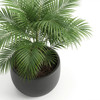
Areca catechu

Bring instant tropical luxury to your space with Areca catechu. Its slim canes and airy fronds fill corners beautifully without feeling heavy, making it perfect for receptions, living rooms, and open-plan offices. With bright filtered light, consistent moisture, and a touch of humidity, it stays vibrant and architectural all year.
1. Basic Identification
Common Name: Areca Palm, Betel Nut Palm
Botanical Name: Areca catechu
Plant Variant: Standard
Plant Color: Natural
Plant Country: تركيا
Arabic Name: أريكا
Stems: 6
Family: Arecaceae
2. Taxonomy & Classification
Areca catechu belongs to the genus Areca within the family Arecaceae (the palm family). It is a monocot and part of the order Arecales. It is distinct from the common houseplant Areca palm (Dypsis lutescens), though they share a common name.
3. Origin & Distribution
Native to the tropical regions of the Pacific, Southeast Asia, South Asia, and parts of East Africa. It is widely cultivated in tropical climates for its economic and ornamental value.
4. Visual Characteristics
The Betel Nut Palm features a slender, unbranched, erect trunk that can become quite tall. It is topped with a crown of lush, pinnate (feather-like) fronds that arch gracefully. The trunk often shows distinct circular leaf scars from fallen fronds.
5. Size & Dimensions
In its natural tropical habitat, it can reach heights of 15 to 30 meters. When grown in containers or as a medium-sized indoor specimen, its growth is significantly restricted, typically reaching 2 to 4 meters depending on the environment and pot size.
6. Light Requirements
Prefers bright, indirect light or filtered sunlight. While it enjoys a sunny spot, direct midday sun in hot climates can scorch the delicate leaflets. Indoors, it thrives near large, bright windows.
7. Watering Needs
Requires consistent moisture. The soil should be kept damp but never soggy. Water once the top inch of soil feels dry to the touch. It is sensitive to drought and should not be allowed to dry out completely.
8. Soil & Potting
Thrives in a rich, well-drained potting mix. A blend containing peat moss, leaf mold, and perlite or coarse sand is ideal to ensure proper drainage while retaining necessary moisture.
9. Temperature & Humidity
Being a true tropical palm, it requires warm temperatures, ideally between 18°C and 30°C. It is sensitive to cold drafts and temperatures below 10°C. High humidity is essential for healthy fronds; misting or using a humidifier is recommended in dry indoor environments.
10. Fertilization
Apply a balanced liquid fertilizer or a specific slow-release palm fertilizer during the growing season (spring and summer) every 4–6 weeks. Avoid over-fertilizing in the winter months.
11. Maintenance & Care Level
Care Level: Easy to Moderate. Maintenance involves removing dead or yellowing lower fronds to keep the plant looking tidy and occasionally wiping the leaves to remove dust and prevent pests.
12. Growth & Propagation
Propagation is primarily achieved through seeds. It has a moderate growth rate when provided with sufficient warmth, light, and nutrients.
13. Common Problems
Susceptible to spider mites and mealybugs, especially in low-humidity conditions. Yellowing leaves may indicate underwatering or nutrient deficiencies (like potassium or magnesium), while brown leaf tips usually point to dry air or salt buildup in the soil.
14. Benefits & Uses
Highly valued as an architectural ornamental plant for large indoor spaces, lobbies, and tropical landscapes. It provides a dense, airy screen and contributes to a tropical aesthetic. Culturally, it is famous for the betel nut it produces.
15. Toxicity & Safety
The fruit (betel nut) is toxic if ingested and has stimulant properties that are harmful to humans and animals. According to the input data, it is classified as neither pet-safe nor human-safe; therefore, it should be kept away from children and pets.