


Arugula
Taste the difference of homegrown! Add a zesty, peppery kick to your meals with our vibrant Arugula plant. Perfect for the modern foodie and health-conscious individual, this easy-to-grow herb delivers garden-to-table freshness in weeks. It's the simple way to elevate your cooking and add a touch of green to your kitchen or balcony. Don't just buy greens, cultivate your own flavor. Order your Arugula plant today!
1. Basic Identification
Common Name: Arugula / Rocket
Botanical Name: Eruca vesicaria
Arabic Name: جرجير
Plant Variant: Standard
Plant Color: Green
Plant Country: Netherlands
Family: Brassicaceae
Stems: Not available
2. Taxonomy & Classification
Arugula belongs to the Kingdom Plantae, Order Brassicales, and Family Brassicaceae (the mustard family). It is classified under the genus Eruca and the species E. vesicaria. It is closely related to other cruciferous vegetables like kale, broccoli, and mustard greens.
3. Origin & Distribution
Native to the Mediterranean region, particularly southern Europe, northern Africa, and western Asia. It has been cultivated since Roman times and is now widely distributed and grown as a popular salad herb across the globe, especially in temperate climates.
4. Visual Characteristics
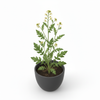
The plant features deeply lobed, elongated, bright green leaves that grow in a basal rosette. The leaves are tender when young and become more fibrous as the plant matures. If allowed to mature, it produces small, four-petaled white or cream-colored flowers with distinct purple or brown veins.
5. Size & Dimensions
Arugula typically reaches a height of 20 to 100 cm (8 to 39 inches) when it bolts to flower. For culinary harvest, it is usually kept much shorter, around 10 to 15 cm in height.
6. Light Requirements
Thrives in full sun (at least 6 hours of direct sunlight) but can tolerate partial shade. In very hot climates, partial shade is actually beneficial to prevent the plant from bolting (flowering prematurely) due to heat stress.
7. Watering Needs
Requires consistent moisture. The soil should be kept evenly moist but not waterlogged. Frequent, light watering is better than occasional heavy soaking, as drought can make the leaves excessively bitter.
8. Soil & Potting
Prefers well-draining, nutrient-rich soil with a high organic matter content. A pH between 6.0 and 7.0 is ideal. For containers, a high-quality potting mix enriched with compost works best.
9. Temperature & Humidity
A cool-season crop that grows best in temperatures between 10°C and 18°C (50°F to 65°F). It is frost-tolerant but will quickly go to seed and develop a harsh flavor in temperatures above 25°C. It adapts well to average humidity levels.
10. Fertilization
Benefits from a balanced, water-soluble fertilizer or a side-dressing of compost every 3-4 weeks. Since it is grown for its foliage, a nitrogen-rich fertilizer can help promote lush leaf growth.
11. Maintenance & Care Level
Maintenance level is Easy/Low. Regular harvesting of the outer leaves encourages the plant to continue producing new foliage. Weeding is necessary to prevent competition for nutrients and water.
12. Growth & Propagation
Fast-growing and usually ready for harvest in 20 to 40 days. It is primarily propagated by seeds. Seeds can be sown directly into the soil or pots and will germinate quickly, often within 3 to 7 days.
13. Common Problems
Common pests include flea beetles, aphids, and slugs. It can also suffer from downy mildew if there is poor air circulation or excessive overhead watering. Bolting (flowering too early) is the most common issue in warm weather.
14. Benefits & Uses
Widely used in culinary applications for its peppery flavor in salads, sandwiches, pizzas, and pestos. Nutritionally, it is a powerhouse, being high in Vitamin K, Vitamin A, Vitamin C, folate, and calcium.
15. Toxicity & Safety
Arugula is safe for human consumption and is generally considered non-toxic to cats, dogs, and horses. It is a healthy addition to a human diet and poses no safety risks when handled.
Arugula

Taste the difference of homegrown! Add a zesty, peppery kick to your meals with our vibrant Arugula plant. Perfect for the modern foodie and health-conscious individual, this easy-to-grow herb delivers garden-to-table freshness in weeks. It's the simple way to elevate your cooking and add a touch of green to your kitchen or balcony. Don't just buy greens, cultivate your own flavor. Order your Arugula plant today!
1. Basic Identification
Common Name: Arugula / Rocket
Botanical Name: Eruca vesicaria
Arabic Name: جرجير
Plant Variant: Standard
Plant Color: Green
Plant Country: Netherlands
Family: Brassicaceae
Stems: Not available
2. Taxonomy & Classification
Arugula belongs to the Kingdom Plantae, Order Brassicales, and Family Brassicaceae (the mustard family). It is classified under the genus Eruca and the species E. vesicaria. It is closely related to other cruciferous vegetables like kale, broccoli, and mustard greens.
3. Origin & Distribution
Native to the Mediterranean region, particularly southern Europe, northern Africa, and western Asia. It has been cultivated since Roman times and is now widely distributed and grown as a popular salad herb across the globe, especially in temperate climates.
4. Visual Characteristics
The plant features deeply lobed, elongated, bright green leaves that grow in a basal rosette. The leaves are tender when young and become more fibrous as the plant matures. If allowed to mature, it produces small, four-petaled white or cream-colored flowers with distinct purple or brown veins.
5. Size & Dimensions
Arugula typically reaches a height of 20 to 100 cm (8 to 39 inches) when it bolts to flower. For culinary harvest, it is usually kept much shorter, around 10 to 15 cm in height.
6. Light Requirements
Thrives in full sun (at least 6 hours of direct sunlight) but can tolerate partial shade. In very hot climates, partial shade is actually beneficial to prevent the plant from bolting (flowering prematurely) due to heat stress.
7. Watering Needs
Requires consistent moisture. The soil should be kept evenly moist but not waterlogged. Frequent, light watering is better than occasional heavy soaking, as drought can make the leaves excessively bitter.
8. Soil & Potting
Prefers well-draining, nutrient-rich soil with a high organic matter content. A pH between 6.0 and 7.0 is ideal. For containers, a high-quality potting mix enriched with compost works best.
9. Temperature & Humidity
A cool-season crop that grows best in temperatures between 10°C and 18°C (50°F to 65°F). It is frost-tolerant but will quickly go to seed and develop a harsh flavor in temperatures above 25°C. It adapts well to average humidity levels.
10. Fertilization
Benefits from a balanced, water-soluble fertilizer or a side-dressing of compost every 3-4 weeks. Since it is grown for its foliage, a nitrogen-rich fertilizer can help promote lush leaf growth.
11. Maintenance & Care Level
Maintenance level is Easy/Low. Regular harvesting of the outer leaves encourages the plant to continue producing new foliage. Weeding is necessary to prevent competition for nutrients and water.
12. Growth & Propagation
Fast-growing and usually ready for harvest in 20 to 40 days. It is primarily propagated by seeds. Seeds can be sown directly into the soil or pots and will germinate quickly, often within 3 to 7 days.
13. Common Problems
Common pests include flea beetles, aphids, and slugs. It can also suffer from downy mildew if there is poor air circulation or excessive overhead watering. Bolting (flowering too early) is the most common issue in warm weather.
14. Benefits & Uses
Widely used in culinary applications for its peppery flavor in salads, sandwiches, pizzas, and pestos. Nutritionally, it is a powerhouse, being high in Vitamin K, Vitamin A, Vitamin C, folate, and calcium.
15. Toxicity & Safety
Arugula is safe for human consumption and is generally considered non-toxic to cats, dogs, and horses. It is a healthy addition to a human diet and poses no safety risks when handled.