


Athel Tree
Transform your landscape with the Athel Tree, the ultimate survivor for tough climates. Tamarix aphylla is your go-to solution for creating fast-growing shade, natural windbreaks, or simply adding resilient greenery where other plants fail. Its beautiful, feathery foliage and extreme tolerance to drought, heat, and salt make it a smart, sustainable investment for any large garden or landscaping project. Plant it once and watch it thrive with almost no care. Order yours today and build a greener tomorrow, effortlessly.
1. Basic Identification
Common Name: Athel Tree, Athel Tamarisk, Saltcedar
Botanical Name: Tamarix aphylla
Arabic Name: اثل تماركس
Plant Variant: Standard
Plant Color: Natural/Greyish-Green
2. Taxonomy & Classification
Kingdom: Plantae
Clade: Tracheophytes
Order: Caryophyllales
Family: Tamaricaceae
Genus: Tamarix
Species: Tamarix aphylla
3. Origin & Distribution
The Athel Tree is native to Northern and Eastern Africa, the Middle East (including the United Arab Emirates), and parts of Western and Southern Asia. It is highly adapted to arid and semi-arid desert environments.
4. Visual Characteristics
This evergreen tree features a rugged trunk with greyish-brown bark. Its foliage is unique, consisting of tiny, scale-like leaves that appear as jointed, needle-like branchlets, giving it a soft, feathery appearance. It produces small, inconspicuous pink to white flowers on slender racemes during late summer.
5. Size & Dimensions
A fast-growing species that typically reaches heights of 10 to 18 meters (33–60 feet). It develops a broad, dense canopy that can spread 5 to 10 meters wide, making it an excellent shade provider.
6. Light Requirements
Requires full sun. It thrives in high-intensity light and direct sunlight, which is essential for its rapid growth and health.
7. Watering Needs
Low watering needs. While it requires regular watering during the first few years to establish a deep root system, mature trees are exceptionally drought-tolerant. It can survive on very little supplemental water in desert climates.
8. Soil & Potting
Highly versatile and tolerant of poor soils. It thrives in sandy, loamy, and even heavy clay soils. It is particularly noted for its extreme salt tolerance (halophytic), making it ideal for coastal or saline inland areas. Not recommended for standard indoor potting due to its size and root system.
9. Temperature & Humidity
Extremely heat-tolerant, easily withstanding temperatures well above 45°C. It is also moderately frost-hardy once established. It thrives in low-humidity, arid environments.
10. Fertilization
Generally does not require fertilization. In very poor soils, a slow-release nitrogen-rich fertilizer can be applied in early spring to encourage faster canopy growth.
11. Maintenance & Care Level
Low maintenance. Care primarily involves structural pruning in its early years to establish a strong trunk and removing lower branches if used as a shade tree. It is a "plant and forget" species once established.
12. Growth & Propagation
Fast growth rate. It is easily propagated through hardwood cuttings or by seed. In many regions, it is used for rapid afforestation and sand dune stabilization.
13. Common Problems
Relatively pest and disease-free. The most common issue is root rot if planted in waterlogged soils with no drainage. It can be invasive in certain riparian ecosystems outside its native range due to its efficient water consumption.
14. Benefits & Uses
Widely used as a windbreak or shelterbelt to protect crops and homes from desert winds and sand. It provides excellent shade, stabilizes soil against erosion, and is used for land reclamation in saline areas.
15. Toxicity & Safety
Considered safe and non-toxic to humans and common livestock. It is generally regarded as pet-safe, though its leaves can accumulate salt which might be unpalatable.
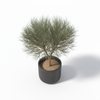
Athel Tree

Transform your landscape with the Athel Tree, the ultimate survivor for tough climates. Tamarix aphylla is your go-to solution for creating fast-growing shade, natural windbreaks, or simply adding resilient greenery where other plants fail. Its beautiful, feathery foliage and extreme tolerance to drought, heat, and salt make it a smart, sustainable investment for any large garden or landscaping project. Plant it once and watch it thrive with almost no care. Order yours today and build a greener tomorrow, effortlessly.
1. Basic Identification
Common Name: Athel Tree, Athel Tamarisk, Saltcedar
Botanical Name: Tamarix aphylla
Arabic Name: اثل تماركس
Plant Variant: Standard
Plant Color: Natural/Greyish-Green
2. Taxonomy & Classification
Kingdom: Plantae
Clade: Tracheophytes
Order: Caryophyllales
Family: Tamaricaceae
Genus: Tamarix
Species: Tamarix aphylla
3. Origin & Distribution
The Athel Tree is native to Northern and Eastern Africa, the Middle East (including the United Arab Emirates), and parts of Western and Southern Asia. It is highly adapted to arid and semi-arid desert environments.
4. Visual Characteristics
This evergreen tree features a rugged trunk with greyish-brown bark. Its foliage is unique, consisting of tiny, scale-like leaves that appear as jointed, needle-like branchlets, giving it a soft, feathery appearance. It produces small, inconspicuous pink to white flowers on slender racemes during late summer.
5. Size & Dimensions
A fast-growing species that typically reaches heights of 10 to 18 meters (33–60 feet). It develops a broad, dense canopy that can spread 5 to 10 meters wide, making it an excellent shade provider.
6. Light Requirements
Requires full sun. It thrives in high-intensity light and direct sunlight, which is essential for its rapid growth and health.
7. Watering Needs
Low watering needs. While it requires regular watering during the first few years to establish a deep root system, mature trees are exceptionally drought-tolerant. It can survive on very little supplemental water in desert climates.
8. Soil & Potting
Highly versatile and tolerant of poor soils. It thrives in sandy, loamy, and even heavy clay soils. It is particularly noted for its extreme salt tolerance (halophytic), making it ideal for coastal or saline inland areas. Not recommended for standard indoor potting due to its size and root system.
9. Temperature & Humidity
Extremely heat-tolerant, easily withstanding temperatures well above 45°C. It is also moderately frost-hardy once established. It thrives in low-humidity, arid environments.
10. Fertilization
Generally does not require fertilization. In very poor soils, a slow-release nitrogen-rich fertilizer can be applied in early spring to encourage faster canopy growth.
11. Maintenance & Care Level
Low maintenance. Care primarily involves structural pruning in its early years to establish a strong trunk and removing lower branches if used as a shade tree. It is a "plant and forget" species once established.
12. Growth & Propagation
Fast growth rate. It is easily propagated through hardwood cuttings or by seed. In many regions, it is used for rapid afforestation and sand dune stabilization.
13. Common Problems
Relatively pest and disease-free. The most common issue is root rot if planted in waterlogged soils with no drainage. It can be invasive in certain riparian ecosystems outside its native range due to its efficient water consumption.
14. Benefits & Uses
Widely used as a windbreak or shelterbelt to protect crops and homes from desert winds and sand. It provides excellent shade, stabilizes soil against erosion, and is used for land reclamation in saline areas.
15. Toxicity & Safety
Considered safe and non-toxic to humans and common livestock. It is generally regarded as pet-safe, though its leaves can accumulate salt which might be unpalatable.