


Azalea Standard
Elevate your space with the breathtaking beauty of the Azalea Standard. Expertly trained into an elegant tree-like form, this plant features a lush canopy of green leaves that explodes into a profusion of vibrant blooms. Perfect as a stunning centerpiece for your living room, entryway, or as an unforgettable gift, the Azalea Standard brings sophisticated color and life to any setting. While it requires mindful care, the reward is a spectacular floral display that is second to none.
1. Basic Identification
Common Name: Azalea Standard
Botanical Name: Rhododendron simsii
Arabic Name: ازاليا
Variant: Standard
Color: Multicolor
Country of Origin: Netherlands
Family: Ericaceae
2. Taxonomy & Classification
Kingdom: Plantae
Clade: Tracheophytes
Order: Ericales
Family: Ericaceae
Genus: Rhododendron
Species: Rhododendron simsii
3. Origin & Distribution
Rhododendron simsii is native to East Asia, including regions of China, Taiwan, Thailand, and Vietnam. The "Standard" variant provided here is expertly cultivated in the Netherlands for the international ornamental market.
4. Visual Characteristics
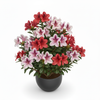
The Azalea Standard is characterized by a single, straight woody stem (the trunk) topped with a dense, rounded crown of foliage. The leaves are small, elliptic to ovate, and dark green. During the blooming season, the canopy is nearly covered with large, funnel-shaped flowers that can be single or double-petaled, appearing in vibrant shades of pink, red, white, or bicolors.
5. Size & Dimensions
Typically maintained at a height of 60 to 90 cm (24 to 36 inches). The canopy spread is usually between 30 and 45 cm, making it a perfectly sized "Medium Plant" for indoor display.
6. Light Requirements
Prefers bright, indirect light. It should be kept away from harsh, direct afternoon sun, which can scorch the delicate petals and leaves. A spot near an east-facing window is often ideal.
7. Watering Needs
Azaleas have shallow root systems and require consistent moisture. The soil should be kept damp but never waterlogged. Do not allow the root ball to dry out completely. Using lime-free or distilled water is recommended as they are sensitive to hard water.
8. Soil & Potting
Requires acidic soil (pH 4.5–5.5). Use an ericaceous potting mix specifically designed for azaleas and rhododendrons. Ensure the pot has adequate drainage holes to prevent root rot.
9. Temperature & Humidity
Thrives in cool to moderate temperatures, ideally between 10°C and 20°C (50°F–68°F). It requires high humidity to maintain its blooms; regular misting or placing the pot on a tray filled with pebbles and water can help.
10. Fertilization
Apply a liquid fertilizer formulated for acid-loving plants every two weeks during the growing and flowering season. Reduce feeding during the winter months.
11. Maintenance & Care Level
Care Level: Moderate to High. This plant requires attention to moisture levels and humidity. Deadheading (removing dead flowers) is necessary to keep the plant looking tidy and to promote future blooming.
12. Growth & Propagation
Azaleas are slow to moderate growers. The standard form is achieved through specialized training and pruning over several years. Propagation is typically done via semi-hardwood cuttings, though achieving the standard tree form requires significant skill.
13. Common Problems
Susceptible to root rot if overwatered and bud drop if the soil becomes too dry or the air is too hot. Common pests include spider mites, aphids, and lace bugs. Yellowing leaves (chlorosis) may indicate that the soil pH is too high.
14. Benefits & Uses
Primarily used as a decorative ornamental plant. Its tree-like structure makes it a sophisticated choice for interior design, specifically in lobbies, reception areas, and living rooms. It is a highly popular choice for floral gifting.
15. Toxicity & Safety
Azaleas are toxic to both humans and pets (dogs and cats) if ingested. They contain grayanotoxins, which can cause cardiovascular and gastrointestinal distress. Keep out of reach of children and animals.
Azalea Standard

Elevate your space with the breathtaking beauty of the Azalea Standard. Expertly trained into an elegant tree-like form, this plant features a lush canopy of green leaves that explodes into a profusion of vibrant blooms. Perfect as a stunning centerpiece for your living room, entryway, or as an unforgettable gift, the Azalea Standard brings sophisticated color and life to any setting. While it requires mindful care, the reward is a spectacular floral display that is second to none.
1. Basic Identification
Common Name: Azalea Standard
Botanical Name: Rhododendron simsii
Arabic Name: ازاليا
Variant: Standard
Color: Multicolor
Country of Origin: Netherlands
Family: Ericaceae
2. Taxonomy & Classification
Kingdom: Plantae
Clade: Tracheophytes
Order: Ericales
Family: Ericaceae
Genus: Rhododendron
Species: Rhododendron simsii
3. Origin & Distribution
Rhododendron simsii is native to East Asia, including regions of China, Taiwan, Thailand, and Vietnam. The "Standard" variant provided here is expertly cultivated in the Netherlands for the international ornamental market.
4. Visual Characteristics
The Azalea Standard is characterized by a single, straight woody stem (the trunk) topped with a dense, rounded crown of foliage. The leaves are small, elliptic to ovate, and dark green. During the blooming season, the canopy is nearly covered with large, funnel-shaped flowers that can be single or double-petaled, appearing in vibrant shades of pink, red, white, or bicolors.
5. Size & Dimensions
Typically maintained at a height of 60 to 90 cm (24 to 36 inches). The canopy spread is usually between 30 and 45 cm, making it a perfectly sized "Medium Plant" for indoor display.
6. Light Requirements
Prefers bright, indirect light. It should be kept away from harsh, direct afternoon sun, which can scorch the delicate petals and leaves. A spot near an east-facing window is often ideal.
7. Watering Needs
Azaleas have shallow root systems and require consistent moisture. The soil should be kept damp but never waterlogged. Do not allow the root ball to dry out completely. Using lime-free or distilled water is recommended as they are sensitive to hard water.
8. Soil & Potting
Requires acidic soil (pH 4.5–5.5). Use an ericaceous potting mix specifically designed for azaleas and rhododendrons. Ensure the pot has adequate drainage holes to prevent root rot.
9. Temperature & Humidity
Thrives in cool to moderate temperatures, ideally between 10°C and 20°C (50°F–68°F). It requires high humidity to maintain its blooms; regular misting or placing the pot on a tray filled with pebbles and water can help.
10. Fertilization
Apply a liquid fertilizer formulated for acid-loving plants every two weeks during the growing and flowering season. Reduce feeding during the winter months.
11. Maintenance & Care Level
Care Level: Moderate to High. This plant requires attention to moisture levels and humidity. Deadheading (removing dead flowers) is necessary to keep the plant looking tidy and to promote future blooming.
12. Growth & Propagation
Azaleas are slow to moderate growers. The standard form is achieved through specialized training and pruning over several years. Propagation is typically done via semi-hardwood cuttings, though achieving the standard tree form requires significant skill.
13. Common Problems
Susceptible to root rot if overwatered and bud drop if the soil becomes too dry or the air is too hot. Common pests include spider mites, aphids, and lace bugs. Yellowing leaves (chlorosis) may indicate that the soil pH is too high.
14. Benefits & Uses
Primarily used as a decorative ornamental plant. Its tree-like structure makes it a sophisticated choice for interior design, specifically in lobbies, reception areas, and living rooms. It is a highly popular choice for floral gifting.
15. Toxicity & Safety
Azaleas are toxic to both humans and pets (dogs and cats) if ingested. They contain grayanotoxins, which can cause cardiovascular and gastrointestinal distress. Keep out of reach of children and animals.