


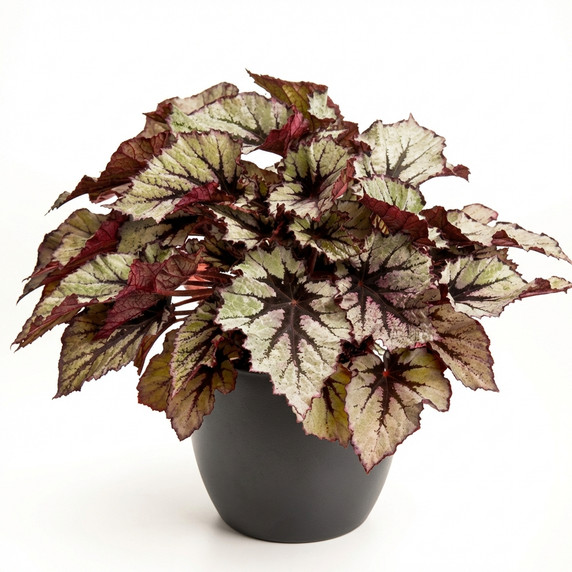


Bring gallery-level color to your space with Rex Begonia—lush, patterned leaves in silver, green, and burgundy that look painted by hand. Its compact size makes it ideal for desks and shelves, while the premium foliage gives an instant “designer plant” feel. Place it in bright, indirect light, water carefully, and enjoy bold texture all year.
Common Name: Rex Begonia
Botanical Name: Begonia rex-cultorum
Former Name: Not available
Plant Type: Foliage houseplant
Plant Code / SKU: PLT-0247
Alternative Names:
بيغونيا
Order: Cucurbitales
Family: Begoniaceae
Genus: Begonia
Species: Begonia rex-cultorum (Rex Cultorum Group)
Native to the Eastern Himalayas of India (Sikkim, Manipur) and northern Myanmar. Selected and bred in Europe in the mid-19th century, Rex Begonia cultivars are now distributed worldwide as ornamental houseplants.
Leaves large, asymmetrical, ovate to orbicular with heavily textured, corrugated surfaces. Foliage displays striking variegation: metallic silver splashes, deep burgundy, green marbling, and contrasting veins. Undersides often deep red to purple. Stems erect to arching, succulent.
Height: 20–30 cm (8–12 in)
Spread: 25–40 cm (10–16 in)
Leaf length: 10–18 cm (4–7 in)
Bright indirect light; avoid direct midday sun which can scorch foliage. Tolerates lower light but variegation may fade. Ideal placement near east- or north-facing window.
Keep soil evenly moist but not waterlogged. Water when top 2–3 cm of soil feels dry. Reduce frequency in winter. Avoid wetting leaves excessively.
Use a well-draining, peat-based potting mix with perlite or coarse sand. pH slightly acidic, 5.5–6.5. Repot every 1–2 years in spring to refresh substrate and inspect rhizomes.
Optimal temperature: 18–24 °C (65–75 °F). Do not allow below 16 °C (60 °F). Requires high humidity (50–80%). Use humidifier, pebble tray, or grouping to maintain moisture.
Feed with a balanced, water-soluble fertilizer (e.g., 20-20-20) at half strength every 4 weeks during spring and summer growth. Withhold or reduce feeding in autumn and winter.
Moderate care. Remove yellowing or damaged leaves to encourage new growth. Rotate plant occasionally for even light exposure. Monitor for pests regularly.
Growth habit: clumping, rhizomatous. Propagate by leaf petiole or leaf-blade cuttings: place on moist mix or in water until roots form. Division of rhizomes in spring also effective.
Overwatering can cause root rot. Low humidity may lead to brown leaf edges. Susceptible to powdery mildew, mealybugs, spider mites, and thrips. Leggy growth if light is insufficient.
Primarily ornamental: striking foliage adds designer flair to interiors. Compact size ideal for desks, shelves, and terrariums. May contribute to minor air-purifying effects.
Contains insoluble calcium oxalates; toxic to cats, dogs, and humans if ingested. May cause oral irritation, drooling, vomiting, and difficulty swallowing. Handle with care and keep out of reach of pets and children.
Bring gallery-level color to your space with Rex Begonia—lush, patterned leaves in silver, green, and burgundy that look painted by hand. Its compact size makes it ideal for desks and shelves, while the premium foliage gives an instant “designer plant” feel. Place it in bright, indirect light, water carefully, and enjoy bold texture all year.
Common Name: Rex Begonia
Botanical Name: Begonia rex-cultorum
Former Name: Not available
Plant Type: Foliage houseplant
Plant Code / SKU: PLT-0247
Alternative Names:
بيغونيا
Order: Cucurbitales
Family: Begoniaceae
Genus: Begonia
Species: Begonia rex-cultorum (Rex Cultorum Group)
Native to the Eastern Himalayas of India (Sikkim, Manipur) and northern Myanmar. Selected and bred in Europe in the mid-19th century, Rex Begonia cultivars are now distributed worldwide as ornamental houseplants.
Leaves large, asymmetrical, ovate to orbicular with heavily textured, corrugated surfaces. Foliage displays striking variegation: metallic silver splashes, deep burgundy, green marbling, and contrasting veins. Undersides often deep red to purple. Stems erect to arching, succulent.
Height: 20–30 cm (8–12 in)
Spread: 25–40 cm (10–16 in)
Leaf length: 10–18 cm (4–7 in)
Bright indirect light; avoid direct midday sun which can scorch foliage. Tolerates lower light but variegation may fade. Ideal placement near east- or north-facing window.
Keep soil evenly moist but not waterlogged. Water when top 2–3 cm of soil feels dry. Reduce frequency in winter. Avoid wetting leaves excessively.
Use a well-draining, peat-based potting mix with perlite or coarse sand. pH slightly acidic, 5.5–6.5. Repot every 1–2 years in spring to refresh substrate and inspect rhizomes.
Optimal temperature: 18–24 °C (65–75 °F). Do not allow below 16 °C (60 °F). Requires high humidity (50–80%). Use humidifier, pebble tray, or grouping to maintain moisture.
Feed with a balanced, water-soluble fertilizer (e.g., 20-20-20) at half strength every 4 weeks during spring and summer growth. Withhold or reduce feeding in autumn and winter.
Moderate care. Remove yellowing or damaged leaves to encourage new growth. Rotate plant occasionally for even light exposure. Monitor for pests regularly.
Growth habit: clumping, rhizomatous. Propagate by leaf petiole or leaf-blade cuttings: place on moist mix or in water until roots form. Division of rhizomes in spring also effective.
Overwatering can cause root rot. Low humidity may lead to brown leaf edges. Susceptible to powdery mildew, mealybugs, spider mites, and thrips. Leggy growth if light is insufficient.
Primarily ornamental: striking foliage adds designer flair to interiors. Compact size ideal for desks, shelves, and terrariums. May contribute to minor air-purifying effects.
Contains insoluble calcium oxalates; toxic to cats, dogs, and humans if ingested. May cause oral irritation, drooling, vomiting, and difficulty swallowing. Handle with care and keep out of reach of pets and children.

Take 20% off your first order
Enter the code below at checkout to get 20% off your first order