


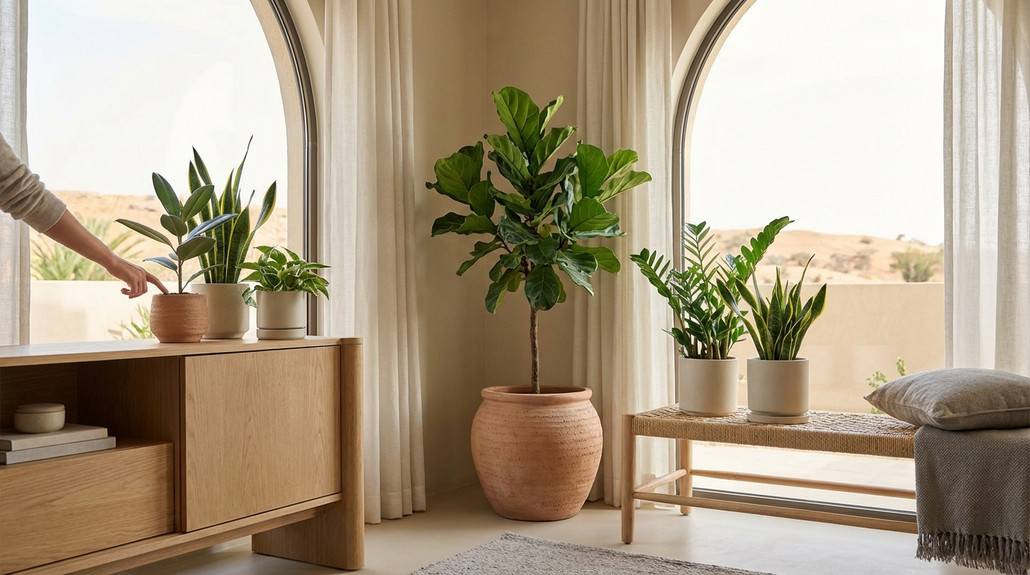
How to Care for Indoor Plants During Extreme Summer Heat in Saudi Arabia Homes
Posted by Mozher Experts on 24.02.26
The Unique Challenge of Indoor Climates in Saudi Arabia
Maintaining healthy indoor plants in Saudi Arabia presents a distinct challenge not found in many other parts of the world. The issue is not just the intense external heat but the extreme contrast with our indoor environments. Homes and offices are kept cool by constant air conditioning, which creates an artificially dry and cool microclimate. This constant AC operation drastically reduces ambient humidity, a critical factor for the health of most popular houseplants, which are often tropical in origin. The soil of your plants may dry out much faster than expected due to this arid air, even if the room feels cool. Conversely, a plant placed directly under an AC vent can suffer from cold drafts and its soil may stay wet for too long, leading to root rot. Therefore, a fixed watering schedule, such as watering every Saturday, is ineffective and often harmful. The key to success is learning to observe your plants and their soil, responding to their actual needs rather than a predetermined calendar. Understanding this dynamic between external heat and internal AC-driven dryness is the first step toward mastering plant care in this region.
Abandoning the Schedule: The Soil Moisture Test
The single most important skill in watering indoor plants is learning when they actually need water. The most reliable method is to physically check the soil moisture before every watering session. A fixed weekly or bi-weekly schedule ignores the daily fluctuations in temperature, AC usage, and light exposure that affect how quickly a plant uses water. For most common houseplants, the standard guideline is to water when the top 5-7 cm of soil feels dry to the touch. To check, simply insert your index finger into the soil up to your second knuckle. If the soil feels dry and doesn't stick to your finger, it is likely time to water. If you feel moisture or soil clings to your skin, wait another day or two and check again. This tactile method prevents the primary cause of plant failure: overwatering. For those who prefer a more precise approach, using a reliable moisture meter can remove all guesswork. You simply insert the probe into the soil to get an instant reading of the moisture level at the root zone, allowing you to water with complete confidence and avoid damaging the delicate root system.
Proper Watering Technique for Healthy Roots
Once you've determined that your plant needs water, the technique you use is just as important as the timing. The goal is to moisten the entire root ball thoroughly, not just the surface. Avoid giving your plants small, frequent sips of water. This practice encourages shallow root growth and can lead to a buildup of mineral salts on the soil surface. Instead, water deeply and thoroughly. Pour water slowly and evenly over the entire soil surface until you see it begin to flow freely from the drainage holes at the bottom of the pot. This ensures that every part of the root system has access to moisture and also helps to flush out any accumulated salts from fertilizers or tap water. After watering, allow the pot to drain completely for 15-20 minutes in a sink or bathtub. It is critical to discard any excess water that collects in the saucer or cachepot. Allowing a plant to sit in a saucer full of water is one of the quickest ways to cause root rot, a fatal condition where roots suffocate and decay due to a lack of oxygen. A good quality, long-spouted watering can allows you to deliver water directly to the soil without splashing the leaves, which can help prevent fungal issues.
Recognizing the Signs of Overwatering vs. Underwatering
Plants communicate their needs through their leaves, but the signals for too much and too little water can be confusingly similar. Understanding the subtle differences is key to diagnosing the problem correctly. An underwatered plant will typically have wilting or drooping leaves that feel soft and limp. The leaves may also start to turn brown and crispy at the edges, and the lower, older leaves might turn yellow and fall off. The soil will be visibly dry and may even pull away from the sides of the pot. In contrast, an overwatered plant often exhibits yellowing leaves as well, but they will feel soft and mushy, not crispy. The plant may wilt even when the soil is wet because the roots are suffocating and unable to absorb water. You might also notice a musty smell from the soil, fungus gnats flying around the pot, or soft, brown stems near the soil line. In the dry, air-conditioned homes of Saudi Arabia, it's common for plant owners to see a wilting plant and assume it's thirsty, leading them to water it again and worsen the problem of root rot. Always confirm your diagnosis by checking the soil moisture first before reaching for the water.
Managing Humidity in an Air-Conditioned Environment
Low humidity is the silent stressor for many indoor plants in the region. Air conditioners are excellent at cooling air, but they are also powerful dehumidifiers. Most popular houseplants, like ferns, Calatheas, and Alocasias, originate from humid jungle floors and will struggle in the dry air produced by a constantly running AC. Symptoms of low humidity include brown, crispy leaf tips and edges, stunted growth, and increased vulnerability to pests like spider mites. To counteract this, you need to actively increase the moisture in the air around your plants. Grouping plants together is a simple and effective strategy; as they transpire, they collectively raise the humidity in their immediate vicinity. Another method is to place plants on a pebble tray. This is a shallow tray filled with pebbles and water. The pot sits on top of the pebbles, above the water line, and as the water evaporates, it creates a pocket of humid air around the plant. For particularly sensitive specimens, regular misting can provide temporary relief, but a small room humidifier offers the most consistent and effective solution. You can also strategically place plants that thrive in higher humidity in bathrooms or kitchens, where moisture levels are naturally higher.
The Critical Role of Pots, Soil, and Drainage
The foundation of a healthy, well-watered plant is what it lives in. The right combination of pot, soil, and drainage is non-negotiable, especially in a challenging climate. Every pot must have drainage holes. Without them, excess water has no way to escape, the soil becomes waterlogged, and roots will inevitably rot. If you love the look of a decorative pot without holes (a cachepot), use it as a sleeve. Keep your plant in a functional nursery pot with drainage, and simply place it inside the decorative one. Remember to remove the inner pot for watering or pour out any excess water that collects at the bottom of the cachepot. The soil mix is equally important. A high-quality potting mix designed for indoor plants will be formulated to retain some moisture while also allowing for excellent aeration. Avoid using heavy garden soil, which compacts easily and holds too much water. For plants like succulents and cacti, use a specialized, fast-draining cactus mix. The material of the pot also influences watering frequency. Porous materials like terracotta allow moisture to evaporate through their walls, causing the soil to dry out faster. This can be beneficial for plants prone to root rot, but it also means you will need to check their moisture levels more frequently. Non-porous materials like glazed ceramic or plastic retain moisture for longer. Choosing the right well-draining pots and soil for your specific plant is a crucial step in setting it up for success.
Adapting Your Routine for Different Plant Varieties
Not all indoor plants are created equal; their watering needs can vary significantly based on their species and origin. Treating every plant in your home the same is a common mistake. Cacti and succulents, for example, are adapted to arid conditions and store water in their leaves and stems. They need to dry out completely between waterings, and it's far better to underwater them than to overwater. In contrast, tropical plants like ferns and Calatheas prefer their soil to remain consistently moist (but not soggy). Allowing them to dry out completely can cause significant stress and damage. Plants with large, thin leaves, like a Fiddle Leaf Fig, tend to transpire more and may require water more frequently than a Snake Plant, which has thick, waxy leaves that conserve moisture. As you expand your collection, take the time to learn the specific preferences of each new plant. This research will guide your watering practices and help you understand the unique cues each plant gives when it is thirsty. A plant's light exposure also plays a major role; a plant in a bright, sunny spot will use water much faster than the same plant in a low-light corner. Regularly observing and learning from our curated collection of best-selling plants will turn you into an intuitive and effective plant parent.
How often should I really water my plants in a Saudi summer?
There is no single correct answer or schedule. The frequency depends on the plant type, pot size, light exposure, and how much your AC is running. Instead of a schedule, commit to a routine of checking. For thirsty tropical plants, you might check the soil every 3-4 days. For succulents, you might only check every 2-3 weeks. The key is to let the top layer of soil tell you when it's time.
Is tap water in the Kingdom safe for my plants?
Tap water in many parts of Saudi Arabia can be high in salts and minerals due to the desalination process. While many resilient plants tolerate it, sensitive species like Calatheas or Dracaenas can develop brown leaf tips from mineral buildup. To mitigate this, let your tap water sit in an open container for 24 hours before use. This allows some chlorine to evaporate. For very sensitive plants, using filtered or distilled water is the safest option.
Why are my plant's leaf tips turning brown and crispy?
While this can sometimes be related to underwatering, in an air-conditioned Saudi home, the most common culprit is low humidity. The dry air from the AC pulls moisture out of the leaves faster than the roots can supply it, causing the tips to die back. Check the soil first to rule out thirst. If the soil is moist, focus on increasing humidity by grouping plants, using a pebble tray, or introducing a small humidifier.