


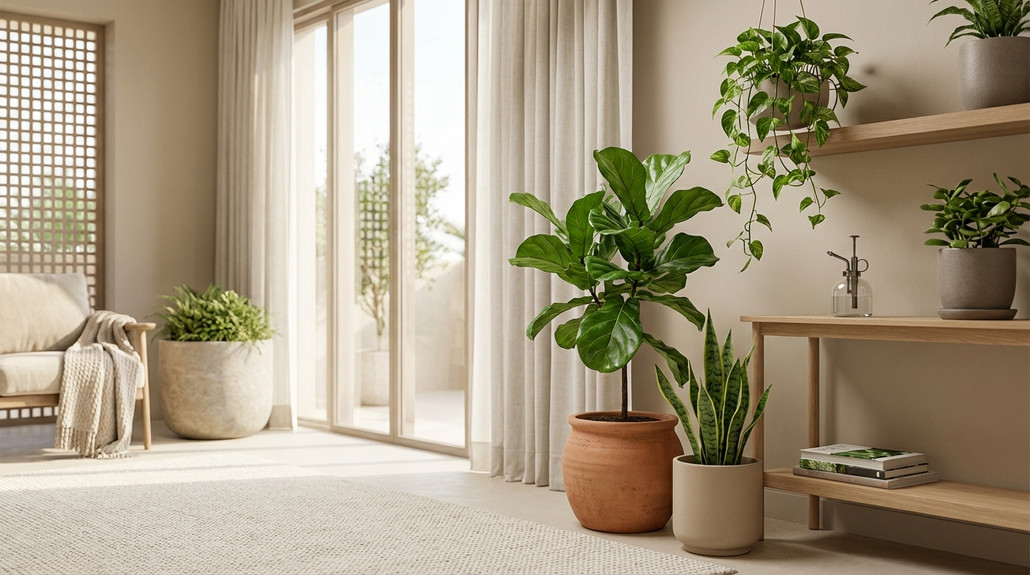
Indoor Plant Care Mistakes That Kill Plants Slowly in Iraq Homes
Posted by Mozher Experts on 22.02.26
Understanding the Impact of Air Conditioning on Your Plants
The single greatest challenge for indoor plants in Iraq is not the outdoor heat, but the indoor environment created to combat it. Constant air conditioning, or the *sublit*, saves us from the high temperatures but creates an artificial desert for most houseplants. This machinery aggressively removes moisture from the air, causing humidity levels to plummet far below what tropical and subtropical plants require to thrive. The consistent, cool airflow also accelerates the evaporation of water from the soil surface. This leads to a common misunderstanding: the soil top may feel dry to the touch, prompting more watering, while the lower root zone remains saturated. This cycle of a dry top layer and a wet bottom layer is a primary cause of root rot, one of the most common reasons for plant failure in air-conditioned homes. The dry air also directly affects foliage, leading to brown, crispy leaf edges and tips, particularly on plants like Calatheas, Ferns, and Fittonias. It is crucial to see your indoor space not as a simple shelter from heat, but as a unique microclimate with its own set of rules governed by the AC unit.
Improper and Inconsistent Watering Habits
Watering is a skill, not a schedule. A rigid routine of watering every Saturday, for example, ignores the actual needs of the plant, which change based on season, light, and the AC's operation. The most prevalent mistake is overwatering. Fearing the heat will dehydrate their plants, owners provide too much water too frequently. In a well-draining pot, excess water might escape, but in standard nursery pots or decorative pots without drainage, the water pools at the bottom. The roots, deprived of oxygen, begin to decay. This root rot prevents the plant from absorbing any water or nutrients, ironically causing the plant to look wilted and thirsty, which often encourages even more watering. The opposite error, underwatering, is also common due to the rapid drying effect of air conditioners. The solution is to abandon the calendar and assess the soil directly. The most reliable method is to check the top 5-7 cm of soil. If it is dry, it is likely time to water. For greater precision and to avoid guesswork, consider using a moisture meter. This simple tool provides a clear reading of the moisture level at the root zone, eliminating the risk of over- or underwatering and promoting consistent root health.
Ignoring the Importance of Soil and Drainage
The foundation of any healthy indoor plant is the medium it grows in. Using low-quality, dense soil, or worse, soil taken directly from an outdoor garden, is a critical error. Outdoor soil is heavy, compacts easily in pots, and often contains pests or pathogens. For indoor plants, especially in our climate, the soil mix must provide a balance of moisture retention, aeration, and drainage. A quality potting mix is engineered to be light and porous, allowing roots to breathe and water to flow through freely. This prevents the waterlogging that leads to root rot. Equally important is the pot itself. A decorative pot without a drainage hole is a container for root decay. Water has nowhere to go, and the soil becomes a saturated, oxygen-deprived environment. Always ensure your plant is in a pot with at least one drainage hole. If you use a decorative cachepot, place the nursery pot inside it and be sure to empty any excess water from the cachepot about 30 minutes after watering. Providing your plants with the right foundation from the start is a non-negotiable step for long-term success. You can find appropriate soil and fertilizer supplies specifically formulated for the needs of houseplants.
Providing Incorrect Light Exposure
Light is a plant's food, and providing the wrong amount or intensity is a slow but certain way to weaken it. A common mistake in Iraq is equating "bright light" with the intense, direct sun that streams through windows. For most popular houseplants, such as Monsteras, Philodendrons, and ZZ plants, this direct sunlight is far too harsh. It will scorch their leaves, causing yellow or brown patches and stressing the plant significantly. These plants evolved under the canopies of larger trees, where they receive filtered or dappled sunlight. The goal indoors is to replicate this. "Bright, indirect light" means placing a plant in a room that is well-illuminated for most of the day, but where the sun's rays do not fall directly on the foliage. This could be a few feet away from an east-facing window or near a south- or west-facing window that is covered by a sheer curtain. Low light does not mean no light; it means a spot further into a room that still receives some ambient light. Placing a plant in a dark corner will cause it to become leggy, pale, and weak as it stretches desperately for a light source. Observe your space throughout the day to understand where the light falls, and choose plants that thrive in bright, indirect light for the best results in most indoor settings.
Neglecting Humidity and Proper Air Circulation
As mentioned, air conditioning is the primary culprit behind low indoor humidity. Most popular houseplants are tropical in origin and require humidity levels between 40% and 60% to flourish. The typical air-conditioned home in Iraq can have humidity levels as low as 20-30%. This chronic dryness causes significant stress. The plant loses water through its leaves faster than its roots can absorb it, resulting in crispy brown edges, curling leaves, and a general lack of vigor. There are several practical ways to increase humidity around your plants. Grouping them together creates a small, humid micro-environment as they collectively transpire. Placing pots on a tray filled with pebbles and water (ensuring the pot sits on the pebbles, not in the water) allows the evaporating water to raise local humidity. Regular misting can provide a temporary boost, but it must be done frequently to be effective. It's also important to avoid placing plants directly in the path of an AC vent. The constant blast of cold, dry air is extremely damaging. Good air circulation is different; it prevents stagnant air that can encourage fungal diseases and pests, but it should be gentle, not a direct draft.
The Shock of Immediate Repotting and Relocation
When you bring a new plant home, it has just undergone a significant journey from a nursery to our delivery vehicle and finally to your space. Each step is a change in temperature, light, and humidity. This process causes acclimation stress. A common mistake is to immediately repot the plant into a new, larger container. While well-intentioned, this adds another major shock to an already stressed plant, often proving to be too much for it to handle. It is best to let a new plant acclimate to its new environment for at least two to four weeks before considering repotting. Place it in its intended location and focus only on providing the correct light and water. This allows the plant to stabilize and adjust its systems to your home's unique conditions. Similarly, constantly moving plants around the house "to find the perfect spot" can also be stressful. Once you find a location where the plant seems content, leave it there. Every plant in our curated collection of indoor plants has been cared for in a controlled environment, and giving it time to adjust patiently is key to a successful transition into your home.
Overlooking Dust and Pest Management
In our region, dust is a constant factor. A fine layer of dust can accumulate on plant leaves surprisingly quickly, and this is more than just an aesthetic issue. This layer blocks sunlight from reaching the leaf surface, reducing the plant's ability to photosynthesize effectively. It can also clog the stomata, which are tiny pores on the leaves that plants use for gas exchange, essentially hindering their ability to breathe. A simple but vital part of indoor plant care is regularly cleaning the leaves. For smooth-leaved plants, use a soft, damp cloth to gently wipe down the top and bottom of each leaf every few weeks. For fuzzy-leaved plants like African Violets, a soft brush is a better option. This simple act keeps the plant efficient and vibrant. Neglecting this also makes your plants more susceptible to pests like spider mites, which thrive in dusty, dry conditions. Regularly inspecting your plants, especially the undersides of leaves and where the leaf meets the stem, allows you to catch any potential pest infestations early before they become a major problem. For more guidance, you can review our detailed plant care instructions for specific plant types.
Frequently Asked Questions on Plant Care in Dry Climates
How often should I truly water my plants in an AC-cooled room?
There is no fixed schedule. The frequency depends on the plant type, pot size, soil mix, and how often your AC is running. The only reliable method is to check the soil. For most plants, wait until the top 5-7 cm of soil is completely dry. Insert your finger or a wooden stick into the soil to that depth. If it comes out clean and dry, it's time to water thoroughly until water drains from the bottom. If it comes out with moist soil attached, wait a few more days and check again.
Can I place my plants directly in front of the AC unit for cooling?
No, this is highly detrimental. A direct draft of cold, dry air from an AC unit will shock the plant. It causes rapid dehydration of the leaves, can lead to cold damage, and creates extreme temperature fluctuations that stress the plant's system. Always position your plants away from the direct airflow of AC vents, heaters, or fans.
Why are the leaf tips on my plant turning brown and crispy?
Brown, crispy leaf tips are the most common symptom of low humidity, a direct result of living in an air-conditioned environment. The plant is losing moisture from its leaves faster than it can be replaced by the roots. While inconsistent watering can also be a cause, if you are confident in your watering routine, the primary culprit is dry air. Increasing humidity by grouping plants, using a pebble tray, or placing a small humidifier nearby can help prevent this.