


Indoor Plants That Don’t Require Constant Attention in UAE Homes
Posted by Mozher Experts on 25.02.26
The UAE Indoor Environment Challenge: Beyond Just Heat
Many people in the UAE seek the tranquility of indoor plants but are constrained by demanding schedules. The assumption is that the main obstacle is the intense outdoor heat. However, the real challenge for houseplants is the indoor environment we create to escape it. Constant air conditioning is essential for comfort, but it creates a unique microclimate of low humidity, cold drafts, and a significant temperature differential from the outdoors. This dry, cool air can be more stressful for tropical plants than the natural heat and humidity they are evolved for. Choosing a plant that can thrive in these specific, often harsh, indoor conditions is the first step toward success. The goal is to select species that are not just tolerant of neglect, but are genuinely suited to the dry, climate-controlled reality of a modern UAE home or office. These are plants that prefer consistency and are unfazed by the very conditions that cause more delicate species to fail.
Defining Truly Low-Maintenance Plants
The term "low maintenance" is often misused. A truly low-maintenance plant is not one that survives neglect, but one that thrives on it. These species have specific biological adaptations that make them resilient to the most common mistakes made by new plant owners: inconsistent watering and improper light. They possess traits like succulent leaves or thick rhizomes to store water for long periods, making them drought-tolerant. Many have also adapted to grow in low-light conditions, such as on a forest floor beneath a dense canopy. For the UAE's indoor environment, this translates to plants that do not require frequent watering, are not sensitive to the low humidity caused by AC units, and do not need a prime spot near a bright window. Understanding these characteristics is key. You are not looking for a plant you can forget about, but one whose natural cycle aligns with a less frequent, more hands-off care approach. Over-caring, particularly overwatering, is the primary reason these hardy plants fail.
Top Selections for Minimal Effort
For those seeking resilient greenery, a few species consistently outperform others in typical indoor settings. These are our top recommendations based on their ability to withstand the common environmental pressures of homes and offices in the region.
Snake Plant (Sansevieria trifasciata)
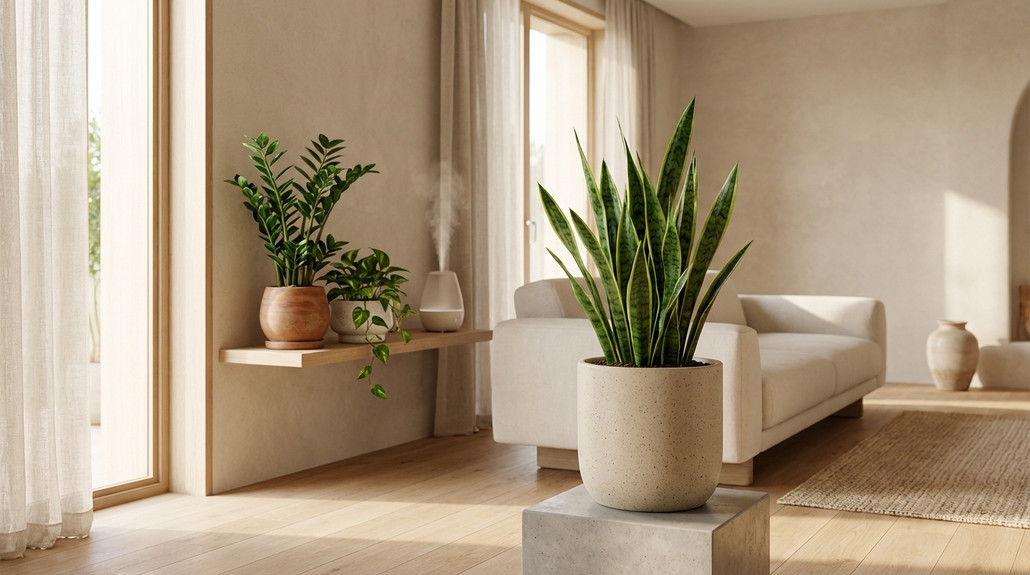
Also known as Mother-in-Law's Tongue, the Snake Plant is the epitome of a neglect-tolerant plant. Its structural, upright leaves are not just for aesthetics; they are highly efficient at storing water. This plant is adapted to arid conditions, meaning it prefers its soil to dry out completely between waterings. This makes it a perfect match for a busy owner who might forget to water it for several weeks. Furthermore, it is exceptionally versatile with light, tolerating the dim corners of a room just as well as areas with bright, indirect sun. Its indifference to low humidity makes it completely unbothered by constant air conditioning. It is a slow grower, requiring minimal intervention, and is known for its air-purifying qualities.
ZZ Plant (Zamioculcas zamiifolia)
The ZZ Plant is arguably one of the most indestructible houseplants available. Its resilience comes from its large, potato-like rhizomes hidden beneath the soil. These rhizomes store significant amounts of water, allowing the plant to survive extended periods of drought without any signs of stress. Its glossy, waxy leaves are not only attractive but also functional, preventing moisture from escaping in the dry air of an air-conditioned room. The ZZ Plant is a top performer in low-light environments, making it ideal for office cubicles, hallways, or rooms with limited natural light. It requires watering very infrequently—only when the soil has been thoroughly dry for some time. Its slow, steady growth means it will not outgrow its space quickly and demands almost no pruning or upkeep.
Pothos (Epipremnum aureum)
Often called Devil's Ivy, the Pothos is a forgiving trailing plant that provides clear visual cues for its needs. When it is thirsty, its leaves will begin to slightly droop, providing an unmistakable signal that it is time to water. It recovers quickly once hydrated. This feedback loop helps prevent the common problem of overwatering. Pothos is highly adaptable to a wide spectrum of lighting conditions, from low to bright indirect light, although its variegation may become less pronounced in dimmer spots. It is a relatively fast grower compared to the Snake Plant or ZZ Plant, which many find rewarding. You can easily prune it to encourage fuller growth or let its vines trail from a shelf or hanging planter.
Establishing a Minimalist Care Routine
Success with easy-care plants comes from a routine built on observation, not a rigid schedule. "Less is more" is the guiding principle. For watering, the most crucial element, always check the soil before adding water. Insert your finger two inches deep; if it feels completely dry, it might be time to water. For plants like the ZZ and Snake Plant, it is wise to wait even a week longer. Relying on a weekly schedule is what leads to root rot in these drought-tolerant species. For lighting, find a suitable spot and let the plant acclimate. These plants dislike being moved. A collection of plants that thrive in low light conditions can simplify placement throughout your home. Fertilizing is a minor task; a balanced liquid fertilizer diluted to half-strength once or twice a year during spring and summer is more than enough. Finally, keep the leaves clean. Dust accumulation from indoor air, especially in the UAE, can block light and hinder photosynthesis. A gentle wipe with a damp cloth every few months is all the grooming these plants need.
Recognizing Signs of Over-Caring
For low maintenance indoor plants, more harm is done by too much attention than too little. Learning to spot the signs of excessive care is critical for long-term success. The most common mistake is overwatering. Yellowing leaves, especially lower ones, are a classic symptom. This indicates that the roots are saturated and unable to breathe, leading to root rot. A mushy stem base is a more advanced and often fatal sign of the same issue. Contrary to popular belief, brown, crispy leaf tips are not always a sign of thirst. In an air-conditioned environment, this can be a reaction to low humidity or a buildup of salts and minerals from tap water. Letting your water sit in an open container for 24 hours before use can help dissipate some chlorine. If a plant shows no new growth, resist the urge to water or fertilize it more. This dormancy can be a natural response to low light or a sign that the roots are already struggling from too much moisture. When in doubt, always err on the side of underwatering.
Matching the Plant to Your Space
Placing the right plant in the right location from the start eliminates most potential problems. This ensures the plant's needs are met passively by its environment, reducing the care required from you.
- For the Desk or Office: A compact ZZ Plant or a small Snake Plant is an excellent choice. They are perfectly content with artificial office lighting and will tolerate the inevitable missed watering when you are busy or away. You can explore a variety of plants for office and desk settings that fit these criteria.
- For a Bedroom Corner: Bedrooms often have lower light levels. A medium to large ZZ Plant or a Cast Iron Plant (Aspidistra elatior) can fill a corner with greenery without demanding any attention.
- For a Living Room or Entryway: To make a visual impact without adding to your workload, a tall Snake Plant variety like the Sansevieria Laurentii is ideal. Its strong vertical lines add architectural interest and it requires minimal floor space.
- For a Bookshelf or High Ledge: The trailing nature of a Golden Pothos is perfect for adding a cascading green element. It is hardy and its vines can be left to grow long or trimmed back to encourage a fuller appearance.
The Single Most Important Rule for Selection
To ensure long-term success and avoid frustration, follow one simple rule: choose a plant for the environment you currently have, not the one you wish you had. Do not purchase a sun-loving Fiddle Leaf Fig for a dark corner, hoping it will adapt. Similarly, avoid humidity-loving ferns if your home is dominated by dry, air-conditioned air. This single discipline prevents the vast majority of plant failures. Begin your journey with one or two proven hardy indoor plants to build your confidence. The experience should be rewarding, not another source of stress. At Mozher, this principle guides our curation. We select a range of quality indoor plants that are well-suited to the real-life conditions of homes in this region, ensuring you start with a plant that is already positioned for success.
Frequently Asked Questions
How often should I really water a low-maintenance plant in an AC room?
Abandon a fixed schedule. The correct frequency is dictated entirely by how quickly the soil dries out. For a Snake Plant or ZZ Plant, this could mean watering as little as once every 3-6 weeks. For a Pothos, it might be every 2-3 weeks. The key is to physically check the soil. Only water when the top 2-3 inches are completely dry to the touch. In the consistent environment of an air-conditioned room, the soil will dry slower than you might expect.
Can these plants survive on only artificial office light?
Yes, the Snake Plant, ZZ Plant, and Pothos are three of the best options for spaces with no natural light. They are highly efficient at photosynthesis and can sustain themselves on standard overhead fluorescent or LED lighting found in most modern offices. While they may grow slower than they would with natural light, they will remain healthy.
Is it better to underwater or overwater a hardy plant?
It is always far better to underwater. These plants are structurally designed to endure drought by storing water in their leaves, stems, or rhizomes. Their roots, however, are not adapted to sit in constantly wet soil, which quickly leads to irreversible root rot. A plant suffering from thirst will show signs like drooping or wrinkling leaves and will almost always recover fully after a thorough watering. An overwatered plant often cannot be saved once root rot has set in.