


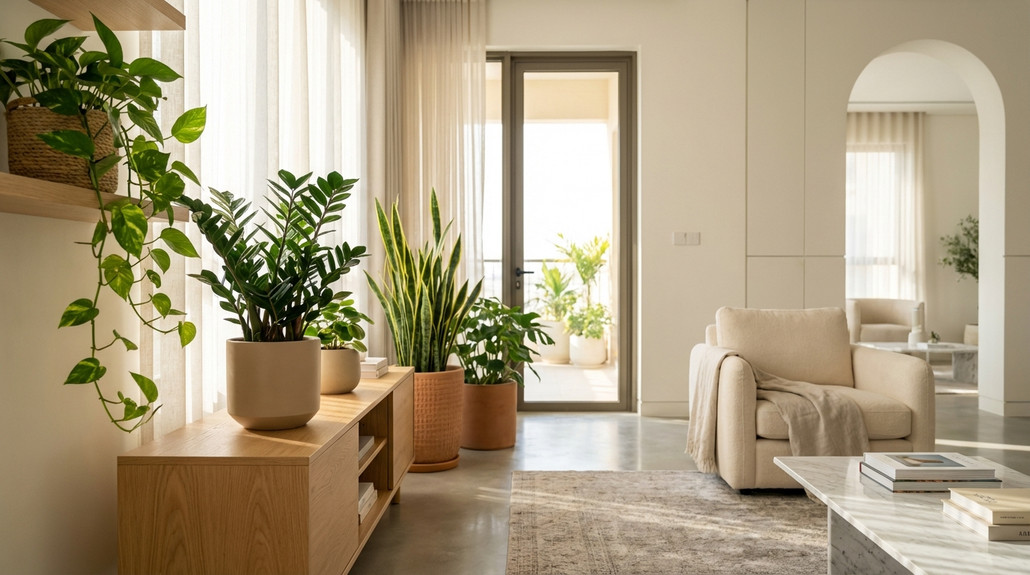
Indoor Plants That Survive Neglect and Irregular Care in UAE Homes
Posted by Mozher Experts on 23.02.26
The Reality of Plant Care in Air-Conditioned Homes
Many people in the UAE desire the calm and beauty of indoor plants but are hesitant due to busy schedules and past failures. The primary challenge is not just the heat outside, but the artificial climate we create inside. Air conditioning runs constantly, leading to extremely dry air and significant temperature drops that can shock and stress many common houseplants. A plant that thrives in a humid, temperate environment will struggle in a home where the AC removes moisture from the air around the clock. This is why selecting the right type of plant is critical for success. Low maintenance does not mean no maintenance; it means choosing plants that are naturally resilient to the specific conditions of a modern UAE residence—namely, inconsistent watering, lower light, and dry air.
The goal is to find plants that tolerate a degree of neglect and are forgiving of beginner mistakes. These are species that have adapted to survive periods of drought and less-than-ideal light. They won't wilt dramatically if you forget to water them for a week or two, and they won't demand the constant humidity that many tropical plants require. Understanding this environmental context is the first step. Rather than fighting your home's climate, you can select plants that are pre-disposed to handle it. This approach saves time, money, and the disappointment of watching a plant decline despite your best efforts. It is about working smarter, not harder, by making an informed choice from the start.
Characteristics of a Truly Forgiving Houseplant
To identify a genuinely low-maintenance plant for our environment, we must look for specific traits beyond a simple label. These characteristics are what give a plant its resilience and ability to bounce back from periods of inconsistent care. It is this built-in toughness that makes them suitable for both beginners and time-poor enthusiasts. The most successful easy-care plants share a few key biological advantages that allow them to withstand the common stressors found in our homes, from forgotten watering to rooms with limited sunlight. Focusing on these traits when selecting a plant is more effective than choosing based on appearance alone.
Drought Tolerance
This is the most critical trait for a low-maintenance plant. Species that are drought-tolerant have evolved to store water in their leaves, stems, or root systems. Think of succulents, Snake Plants, and ZZ Plants. Their fleshy structures act as reservoirs, allowing them to go for extended periods—often weeks—without water. This makes them exceptionally forgiving if you travel or have an unpredictable schedule. They actively prefer their soil to dry out completely between waterings, which protects them from the most common killer of houseplants: root rot caused by overwatering.
Adaptability to Various Light Levels
Many apartments and homes in the UAE have windows treated to reduce heat, which also reduces the intensity of natural light. Plants that can photosynthesize efficiently in lower light are invaluable. While no plant can survive in complete darkness, many plants suited for low-light conditions can thrive far from a window or in a room with only northern exposure. This includes the Cast Iron Plant and certain varieties of Pothos and Snake Plant. Their ability to adapt makes them versatile for placement in different rooms, from a dim hallway to a brighter living room corner.
Resistance to Dry Air
The constant use of air conditioning creates an indoor environment with very low humidity, which is detrimental to many popular tropical plants that require moist air to prevent their leaves from drying out. Hardy plants often originate from arid or semi-arid climates, making them naturally better suited to the dry air in our homes. They do not depend on environmental humidity to the same extent and are less likely to develop brown, crispy leaf edges. This resilience means you do not need to invest in humidifiers or constantly mist your plants to keep them healthy.
Top Selections for Ultimate Durability
Based on the essential traits of drought tolerance, light adaptability, and resistance to dry air, a few species consistently stand out as nearly foolproof. These are the plants we recommend to clients who are new to plant ownership or simply want greenery without the demanding routine. They provide maximum visual impact for minimal effort and have a proven track record of surviving in local conditions. Each of these plants has unique structural features that contribute to their hardiness, making them excellent long-term additions to any home or office.
ZZ Plant (Zamioculcas zamiifolia)
The ZZ Plant is perhaps the most indestructible houseplant available. Its resilience is due to its large, potato-like rhizomes located just below the surface of the soil. These rhizomes store significant amounts of water, allowing the plant to survive for months without a single drop. It tolerates extremely low light levels, making it perfect for interior rooms or offices with fluorescent lighting. Its waxy, dark green leaves are also efficient at retaining moisture and are not bothered by the dry air from AC. The ZZ Plant grows slowly, requiring no pruning and very infrequent repotting, truly embodying the "set it and forget it" principle.
Snake Plant (Dracaena trifasciata)
Also known as Mother-in-Law's Tongue, the Snake Plant is a type of succulent. Its stiff, upright leaves are architectural and modern, but they also serve a purpose: they are highly efficient at water storage. Snake Plants thrive on neglect and are far more likely to suffer from too much water than too little. They are adaptable to a wide range of light conditions, from low indirect light to bright spots. Furthermore, they are renowned for their air-purifying qualities. With dozens of varieties in different sizes and color patterns, there is a Snake Plant for nearly any space, from a small desk to a large floor planter.
Golden Pothos (Epipremnum aureum)
The Pothos is a forgiving vine that is perfect for beginners. While it appreciates more consistent moisture than a ZZ or Snake Plant, it is remarkably communicative. Its leaves will begin to droop slightly when it is thirsty, providing a clear visual cue for when to water. It recovers quickly once hydrated. Pothos is highly adaptable to different light levels, though its variegation may become less pronounced in lower light. It is a fast grower, but its vining nature makes it easy to propagate or trim back as needed. It can be grown in a hanging basket or trained to climb, offering great decorative versatility.
A Practical Care Routine for the Forgetful Owner
Even the hardiest plants require a baseline of care. The key is to make this routine as simple and infrequent as possible. Forget complex schedules and daily check-ins. For these types of plants, a minimalist approach is not only easier for you but is often healthier for the plant. The biggest mistake owners make is providing too much attention, especially too much water. A simple routine performed every few weeks is all that is needed to keep these resilient plants thriving. Establishing this basic rhythm prevents the most common problems and ensures your plant remains a source of enjoyment, not stress.
Your primary task is watering, but it should be done thoughtfully. Never water on a fixed schedule like "once a week." Instead, check the soil every two weeks. Insert your finger about two inches deep; if the soil feels completely dry, it is time to water. If there is any moisture, wait longer. When you do water, do it thoroughly until water drains from the bottom of the pot, then discard the excess. For more precision, using a reliable moisture meter removes all guesswork. Beyond watering, dust the leaves with a damp cloth every month or two. Dust buildup in the UAE is common and can block light, hindering photosynthesis. Finally, fertilizing is rarely needed. A single dose of a balanced liquid fertilizer, diluted to half-strength, once in the spring is sufficient for the entire year.
Warning Signs of Excessive Care
With low-maintenance plants, problems are more often caused by over-attentiveness than by neglect. Killing a plant with kindness is a common scenario for new owners who assume more water, more fertilizer, and more light are always better. These hardy species are adapted to scarcity and can be easily overwhelmed by an abundance of resources. Recognizing the signs of over-care is crucial to correcting your approach before permanent damage occurs. These symptoms are often misinterpreted as signs of neglect, leading owners to compound the problem by watering or feeding an already stressed plant.
Yellowing Leaves
While a single older leaf yellowing and dropping is normal, widespread yellowing, especially on lower leaves, is a classic sign of overwatering. When the soil is perpetually wet, the roots cannot access oxygen and begin to rot. This prevents them from absorbing nutrients, causing the foliage to turn yellow. Before reaching for the watering can, always check the soil moisture first. If it is damp, you have found the cause. Allow the soil to dry out completely before watering again.
Mushy Stems or a Soft Base
If the base of the plant where the stems emerge from the soil feels soft, mushy, or unstable, severe root rot has likely set in. This is an advanced stage of overwatering and can be difficult to reverse. At this point, the plant's vascular system is decaying. This is most common in plants kept in decorative pots without drainage holes, where water pools at the bottom and suffocates the roots. It is a clear signal to immediately reduce watering frequency and ensure the pot has adequate drainage.
Persistent Brown, Crispy Leaf Tips
Crispy brown edges on leaves can indicate several issues, but in an AC-heavy environment, it often points to very low humidity or a buildup of salts and minerals from tap water. While these plants tolerate dry air, extremely low humidity can still cause some cosmetic damage. However, before increasing humidity, consider your water source. Tap water in the region can be high in minerals. Letting water sit out for 24 hours before use, or using filtered water, can sometimes prevent this issue. It is rarely a sign that the plant needs more frequent watering.
Strategic Placement for Effortless Growth
Choosing the right location for your plant is just as important as choosing the right species. Placing a plant in an environment that suits its natural preferences means you will have to intervene less often. A well-placed plant requires minimal adjustment and can be left to thrive with only occasional care. Consider the available light and the intended purpose of the plant in each room. By matching the plant to the space, you create a self-sustaining green feature rather than a high-needs dependant. This strategic approach is fundamental to achieving a low-maintenance indoor garden.
- For a Desk or Office Space: Smaller plants that tolerate artificial light and don't grow too quickly are perfect. A small Snake Plant variety like the 'Hahnii' or a compact ZZ Plant fits perfectly on a tabletop without overwhelming the space. They require very little attention, making them ideal for a busy work environment. You can explore our selection for office and desk spaces for more ideas.
- For a Dim Hallway or Corner: These areas often have the lowest light in the home, making them challenging for most plants. The Cast Iron Plant is an unbeatable choice here, as it can tolerate deep shade. A tall, dark-leafed Snake Plant, such as the 'Black Coral' variety, can also make a dramatic statement in a low-light corner.
- For a Bedroom: Plants known for their air-purifying properties are excellent choices for the bedroom. A Snake Plant is a top contender, as it uniquely releases oxygen at night. A Pothos placed on a high shelf can also add a beautiful, cascading element without taking up floor space.
- For a Bright Living Room: For areas that receive plenty of bright, indirect light but are shielded from the harsh direct sun, most hardy indoor plants will thrive. A Golden Pothos will show off its beautiful variegation, and a larger ZZ Plant can become a stunning floor-standing specimen. Just ensure they are not placed directly in the path of a hot sunbeam from a window.
Frequently Asked Questions
Can these plants survive in a room with no windows?
No plant can live indefinitely in complete darkness, as all plants require some form of light for photosynthesis. However, plants like the ZZ Plant and Snake Plant are exceptionally tolerant of very low light and can often survive for long periods under standard artificial office or home lighting. They will not grow much, if at all, but they can maintain their appearance. For best results in a windowless room, it is ideal to rotate the plant to a brighter spot for a week every month or to supplement with a dedicated grow light.
How often should I really water a drought-tolerant plant here?
There is no single answer, as the frequency depends on pot size, soil type, airflow, and ambient temperature. The most reliable method is to ignore the calendar and check the soil. As a general guide for a medium-sized pot, a ZZ or Snake Plant may only need water once every 3-4 weeks in summer and potentially as little as once every 6-8 weeks in the cooler winter months. The key is to always let the soil dry out completely. When in doubt, it is always safer to wait another week.
Is a special pot necessary for these plants?
The type of pot is less important than its core function: drainage. It is absolutely essential that you use a pot with proper drainage holes at the bottom. This allows excess water to escape freely, which is the single most effective way to prevent root rot. If you wish to use a decorative pot without holes (a cachepot), keep the plant in its plastic nursery pot and place it inside the decorative one. You can then remove it for watering, let it drain completely, and place it back. This gives you aesthetic flexibility without compromising the plant's health.