


Low Maintenance Indoor Plants for Busy People in UAE Homes
Posted by Mozher Experts on 25.02.26
The Reality of Indoor Greening in a UAE Climate
Maintaining indoor plants in the UAE presents a unique set of challenges not found in more temperate climates. The primary goal is often to bring life and nature indoors, away from the intense outdoor heat. However, the very solution to that heat—constant air conditioning—creates an artificially arid environment. This dry air, coupled with a busy lifestyle that leaves little room for complex care routines, means that standard plant advice often fails. The key to success is not just choosing a plant labeled "easy," but selecting one that is specifically resilient to the conditions inside a modern UAE home or office. These spaces are characterized by low humidity, significant temperature stability, and a high potential for neglect due to demanding schedules. A truly low maintenance plant here is one that tolerates infrequent watering, is not sensitive to the drying effects of the AC, and can adapt to the typical light levels available indoors, which may range from a bright window to a dim corner.
Many plant enthusiasts discover that species thriving elsewhere quickly develop brown, crispy leaf edges or fail to grow. This is a direct result of the air conditioner stripping moisture from the air. Furthermore, the dust that settles indoors can coat leaves, hindering their ability to photosynthesize effectively. Therefore, a successful low-care strategy involves selecting plants with inherent drought tolerance and structural adaptations—like thick, waxy leaves or water-storing root systems—that make them suited for this specific indoor ecosystem. Understanding this context is the first and most critical step toward building a sustainable indoor garden that enhances your space without becoming another source of stress. It requires a shift in mindset from frequent nurturing to intelligent, minimal intervention.
Characteristics of a Genuinely Hardy Indoor Plant
The term "low maintenance" is often overused. For it to be meaningful in our region, it must be defined by specific, practical traits. A truly hardy indoor plant is, above all, drought-tolerant. This is the most critical feature for anyone with a busy schedule or who travels frequently. Such plants have evolved mechanisms to store water in their leaves, stems, or roots, allowing them to survive for weeks without hydration. This resilience directly counteracts the most common cause of plant failure: inconsistent watering. They forgive forgetfulness. You will find that many of these hardy specimens are available within our collection of indoor plants, selected precisely for these durable qualities.
The second key characteristic is adaptability to various light conditions. While no plant can survive in complete darkness, a low maintenance choice will thrive in a range of indirect light levels. This includes the dimmer corners of a living room or an office illuminated only by artificial light. This flexibility removes the stress of finding a "perfect" spot, which is often a challenge in apartment living. Finally, these plants are typically slow-growing and have a low demand for nutrients. This translates to less frequent needs for pruning, repotting, and fertilizing. They maintain their shape and size for long periods, demanding very little from their owner. When you combine these three traits—drought tolerance, light adaptability, and slow growth—you have a plant that is genuinely equipped to prosper with minimal effort in a controlled indoor environment.
Top Selections for Effortless Greenery
Based on years of observation in UAE homes, a few species consistently outperform others in their ability to withstand neglect and challenging indoor conditions. These are not just easy to care for; they are fundamentally difficult to kill. They are the ideal starting point for anyone new to plants or for experienced owners seeking to expand their collection with minimal added responsibility.
The Snake Plant (Dracaena trifasciata)
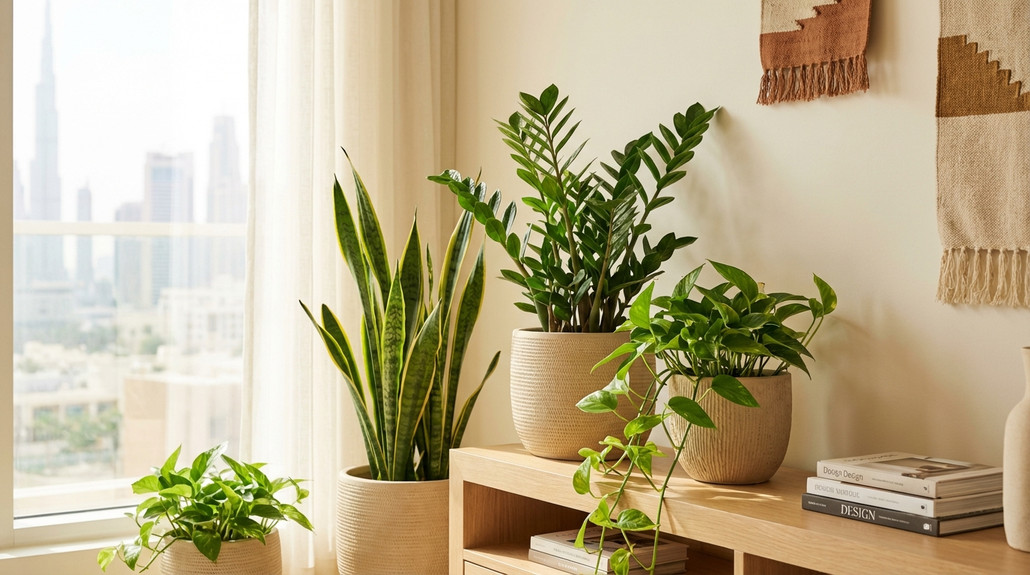
Commonly known as Sansevieria, the Snake Plant is the epitome of resilience. Its structural, upright leaves are not just for aesthetics; they are thick, waxy reservoirs of water. This allows the plant to go for extended periods, often three to four weeks, between waterings. It is exceptionally tolerant of low light conditions, making it perfect for hallways or corners far from a window. In fact, it can be damaged by the intense, direct sun that streams through south-facing windows in the UAE. Its air-purifying capabilities are an added benefit, as it is one of the few plants that convert CO2 into oxygen at night. It is slow-growing and requires almost no intervention beyond an occasional dusting of its leaves to ensure it can absorb light efficiently.
The ZZ Plant (Zamioculcas zamiifolia)
The ZZ Plant is arguably the most drought-tolerant houseplant available. Its survival mechanism lies underground in its large, potato-like rhizomes that store significant amounts of water. This feature means it actively prefers its soil to dry out completely between waterings. Overwatering is the only common way to harm it. Its glossy, dark green leaves are so uniform they are sometimes mistaken for artificial. The ZZ Plant is perfectly content in low to medium indirect light and handles the dry air from AC systems without any signs of stress, such as browning tips. It is a slow grower, meaning you will not need to repot it for years, making it an excellent long-term, set-it-and-forget-it option.
The Pothos (Epipremnum aureum)
While requiring slightly more frequent watering than a Snake or ZZ Plant, the Pothos earns its place on this list due to its incredible adaptability and clear communication. Its leaves will visibly droop when it is thirsty, providing a clear, unmistakable signal for when to water. It recovers quickly once hydrated. This feedback loop makes it an excellent teacher for beginners. Pothos can thrive in a wide spectrum of light conditions, from bright indirect light to lower-light office environments. Its fast-growing, trailing vines can be easily pruned to encourage fuller growth or left to cascade down a shelf, adding a dynamic layer of green to any space.
A Practical Minimum Care Routine
Caring for low maintenance plants is less about a rigid schedule and more about occasional, observant checks. The goal is to provide the bare minimum required for the plant to thrive, avoiding the common pitfall of over-caring. A simple, effective routine can be condensed into a few key actions performed infrequently. First, abandon the weekly watering schedule. For plants like the ZZ and Snake Plant, this is a path to root rot. Instead, adopt the "check, don't just water" method. Once every two to three weeks, insert your finger about two inches into the soil. If it feels completely dry, it is time to water. If there is any moisture, wait another week and check again. When you do water, do so thoroughly until water drains from the bottom of the pot, then discard the excess. This ensures the entire root system gets hydrated.
Second, address the dust. In the UAE, dust accumulation on leaves can be significant. Once a month, use a soft, damp cloth to gently wipe the leaves. This simple act keeps the plant looking fresh and, more importantly, clears the pores (stomata), allowing the plant to breathe and photosynthesize efficiently. Finally, fertilization should be minimal. These hardy plants do not require much feeding. Fertilize once in the spring and perhaps once in the summer with a balanced, diluted liquid fertilizer. Do not fertilize in the winter when growth naturally slows. Using the appropriate soil and care tools will make these simple tasks even easier.
Signs of Over-Caring: When Good Intentions Go Wrong
With neglect-tolerant plants, the most common problems arise not from inattention but from excessive care. Well-meaning plant owners, conditioned to think that more is better, often inadvertently harm their resilient greenery. The primary mistake is overwatering. These plants are adapted to dry conditions, and their roots cannot tolerate being in constantly soggy soil. This leads to root rot, a condition from which recovery is difficult. The signs of overwatering are often mistaken for underwatering: yellowing leaves (especially lower ones), a soft or mushy stem base, and stunted growth. If you see these symptoms, your first action should be to stop watering and check the soil moisture. Let the soil dry out completely before even considering watering again.
Another common error is placing a low-light tolerant plant in direct, intense sunlight. While they are adaptable, the harsh sun from a UAE window can scorch their leaves, leaving permanent brown or bleached patches. "Tolerates low light" does not mean "loves bright, direct sun." It is always safer to provide bright, indirect light. Lastly, resist the urge to constantly repot. Plants like the Snake Plant and ZZ Plant prefer to be slightly root-bound in their pots. Repotting them into a much larger container too soon can lead to the soil staying wet for too long, again increasing the risk of root rot. Unless you see roots growing aggressively out of the drainage holes, it is best to leave them be. They thrive on stability and minimal disruption.
Matching the Right Plant to Your Space
Selecting the ideal low maintenance plant can be further refined by considering the specific function and conditions of the room it will inhabit. This strategic placement ensures the plant not only survives but also enhances the intended atmosphere of the space.
For the Office or Desk
An office environment often has limited natural light and inconsistent attention from busy employees. The best choices are compact, unobtrusive, and highly tolerant of artificial lighting and infrequent watering. A small ZZ Plant or a compact variety of Snake Plant, like the 'Hahnii', are perfect selections. They require minimal space and their slow growth means they will not outgrow their spot for years. They are some of the most reliable office and desk plants available, adding a touch of green without demanding any time from a packed workday.
For a Dim Living Room Corner
Many living rooms have corners that are too far from a window to support most plants. This is where a larger Snake Plant or a ZZ Plant truly shines. Their tolerance for lower light levels allows you to bring life to otherwise empty spaces. A Pothos placed on a high shelf in such a corner can also work well, with its trailing vines creating vertical interest. These species are excellent examples of low light indoor plants that perform reliably without direct sun.
For the Bedroom
The bedroom is a space for rest and relaxation, and the right plant can contribute to a serene environment. The Snake Plant is an outstanding choice due to its unique ability to perform crassulacean acid metabolism (CAM), releasing oxygen at night. This is the reverse of most plants, which release oxygen during the day. This quality, combined with its minimal care needs, makes it one of the best plants suitable for bedrooms, promoting a healthier atmosphere while you sleep.
Frequently Asked Questions
How often should I actually water these plants?
There is no fixed schedule. For a ZZ Plant or Snake Plant in a typical UAE air-conditioned home, this could be as infrequent as once every 3-6 weeks. For a Pothos, it might be every 1-2 weeks. The golden rule is to always check the soil first. Only water when the top two inches of soil are completely dry to the touch. It is always safer to underwater than to overwater these types of plants.
Do low maintenance plants still need fertilizer?
Yes, but very sparingly. They are not heavy feeders. A balanced indoor plant fertilizer diluted to half-strength can be applied once or twice during the main growing season (spring and summer). Do not fertilize during the autumn and winter months, as the plant's growth naturally slows down, and it will not be able to use the excess nutrients.
Can these plants survive in a room with no windows?
While the plants listed are tolerant of low light, no plant can survive in zero natural light indefinitely. They can tolerate a windowless room, like a bathroom or internal office, if it is supplemented with a full-spectrum grow light for at least 8-10 hours per day. Standard fluorescent office lighting can sustain them for some time, but they will not thrive or grow robustly without a light source designed for plants.
What is the single most important factor for success in the UAE?
Managing water correctly. The combination of dry air from AC and the drought-tolerant nature of these recommended plants means that overwatering is the number one threat. Learning to let the soil dry out completely is the most crucial skill. Resist the impulse to water frequently. When in doubt, wait a few more days.