





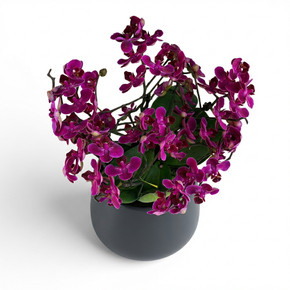
Make an unforgettable statement with our breathtaking Blue Orchid. Each bloom is a work of art, displaying a mesmerizing deep blue that brings a touch of modern elegance and exotic wonder to any room. Perfect as a luxurious gift or a personal indulgence, this Phalaenopsis orchid offers long-lasting beauty with its resilient, repeating flowers. It’s more than a plant; it's a living sculpture. Order yours today and transform your space with its unique color.
Common Name: Blue Orchid / Moth Orchid
Botanical Name: Phalaenopsis spp.
Variant: Dyed Blue
Color: Blue
Country of Origin: Netherlands
Arabic Name: اوركيد
Family: Orchidaceae
Kingdom: Plantae; Clade: Tracheophytes; Clade: Angiosperms; Clade: Monocots; Order: Asparagales; Family: Orchidaceae; Genus: Phalaenopsis.
While Phalaenopsis orchids are native to the tropical rainforests of Southeast Asia (Philippines, Indonesia, and Thailand) and Australia, the blue variant is specifically produced in nurseries, often in the Netherlands, using a patented dyeing or infusion process. They do not naturally occur in this electric blue shade in the wild.
Features broad, flat, dark green leathery leaves that grow in a basal rosette. The flowers are distinctive moth-like shapes, typically blooming in a vibrant, saturated blue. The flower spikes can be quite tall and elegant, often supported by a stake.
Typically 20 to 30 inches tall (50-75 cm) including the bloom spike. The leaf spread ranges from 8 to 12 inches (20-30 cm).
Bright, indirect light is essential. Avoid direct midday sun, which can burn the leaves. A spot near an east-facing window or a shaded south-facing window is usually ideal.
Water once a week or when the potting medium (bark or moss) feels nearly dry to the touch. Do not allow the plant to sit in standing water, as this causes root rot. Using tepid water is recommended to avoid temperature shock.
Requires a well-aerated potting medium specifically formulated for orchids, such as fir bark, orchid mix, or sphagnum moss. Clear plastic pots with excellent drainage are preferred to allow air circulation and to monitor root health.
Thrives in temperatures between 65°F and 80°F (18°C–27°C). High humidity (50–70%) is beneficial; placing the pot on a tray of wet pebbles or using a humidifier helps maintain the preferred moisture levels.
Use a balanced orchid fertilizer (e.g., 20-20-20) at half strength every two weeks during the growing season. Flush the medium with plain water once a month to remove salt buildup.
Maintenance Level: Moderate. While Phalaenopsis are among the easiest orchids to grow, care must be taken with watering. Note that the blue color is temporary; subsequent blooms will return to the orchid's natural color (usually white).
Phalaenopsis orchids grow slowly. Propagation is commonly done through 'keikis' (offsets) that appear on the flower spikes, or through tissue culture in professional laboratories. They typically bloom once a year, with flowers lasting several months.
Common issues include root rot from overwatering, scale, mealybugs, and spider mites. Bud blast (dropping of buds) can occur due to sudden changes in temperature, drafts, or low humidity.
Excellent air purifier, especially at night when it releases oxygen. Widely used for interior decoration, modern home styling, and as a luxury gift due to its unique appearance and symbolic elegance.
Phalaenopsis orchids are considered non-toxic to cats, dogs, and humans by the ASPCA, making them a safe choice for households with pets.
Make an unforgettable statement with our breathtaking Blue Orchid. Each bloom is a work of art, displaying a mesmerizing deep blue that brings a touch of modern elegance and exotic wonder to any room. Perfect as a luxurious gift or a personal indulgence, this Phalaenopsis orchid offers long-lasting beauty with its resilient, repeating flowers. It’s more than a plant; it's a living sculpture. Order yours today and transform your space with its unique color.
Common Name: Blue Orchid / Moth Orchid
Botanical Name: Phalaenopsis spp.
Variant: Dyed Blue
Color: Blue
Country of Origin: Netherlands
Arabic Name: اوركيد
Family: Orchidaceae
Kingdom: Plantae; Clade: Tracheophytes; Clade: Angiosperms; Clade: Monocots; Order: Asparagales; Family: Orchidaceae; Genus: Phalaenopsis.
While Phalaenopsis orchids are native to the tropical rainforests of Southeast Asia (Philippines, Indonesia, and Thailand) and Australia, the blue variant is specifically produced in nurseries, often in the Netherlands, using a patented dyeing or infusion process. They do not naturally occur in this electric blue shade in the wild.
Features broad, flat, dark green leathery leaves that grow in a basal rosette. The flowers are distinctive moth-like shapes, typically blooming in a vibrant, saturated blue. The flower spikes can be quite tall and elegant, often supported by a stake.
Typically 20 to 30 inches tall (50-75 cm) including the bloom spike. The leaf spread ranges from 8 to 12 inches (20-30 cm).
Bright, indirect light is essential. Avoid direct midday sun, which can burn the leaves. A spot near an east-facing window or a shaded south-facing window is usually ideal.
Water once a week or when the potting medium (bark or moss) feels nearly dry to the touch. Do not allow the plant to sit in standing water, as this causes root rot. Using tepid water is recommended to avoid temperature shock.
Requires a well-aerated potting medium specifically formulated for orchids, such as fir bark, orchid mix, or sphagnum moss. Clear plastic pots with excellent drainage are preferred to allow air circulation and to monitor root health.
Thrives in temperatures between 65°F and 80°F (18°C–27°C). High humidity (50–70%) is beneficial; placing the pot on a tray of wet pebbles or using a humidifier helps maintain the preferred moisture levels.
Use a balanced orchid fertilizer (e.g., 20-20-20) at half strength every two weeks during the growing season. Flush the medium with plain water once a month to remove salt buildup.
Maintenance Level: Moderate. While Phalaenopsis are among the easiest orchids to grow, care must be taken with watering. Note that the blue color is temporary; subsequent blooms will return to the orchid's natural color (usually white).
Phalaenopsis orchids grow slowly. Propagation is commonly done through 'keikis' (offsets) that appear on the flower spikes, or through tissue culture in professional laboratories. They typically bloom once a year, with flowers lasting several months.
Common issues include root rot from overwatering, scale, mealybugs, and spider mites. Bud blast (dropping of buds) can occur due to sudden changes in temperature, drafts, or low humidity.
Excellent air purifier, especially at night when it releases oxygen. Widely used for interior decoration, modern home styling, and as a luxury gift due to its unique appearance and symbolic elegance.
Phalaenopsis orchids are considered non-toxic to cats, dogs, and humans by the ASPCA, making them a safe choice for households with pets.


Take 20% off your first order
Enter the code below at checkout to get 20% off your first order