

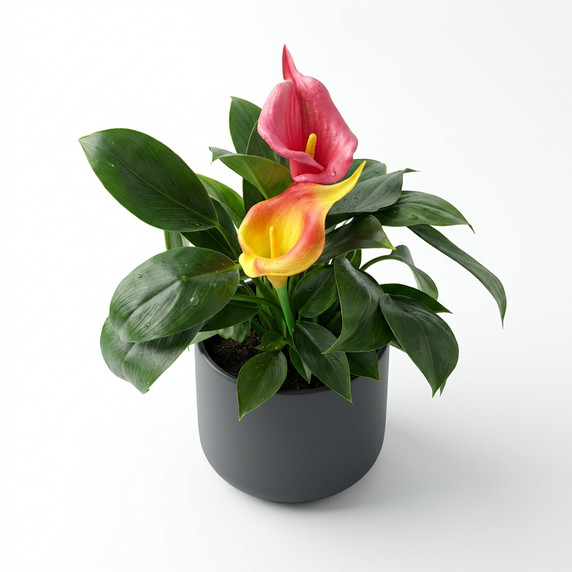





Add instant luxury to any space with the Calla Lily—sleek, modern blooms paired with lush green foliage. Perfect for bright living rooms, reception counters, and thoughtful gifts. With simple watering and occasional feeding, it rewards you with striking flowers that look professionally styled all season.
Common Name: Calla Lily, Arum Lily
Botanical Name: Zantedeschia aethiopica
Arabic Name: فيلو مائي
Family: Araceae
Stems: 1
Variant: Standard
Color: Multicolor
Kingdom: Plantae
Clade: Tracheophytes
Clade: Angiosperms
Clade: Monocots
Order: Alismatales
Family: Araceae
Genus: Zantedeschia
Species: Zantedeschia aethiopica
The Calla Lily is native to southern Africa, specifically found in South Africa, Swaziland, and Lesotho. It has been widely introduced and naturalized in many tropical and temperate regions across the world, including parts of Australia, Europe, and the Americas.
This plant features large, glossy, arrow-shaped dark green leaves. Its most distinctive feature is the large, trumpet-shaped "flower" which is actually a spathe (a modified leaf) that wraps around a central yellow spadix. While white is most common in the species, hybrid varieties offer a range of colors.
In indoor settings, it typically reaches a height of 2 to 3 feet (60–90 cm) with a spread of approximately 1.5 to 2 feet. When grown in ideal outdoor marsh conditions, it can occasionally grow even larger.
Calla Lilies thrive in bright, indirect light. They can tolerate some direct morning sun, but intense afternoon sun can scorch the foliage. If the plant does not receive enough light, it may stop flowering.
Keep the soil consistently moist during the growing season. Unlike many other houseplants, Calla Lilies are semi-aquatic in nature and do not mind "wet feet." However, if grown in pots, ensure the soil is damp but not sitting in stagnant, sour water for long periods.
Use a rich, organic potting mix that retains moisture well. A mixture of peat moss and perlite or a high-quality loam-based compost is ideal. Ensure the pot has drainage holes even though the plant likes moisture.
Prefers moderate temperatures between 60°F and 75°F (15°C to 24°C). They are sensitive to frost and should be moved away from cold drafts. They enjoy moderate to high humidity levels; misting the leaves can be beneficial in dry environments.
Feed every two weeks during the spring and summer using a balanced liquid fertilizer or a bloom-boosting formula to encourage flowering. Do not fertilize during the winter dormancy period.
Maintenance is moderate. Routine care involves removing spent flowers (deadheading) and yellowing leaves to encourage new growth. The plant may enter a period of dormancy after flowering, during which watering should be reduced.
Calla Lilies grow from thick rhizomes. They can be easily propagated by dividing these rhizomes during the spring or when repotting. They can also be grown from seed, though this takes significantly longer to produce blooms.
Susceptible to root and rhizome rot if kept in excessively cold, waterlogged soil without airflow. Common pests include aphids and spider mites. Leaves may turn yellow if the plant is moving into its natural dormancy phase.
Widely used as a luxury cut flower for weddings and bouquets. As a living plant, it is recognized for its air-purifying qualities. It is an excellent choice for ornamental containers, indoor decor, and wetland or bog gardening.
Highly toxic. The plant contains calcium oxalate crystals which are poisonous to humans, cats, and dogs if ingested. Contact with the sap can also cause skin irritation or burning sensations in the mouth and throat.
Add instant luxury to any space with the Calla Lily—sleek, modern blooms paired with lush green foliage. Perfect for bright living rooms, reception counters, and thoughtful gifts. With simple watering and occasional feeding, it rewards you with striking flowers that look professionally styled all season.
Common Name: Calla Lily, Arum Lily
Botanical Name: Zantedeschia aethiopica
Arabic Name: فيلو مائي
Family: Araceae
Stems: 1
Variant: Standard
Color: Multicolor
Kingdom: Plantae
Clade: Tracheophytes
Clade: Angiosperms
Clade: Monocots
Order: Alismatales
Family: Araceae
Genus: Zantedeschia
Species: Zantedeschia aethiopica
The Calla Lily is native to southern Africa, specifically found in South Africa, Swaziland, and Lesotho. It has been widely introduced and naturalized in many tropical and temperate regions across the world, including parts of Australia, Europe, and the Americas.
This plant features large, glossy, arrow-shaped dark green leaves. Its most distinctive feature is the large, trumpet-shaped "flower" which is actually a spathe (a modified leaf) that wraps around a central yellow spadix. While white is most common in the species, hybrid varieties offer a range of colors.
In indoor settings, it typically reaches a height of 2 to 3 feet (60–90 cm) with a spread of approximately 1.5 to 2 feet. When grown in ideal outdoor marsh conditions, it can occasionally grow even larger.
Calla Lilies thrive in bright, indirect light. They can tolerate some direct morning sun, but intense afternoon sun can scorch the foliage. If the plant does not receive enough light, it may stop flowering.
Keep the soil consistently moist during the growing season. Unlike many other houseplants, Calla Lilies are semi-aquatic in nature and do not mind "wet feet." However, if grown in pots, ensure the soil is damp but not sitting in stagnant, sour water for long periods.
Use a rich, organic potting mix that retains moisture well. A mixture of peat moss and perlite or a high-quality loam-based compost is ideal. Ensure the pot has drainage holes even though the plant likes moisture.
Prefers moderate temperatures between 60°F and 75°F (15°C to 24°C). They are sensitive to frost and should be moved away from cold drafts. They enjoy moderate to high humidity levels; misting the leaves can be beneficial in dry environments.
Feed every two weeks during the spring and summer using a balanced liquid fertilizer or a bloom-boosting formula to encourage flowering. Do not fertilize during the winter dormancy period.
Maintenance is moderate. Routine care involves removing spent flowers (deadheading) and yellowing leaves to encourage new growth. The plant may enter a period of dormancy after flowering, during which watering should be reduced.
Calla Lilies grow from thick rhizomes. They can be easily propagated by dividing these rhizomes during the spring or when repotting. They can also be grown from seed, though this takes significantly longer to produce blooms.
Susceptible to root and rhizome rot if kept in excessively cold, waterlogged soil without airflow. Common pests include aphids and spider mites. Leaves may turn yellow if the plant is moving into its natural dormancy phase.
Widely used as a luxury cut flower for weddings and bouquets. As a living plant, it is recognized for its air-purifying qualities. It is an excellent choice for ornamental containers, indoor decor, and wetland or bog gardening.
Highly toxic. The plant contains calcium oxalate crystals which are poisonous to humans, cats, and dogs if ingested. Contact with the sap can also cause skin irritation or burning sensations in the mouth and throat.

Take 20% off your first order
Enter the code below at checkout to get 20% off your first order