




Make a modern statement with Euphorbia ingens—an elegant, sculptural succulent that brings instant height and a desert-chic silhouette to any space. Perfect for bright rooms, entrances, and patios, it rewards you with strong growth on a simple routine: sun, fast drainage, and infrequent watering. Choose it when you want maximum impact with minimal maintenance (and place it where it won’t be touched, as the sap is irritating).
Common Name: Candelabra Tree, Desert Candle, Cowboy Cactus
Botanical Name: Euphorbia ingens
Arabic Name: يوفوربيا إنجنز
Plant Variant: Standard
Plant Color: Natural
Kingdom: Plantae
Order: Malpighiales
Family: Euphorbiaceae
Genus: Euphorbia
Species: E. ingens
Native to Southern Africa, predominantly found in South Africa, Botswana, Zimbabwe, and Mozambique, where it thrives in dry, rocky savanna regions.
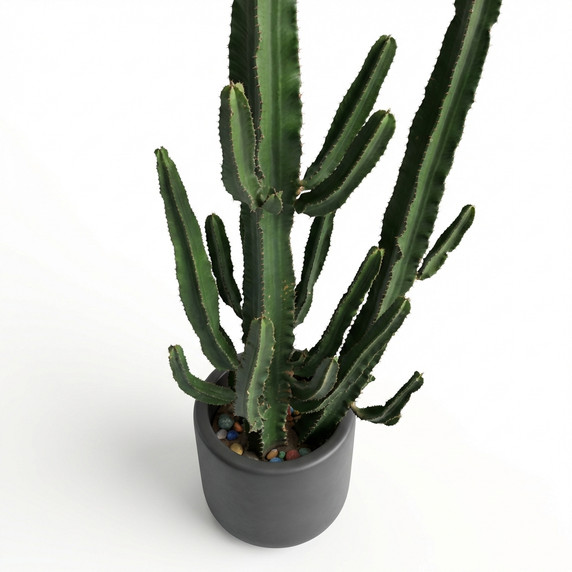
This species is a succulent, tree-like plant with a short, thick trunk and numerous upright, segmented branches. The branches are four-angled, dark green, and resemble a candelabra. Small, scale-like leaves appear on new growth but drop quickly, leaving spines along the ridges. Small yellowish flowers may bloom at the tips of the branches during spring and summer.
In its natural habitat, it can reach heights of 10 to 12 meters. As an indoor specimen, it typically grows between 1 to 3 meters, depending on the container size and available ceiling height.
Requires full sun to bright, direct light. Indoors, it should be placed near a south-facing window. It can tolerate bright indirect light, but growth will be slower and the stems may become thin.
Drought-tolerant. Allow the soil to dry out completely between waterings. During the growing season (spring/summer), water every 2-3 weeks. In winter, reduce watering to once a month or less, as the plant goes dormant.
Requires a very well-draining potting medium, such as a dedicated cactus and succulent mix. Use a heavy pot (clay or terracotta) to provide stability as the plant becomes top-heavy and to allow moisture to evaporate through the walls.
Prefers warm temperatures between 18°C and 30°C. It is not frost-tolerant and should be protected from temperatures below 10°C. Thrives in low humidity environments.
Apply a balanced, diluted liquid fertilizer formulated for succulents once a month during the spring and summer. Do not fertilize during the winter months.
Low maintenance. Care ease is high as the plant requires very little attention. Pruning is rarely necessary except to remove dead parts or to control the size, but caution is required due to the toxic sap.
Slow to moderate growth rate. Propagation is typically achieved through stem cuttings. Cuttings must be allowed to callous for several days before planting in soil to prevent rot.
Overwatering is the primary cause of root and stem rot. It may occasionally be susceptible to mealybugs and spider mites. Inadequate light can cause the branches to stretch or lean (etiolation).
Primarily used as a dramatic architectural statement piece in interior design and xeriscaping. It is highly effective in modern or desert-themed decor for adding height and texture.
High toxicity. Like most Euphorbias, it contains a milky white latex sap that is highly corrosive and irritating to the skin and eyes. It is toxic if ingested by humans or pets. Always wear gloves when handling and keep out of reach of children and animals.
Make a modern statement with Euphorbia ingens—an elegant, sculptural succulent that brings instant height and a desert-chic silhouette to any space. Perfect for bright rooms, entrances, and patios, it rewards you with strong growth on a simple routine: sun, fast drainage, and infrequent watering. Choose it when you want maximum impact with minimal maintenance (and place it where it won’t be touched, as the sap is irritating).
Common Name: Candelabra Tree, Desert Candle, Cowboy Cactus
Botanical Name: Euphorbia ingens
Arabic Name: يوفوربيا إنجنز
Plant Variant: Standard
Plant Color: Natural
Kingdom: Plantae
Order: Malpighiales
Family: Euphorbiaceae
Genus: Euphorbia
Species: E. ingens
Native to Southern Africa, predominantly found in South Africa, Botswana, Zimbabwe, and Mozambique, where it thrives in dry, rocky savanna regions.
This species is a succulent, tree-like plant with a short, thick trunk and numerous upright, segmented branches. The branches are four-angled, dark green, and resemble a candelabra. Small, scale-like leaves appear on new growth but drop quickly, leaving spines along the ridges. Small yellowish flowers may bloom at the tips of the branches during spring and summer.
In its natural habitat, it can reach heights of 10 to 12 meters. As an indoor specimen, it typically grows between 1 to 3 meters, depending on the container size and available ceiling height.
Requires full sun to bright, direct light. Indoors, it should be placed near a south-facing window. It can tolerate bright indirect light, but growth will be slower and the stems may become thin.
Drought-tolerant. Allow the soil to dry out completely between waterings. During the growing season (spring/summer), water every 2-3 weeks. In winter, reduce watering to once a month or less, as the plant goes dormant.
Requires a very well-draining potting medium, such as a dedicated cactus and succulent mix. Use a heavy pot (clay or terracotta) to provide stability as the plant becomes top-heavy and to allow moisture to evaporate through the walls.
Prefers warm temperatures between 18°C and 30°C. It is not frost-tolerant and should be protected from temperatures below 10°C. Thrives in low humidity environments.
Apply a balanced, diluted liquid fertilizer formulated for succulents once a month during the spring and summer. Do not fertilize during the winter months.
Low maintenance. Care ease is high as the plant requires very little attention. Pruning is rarely necessary except to remove dead parts or to control the size, but caution is required due to the toxic sap.
Slow to moderate growth rate. Propagation is typically achieved through stem cuttings. Cuttings must be allowed to callous for several days before planting in soil to prevent rot.
Overwatering is the primary cause of root and stem rot. It may occasionally be susceptible to mealybugs and spider mites. Inadequate light can cause the branches to stretch or lean (etiolation).
Primarily used as a dramatic architectural statement piece in interior design and xeriscaping. It is highly effective in modern or desert-themed decor for adding height and texture.
High toxicity. Like most Euphorbias, it contains a milky white latex sap that is highly corrosive and irritating to the skin and eyes. It is toxic if ingested by humans or pets. Always wear gloves when handling and keep out of reach of children and animals.


Take 20% off your first order
Enter the code below at checkout to get 20% off your first order