


Chinese Evergreen 'Emerald Green'
Transform your space with the effortless beauty of the Chinese Evergreen. This plant is a true survivor, thriving in spots where others won't and asking for very little in return. Its stunning green foliage not only beautifies your home or office but also works silently to clean the air you breathe. Perfect for the modern, busy lifestyle, the Aglaonema is more than a plant—it's a low-maintenance, air-purifying companion. Add this green gem to your cart today and breathe a little easier.
1. Basic Identification
Common Name: Chinese Evergreen / اكلونميا
Botanical Name: Aglaonema commutatum
Variant: Emerald Green
Color: Green
Country of Origin: Netherlands
Family: Araceae
Stems: Clumping stems
Location: Indoor
2. Taxonomy & Classification
Kingdom: Plantae
Clade: Tracheophytes
Order: Alismatales
Family: Araceae
Genus: Aglaonema
Species: Aglaonema commutatum
3. Origin & Distribution
The Aglaonema commutatum is native to the tropical and subtropical regions of Southeast Asia, specifically the Philippines and northeastern Celebes. It has since been naturalized in various other tropical locales and is a staple in indoor horticulture worldwide.
4. Visual Characteristics
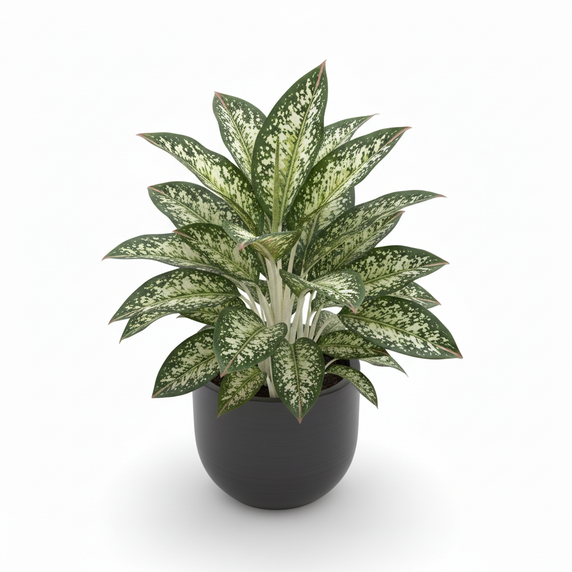
The 'Emerald Green' variant is characterized by its lush, lance-shaped leaves that are a deep, uniform green. Unlike many variegated Aglaonemas, this variant focuses on a rich, saturated color. The leaves grow from clumping stems, creating a dense, bushy appearance that stays vibrant year-round.
5. Size & Dimensions
Typically, this plant reaches a height of 1 to 3 feet (30–90 cm) and spreads to a similar width. The leaves themselves can grow up to 8–10 inches in length, contributing to its full and healthy look.
6. Light Requirements
Chinese Evergreens are famous for their ability to thrive in low-light conditions. While they prefer medium, indirect light, they can adapt to very low light and even artificial office lighting. Avoid direct sunlight, which can burn the foliage.
7. Watering Needs
Water the plant when the top 1 to 2 inches of soil feel dry to the touch. It is drought-tolerant but prefers consistent moisture. Ensure the pot has adequate drainage to prevent water from sitting at the bottom, as the plant is sensitive to root rot.
8. Soil & Potting
A well-draining potting mix is essential. A blend of standard potting soil with perlite or orchid bark works well to ensure aeration and drainage. Repotting is generally only necessary every 2–3 years.
9. Temperature & Humidity
Aglaonema thrives in temperatures between 65°F and 80°F (18°C–27°C). It is sensitive to cold drafts and temperatures below 60°F. While it enjoys high humidity, it is remarkably resilient and adapts well to the standard humidity levels found in most homes and offices.
10. Fertilization
Feed the plant with a balanced, water-soluble liquid fertilizer once a month during the growing season (spring and summer). Reduce feeding during the fall and winter months when the plant’s growth slows down.
11. Maintenance & Care Level
Care Level: Easy. This is a low-maintenance plant. Maintenance involves wiping the leaves occasionally with a damp cloth to remove dust and removing any yellowing or dead leaves at the base to encourage new growth.
12. Growth & Propagation
Growth is slow to moderate. Propagation is most successful through stem cuttings or by dividing the root ball during repotting in the spring.
13. Common Problems
Overwatering is the most common issue, leading to root rot. Occasionally, it may attract pests like mealybugs or spider mites. Brown leaf tips may suggest that the air is too dry or that there is an accumulation of minerals from tap water.
14. Benefits & Uses
Highly valued for its air-purifying qualities, it is efficient at removing common indoor toxins like formaldehyde and benzene. Its aesthetic versatility makes it perfect for reception desks, office cubicles, bedrooms, and living room décor.
15. Toxicity & Safety
The plant contains calcium oxalate crystals, which are toxic if ingested. It can cause irritation to the mouth, tongue, and throat in humans and pets (cats and dogs). Keep out of reach of small children and animals.

Chinese Evergreen 'Emerald Green'
Transform your space with the effortless beauty of the Chinese Evergreen. This plant is a true survivor, thriving in spots where others won't and asking for very little in return. Its stunning green foliage not only beautifies your home or office but also works silently to clean the air you breathe. Perfect for the modern, busy lifestyle, the Aglaonema is more than a plant—it's a low-maintenance, air-purifying companion. Add this green gem to your cart today and breathe a little easier.
1. Basic Identification
Common Name: Chinese Evergreen / اكلونميا
Botanical Name: Aglaonema commutatum
Variant: Emerald Green
Color: Green
Country of Origin: Netherlands
Family: Araceae
Stems: Clumping stems
Location: Indoor
2. Taxonomy & Classification
Kingdom: Plantae
Clade: Tracheophytes
Order: Alismatales
Family: Araceae
Genus: Aglaonema
Species: Aglaonema commutatum
3. Origin & Distribution
The Aglaonema commutatum is native to the tropical and subtropical regions of Southeast Asia, specifically the Philippines and northeastern Celebes. It has since been naturalized in various other tropical locales and is a staple in indoor horticulture worldwide.
4. Visual Characteristics
The 'Emerald Green' variant is characterized by its lush, lance-shaped leaves that are a deep, uniform green. Unlike many variegated Aglaonemas, this variant focuses on a rich, saturated color. The leaves grow from clumping stems, creating a dense, bushy appearance that stays vibrant year-round.
5. Size & Dimensions
Typically, this plant reaches a height of 1 to 3 feet (30–90 cm) and spreads to a similar width. The leaves themselves can grow up to 8–10 inches in length, contributing to its full and healthy look.
6. Light Requirements
Chinese Evergreens are famous for their ability to thrive in low-light conditions. While they prefer medium, indirect light, they can adapt to very low light and even artificial office lighting. Avoid direct sunlight, which can burn the foliage.
7. Watering Needs
Water the plant when the top 1 to 2 inches of soil feel dry to the touch. It is drought-tolerant but prefers consistent moisture. Ensure the pot has adequate drainage to prevent water from sitting at the bottom, as the plant is sensitive to root rot.
8. Soil & Potting
A well-draining potting mix is essential. A blend of standard potting soil with perlite or orchid bark works well to ensure aeration and drainage. Repotting is generally only necessary every 2–3 years.
9. Temperature & Humidity
Aglaonema thrives in temperatures between 65°F and 80°F (18°C–27°C). It is sensitive to cold drafts and temperatures below 60°F. While it enjoys high humidity, it is remarkably resilient and adapts well to the standard humidity levels found in most homes and offices.
10. Fertilization
Feed the plant with a balanced, water-soluble liquid fertilizer once a month during the growing season (spring and summer). Reduce feeding during the fall and winter months when the plant’s growth slows down.
11. Maintenance & Care Level
Care Level: Easy. This is a low-maintenance plant. Maintenance involves wiping the leaves occasionally with a damp cloth to remove dust and removing any yellowing or dead leaves at the base to encourage new growth.
12. Growth & Propagation
Growth is slow to moderate. Propagation is most successful through stem cuttings or by dividing the root ball during repotting in the spring.
13. Common Problems
Overwatering is the most common issue, leading to root rot. Occasionally, it may attract pests like mealybugs or spider mites. Brown leaf tips may suggest that the air is too dry or that there is an accumulation of minerals from tap water.
14. Benefits & Uses
Highly valued for its air-purifying qualities, it is efficient at removing common indoor toxins like formaldehyde and benzene. Its aesthetic versatility makes it perfect for reception desks, office cubicles, bedrooms, and living room décor.
15. Toxicity & Safety
The plant contains calcium oxalate crystals, which are toxic if ingested. It can cause irritation to the mouth, tongue, and throat in humans and pets (cats and dogs). Keep out of reach of small children and animals.