


Codiaeum variegatum 'Aucubaefolia (Gold Dust Croton)'
Bring bold, premium color to your space with Croton—an eye-catching foliage plant with dramatic green, yellow, and red patterns. Perfect for bright corners, entrances, and reception areas. With the right light and steady care, it stays vibrant and lush, instantly upgrading any interior or shaded patio display.
1. Basic Identification
Common Name: Gold Dust Croton / Aucubaefolia Croton
Botanical Name: Codiaeum variegatum 'Aucubaefolia'
Arabic Name: كروتون
Plant Variant: Aucubaefolia (Gold Dust Croton)
Color: Colored (Green with Yellow Speckles)
2. Taxonomy & Classification
Kingdom: Plantae
Order: Malpighiales
Family: Euphorbiaceae
Genus: Codiaeum
Species: Codiaeum variegatum
3. Origin & Distribution
Native to the tropical regions of Southeast Asia and the Western Pacific, including Indonesia, Malaysia, and Australia. It is widely cultivated globally as an ornamental houseplant.
4. Visual Characteristics
The 'Aucubaefolia' variant is characterized by its narrow, glossy, elliptical green leaves that are heavily splattered with bright yellow spots, giving it a 'gold dust' appearance. Unlike some other crotons, this variety focuses on the contrast between deep green and vibrant yellow.
5. Size & Dimensions
Indoors, it typically grows to a height of 2 to 3 feet and a width of about 2 feet. In its natural tropical habitat, it can reach up to 6 feet or more as a woody shrub.
6. Light Requirements
Requires bright, indirect light to maintain its vivid variegation. While it can tolerate some direct morning sun, harsh afternoon sun may burn the foliage. Low light will cause the yellow spots to fade and the plant to become leggy.
7. Watering Needs
Keep the soil consistently moist but not waterlogged. Water when the top inch of soil feels dry to the touch. It is sensitive to both overwatering and extreme drought.
8. Soil & Potting
Prefers a rich, well-draining potting mix. A combination of peat moss, perlite, and standard potting soil is ideal. Ensure the container has adequate drainage holes to prevent root rot.
9. Temperature & Humidity
Thrives in warm temperatures between 60°F and 85°F (15°C - 30°C). It is highly sensitive to cold drafts and temperatures below 50°F (10°C). High humidity is essential; regular misting or a humidifier is recommended.
10. Fertilization
Apply a balanced liquid fertilizer once a month during the active growing season (spring and summer). Do not fertilize during the winter months when growth slows down.
11. Maintenance & Care Level
Moderate. Crotons are known for being 'fussy' if moved frequently. They may drop leaves in response to environmental stress, such as sudden changes in temperature or light levels.
12. Growth & Propagation
A slow to moderate grower. It can be propagated through stem-tip cuttings taken in the spring, ideally using a rooting hormone and providing high humidity during the rooting process.
13. Common Problems
Susceptible to spider mites, mealybugs, and scale, particularly in dry indoor environments. Leaf drop is a common reaction to environmental stress or improper watering.
14. Benefits & Uses
Primarily used as a decorative ornamental plant to add a tropical aesthetic and bright color to interiors, offices, and shaded outdoor patios. It is highly valued for its unique foliage patterns.
15. Toxicity & Safety
Toxic to both humans and pets. If ingested, it can cause mouth irritation, nausea, and vomiting. The milky sap can also cause skin irritation or dermatitis in sensitive individuals.
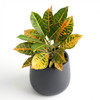
Codiaeum variegatum 'Aucubaefolia (Gold Dust Croton)'

Bring bold, premium color to your space with Croton—an eye-catching foliage plant with dramatic green, yellow, and red patterns. Perfect for bright corners, entrances, and reception areas. With the right light and steady care, it stays vibrant and lush, instantly upgrading any interior or shaded patio display.
1. Basic Identification
Common Name: Gold Dust Croton / Aucubaefolia Croton
Botanical Name: Codiaeum variegatum 'Aucubaefolia'
Arabic Name: كروتون
Plant Variant: Aucubaefolia (Gold Dust Croton)
Color: Colored (Green with Yellow Speckles)
2. Taxonomy & Classification
Kingdom: Plantae
Order: Malpighiales
Family: Euphorbiaceae
Genus: Codiaeum
Species: Codiaeum variegatum
3. Origin & Distribution
Native to the tropical regions of Southeast Asia and the Western Pacific, including Indonesia, Malaysia, and Australia. It is widely cultivated globally as an ornamental houseplant.
4. Visual Characteristics
The 'Aucubaefolia' variant is characterized by its narrow, glossy, elliptical green leaves that are heavily splattered with bright yellow spots, giving it a 'gold dust' appearance. Unlike some other crotons, this variety focuses on the contrast between deep green and vibrant yellow.
5. Size & Dimensions
Indoors, it typically grows to a height of 2 to 3 feet and a width of about 2 feet. In its natural tropical habitat, it can reach up to 6 feet or more as a woody shrub.
6. Light Requirements
Requires bright, indirect light to maintain its vivid variegation. While it can tolerate some direct morning sun, harsh afternoon sun may burn the foliage. Low light will cause the yellow spots to fade and the plant to become leggy.
7. Watering Needs
Keep the soil consistently moist but not waterlogged. Water when the top inch of soil feels dry to the touch. It is sensitive to both overwatering and extreme drought.
8. Soil & Potting
Prefers a rich, well-draining potting mix. A combination of peat moss, perlite, and standard potting soil is ideal. Ensure the container has adequate drainage holes to prevent root rot.
9. Temperature & Humidity
Thrives in warm temperatures between 60°F and 85°F (15°C - 30°C). It is highly sensitive to cold drafts and temperatures below 50°F (10°C). High humidity is essential; regular misting or a humidifier is recommended.
10. Fertilization
Apply a balanced liquid fertilizer once a month during the active growing season (spring and summer). Do not fertilize during the winter months when growth slows down.
11. Maintenance & Care Level
Moderate. Crotons are known for being 'fussy' if moved frequently. They may drop leaves in response to environmental stress, such as sudden changes in temperature or light levels.
12. Growth & Propagation
A slow to moderate grower. It can be propagated through stem-tip cuttings taken in the spring, ideally using a rooting hormone and providing high humidity during the rooting process.
13. Common Problems
Susceptible to spider mites, mealybugs, and scale, particularly in dry indoor environments. Leaf drop is a common reaction to environmental stress or improper watering.
14. Benefits & Uses
Primarily used as a decorative ornamental plant to add a tropical aesthetic and bright color to interiors, offices, and shaded outdoor patios. It is highly valued for its unique foliage patterns.
15. Toxicity & Safety
Toxic to both humans and pets. If ingested, it can cause mouth irritation, nausea, and vomiting. The milky sap can also cause skin irritation or dermatitis in sensitive individuals.