


Corn Plant
Transform your living or work space with the architectural elegance of the Dracaena fragrans. Known as the Corn Plant, its bold, tree-like form and lush, arching leaves make a powerful style statement. But it's not just about looks—this plant is a NASA-approved air-purifying hero, tirelessly working to create a healthier environment. Incredibly easy to care for and tolerant of various light conditions, the Corn Plant is the perfect green companion for anyone, from busy professionals to first-time plant parents. Bring home this icon of resilience and style today!
1. Basic Identification
Common Name: Corn Plant, Dracaena
Botanical Name: Dracaena fragrans
Arabic Name: دراسينيا
Family: Asparagaceae
Plant Variant: Standard
Plant Color: Natural
Country of Origin: Netherlands
2. Taxonomy & Classification
The Dracaena fragrans belongs to the kingdom Plantae, order Asparagales, and family Asparagaceae. It is part of the subfamily Nolinoideae and the genus Dracaena, which comprises approximately 120 species of trees and succulent shrubs.
3. Origin & Distribution
Native to tropical Africa, Dracaena fragrans is found growing naturally in countries such as Sudan, Mozambique, Côte d'Ivoire, and Angola. It has been naturalized in many other tropical regions and is widely cultivated globally as a popular indoor ornamental plant.
4. Visual Characteristics
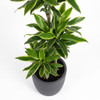
This plant features a thick, woody stem or "cane" that produces rosettes of long, arching, sword-shaped leaves. In the "Standard" form, leaves are typically a deep, glossy green. As the plant matures, lower leaves naturally drop to reveal the textured, tree-like trunk.
5. Size & Dimensions
Indoors, the Corn Plant typically grows to a height of 4 to 6 feet, though it can reach up to 15 feet in high-ceiling environments. The individual leaves can grow between 1 to 3 feet in length and 2 to 4 inches in width.
6. Light Requirements
Dracaena fragrans performs best in bright, indirect sunlight. While it is remarkably tolerant of lower light levels, its growth will slow significantly. Direct sunlight should be avoided as it can scorch and bleach the leaves.
7. Watering Needs
Water thoroughly when the top 50-75% of the soil has dried out. These plants are sensitive to overwatering and fluoride commonly found in tap water, which can cause brown leaf tips. Using filtered or rainwater is recommended.
8. Soil & Potting
A well-draining, loose potting mix is essential. A mixture of peat moss, perlite, and pine bark works well to ensure aeration. They prefer to be slightly root-bound and do not require frequent repotting.
9. Temperature & Humidity
Ideally kept in temperatures between 15°C and 24°C (60°F to 75°F). It can tolerate standard indoor humidity but thrives in slightly more humid environments. Keep away from cold drafts and heating vents.
10. Fertilization
Feed with a balanced, water-soluble liquid fertilizer once a month during the active growing seasons of spring and summer. Do not fertilize during the autumn and winter months when growth slows.
11. Maintenance & Care Level
Considered a low-maintenance plant. Care involves wiping the leaves with a damp cloth to remove dust and maintain photosynthesis efficiency. Pruning the top can be done to manage height and encourage bushier growth.
12. Growth & Propagation
It is a slow-growing evergreen perennial. Propagation is most commonly achieved through stem cuttings (cane cuttings) or air layering, typically performed during the spring or summer.
13. Common Problems
Common issues include brown leaf tips due to low humidity or tap water chemicals, and yellowing leaves from overwatering. Pests like spider mites, scale, and mealybugs may occasionally appear but can be treated with neem oil.
14. Benefits & Uses
Highly valued for its architectural form in interior design. It was featured in NASA's Clean Air Study for its ability to remove indoor toxins such as formaldehyde, benzene, and trichloroethylene, making it an excellent choice for offices and bedrooms.
15. Toxicity & Safety
Dracaena fragrans contains saponins and is toxic to cats and dogs if ingested, potentially causing vomiting and salivation. It is generally considered non-toxic to humans, though ingestion may cause mild stomach upset.
Corn Plant

Transform your living or work space with the architectural elegance of the Dracaena fragrans. Known as the Corn Plant, its bold, tree-like form and lush, arching leaves make a powerful style statement. But it's not just about looks—this plant is a NASA-approved air-purifying hero, tirelessly working to create a healthier environment. Incredibly easy to care for and tolerant of various light conditions, the Corn Plant is the perfect green companion for anyone, from busy professionals to first-time plant parents. Bring home this icon of resilience and style today!
1. Basic Identification
Common Name: Corn Plant, Dracaena
Botanical Name: Dracaena fragrans
Arabic Name: دراسينيا
Family: Asparagaceae
Plant Variant: Standard
Plant Color: Natural
Country of Origin: Netherlands
2. Taxonomy & Classification
The Dracaena fragrans belongs to the kingdom Plantae, order Asparagales, and family Asparagaceae. It is part of the subfamily Nolinoideae and the genus Dracaena, which comprises approximately 120 species of trees and succulent shrubs.
3. Origin & Distribution
Native to tropical Africa, Dracaena fragrans is found growing naturally in countries such as Sudan, Mozambique, Côte d'Ivoire, and Angola. It has been naturalized in many other tropical regions and is widely cultivated globally as a popular indoor ornamental plant.
4. Visual Characteristics
This plant features a thick, woody stem or "cane" that produces rosettes of long, arching, sword-shaped leaves. In the "Standard" form, leaves are typically a deep, glossy green. As the plant matures, lower leaves naturally drop to reveal the textured, tree-like trunk.
5. Size & Dimensions
Indoors, the Corn Plant typically grows to a height of 4 to 6 feet, though it can reach up to 15 feet in high-ceiling environments. The individual leaves can grow between 1 to 3 feet in length and 2 to 4 inches in width.
6. Light Requirements
Dracaena fragrans performs best in bright, indirect sunlight. While it is remarkably tolerant of lower light levels, its growth will slow significantly. Direct sunlight should be avoided as it can scorch and bleach the leaves.
7. Watering Needs
Water thoroughly when the top 50-75% of the soil has dried out. These plants are sensitive to overwatering and fluoride commonly found in tap water, which can cause brown leaf tips. Using filtered or rainwater is recommended.
8. Soil & Potting
A well-draining, loose potting mix is essential. A mixture of peat moss, perlite, and pine bark works well to ensure aeration. They prefer to be slightly root-bound and do not require frequent repotting.
9. Temperature & Humidity
Ideally kept in temperatures between 15°C and 24°C (60°F to 75°F). It can tolerate standard indoor humidity but thrives in slightly more humid environments. Keep away from cold drafts and heating vents.
10. Fertilization
Feed with a balanced, water-soluble liquid fertilizer once a month during the active growing seasons of spring and summer. Do not fertilize during the autumn and winter months when growth slows.
11. Maintenance & Care Level
Considered a low-maintenance plant. Care involves wiping the leaves with a damp cloth to remove dust and maintain photosynthesis efficiency. Pruning the top can be done to manage height and encourage bushier growth.
12. Growth & Propagation
It is a slow-growing evergreen perennial. Propagation is most commonly achieved through stem cuttings (cane cuttings) or air layering, typically performed during the spring or summer.
13. Common Problems
Common issues include brown leaf tips due to low humidity or tap water chemicals, and yellowing leaves from overwatering. Pests like spider mites, scale, and mealybugs may occasionally appear but can be treated with neem oil.
14. Benefits & Uses
Highly valued for its architectural form in interior design. It was featured in NASA's Clean Air Study for its ability to remove indoor toxins such as formaldehyde, benzene, and trichloroethylene, making it an excellent choice for offices and bedrooms.
15. Toxicity & Safety
Dracaena fragrans contains saponins and is toxic to cats and dogs if ingested, potentially causing vomiting and salivation. It is generally considered non-toxic to humans, though ingestion may cause mild stomach upset.