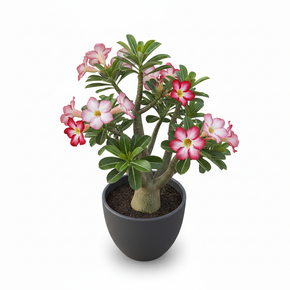




Transform your space with the living art of the Desert Rose Bonsai. A masterpiece of nature, this Adenium obesum boasts a dramatic, swollen caudex and a crown of lush leaves, erupting in a riot of vibrant, tropical flowers. Not just a plant, but a statement of elegance and resilience. Forgiving of forgetful watering and thriving in sunlight, it's the perfect low-maintenance sculpture for a modern home or office. Own a piece of the exotic desert today.
Common Name: Desert Rose Bonsai
Botanical Name: Adenium obesum
Arabic Name: ادينيوم بونزاي
Family: Apocynaceae
Variant: Standard
Color: Natural
Country of Origin: Thailand
Kingdom: Plantae
Clade: Tracheophytes
Order: Gentianales
Family: Apocynaceae
Genus: Adenium
Species: Adenium obesum
The Desert Rose is native to the Sahel regions south of the Sahara (from Mauritania and Senegal to Sudan), and tropical and subtropical eastern and southern Africa and Arabia. It has become widely naturalized and cultivated in Southeast Asia, particularly Thailand.
It is a succulent shrub characterized by a thick, fleshy pachycaul stem or caudex that stores water. The leaves are spirally arranged, leathery, and often clustered at the tips of the branches. Its most striking feature is its funnel-shaped flowers, which typically come in shades of pink, red, and white.
In its natural habitat, it can grow up to 3 meters (10 feet) tall. However, as a bonsai or container plant, it is typically maintained between 30 cm and 60 cm in height through careful pruning and pot restriction.
High light requirements. It thrives in full sun and requires at least 6 hours of direct sunlight daily to bloom successfully. If kept indoors, it must be placed in the sunniest spot available, such as a south-facing window.
Low watering needs. Being a succulent, it stores water in its trunk. Allow the soil to dry out completely between waterings. During the winter dormancy, watering should be reduced to once a month or less.
Requires excellent drainage to prevent root rot. Use a specialized cactus or succulent potting mix, or a blend of potting soil with plenty of perlite, coarse sand, or fine gravel.
Thrives in warm temperatures between 20°C and 35°C. It is extremely sensitive to frost and cold; temperatures below 10°C can cause dormancy or damage. It prefers low to moderate humidity typical of arid environments.
Feed with a balanced, water-soluble fertilizer diluted to half strength during the active growing season (spring and summer). Avoid fertilizing during the winter months.
Low Maintenance / Easy Care. It is highly resilient to drought. Maintenance primarily involves occasional pruning to maintain its bonsai shape and removing spent blooms.
The Desert Rose is a relatively slow grower. It can be propagated via seeds, which produce the characteristic swollen caudex, or through stem cuttings, though cutting-grown plants may not develop a large base as quickly.
The most frequent problem is root rot caused by overwatering or poorly draining soil. It can also be susceptible to common pests like mealybugs, aphids, and spider mites.
Primarily used as an ornamental decorative plant and a specimen for bonsai enthusiasts. Its striking appearance makes it an ideal center-piece for desks, lobbies, and sunny living rooms.
Highly toxic. The sap of Adenium obesum contains cardiac glycosides and is toxic to humans and pets (dogs, cats, and horses) if ingested. The sap can also cause skin irritation, so it is recommended to wear gloves when pruning.
Transform your space with the living art of the Desert Rose Bonsai. A masterpiece of nature, this Adenium obesum boasts a dramatic, swollen caudex and a crown of lush leaves, erupting in a riot of vibrant, tropical flowers. Not just a plant, but a statement of elegance and resilience. Forgiving of forgetful watering and thriving in sunlight, it's the perfect low-maintenance sculpture for a modern home or office. Own a piece of the exotic desert today.
Common Name: Desert Rose Bonsai
Botanical Name: Adenium obesum
Arabic Name: ادينيوم بونزاي
Family: Apocynaceae
Variant: Standard
Color: Natural
Country of Origin: Thailand
Kingdom: Plantae
Clade: Tracheophytes
Order: Gentianales
Family: Apocynaceae
Genus: Adenium
Species: Adenium obesum
The Desert Rose is native to the Sahel regions south of the Sahara (from Mauritania and Senegal to Sudan), and tropical and subtropical eastern and southern Africa and Arabia. It has become widely naturalized and cultivated in Southeast Asia, particularly Thailand.
It is a succulent shrub characterized by a thick, fleshy pachycaul stem or caudex that stores water. The leaves are spirally arranged, leathery, and often clustered at the tips of the branches. Its most striking feature is its funnel-shaped flowers, which typically come in shades of pink, red, and white.
In its natural habitat, it can grow up to 3 meters (10 feet) tall. However, as a bonsai or container plant, it is typically maintained between 30 cm and 60 cm in height through careful pruning and pot restriction.
High light requirements. It thrives in full sun and requires at least 6 hours of direct sunlight daily to bloom successfully. If kept indoors, it must be placed in the sunniest spot available, such as a south-facing window.
Low watering needs. Being a succulent, it stores water in its trunk. Allow the soil to dry out completely between waterings. During the winter dormancy, watering should be reduced to once a month or less.
Requires excellent drainage to prevent root rot. Use a specialized cactus or succulent potting mix, or a blend of potting soil with plenty of perlite, coarse sand, or fine gravel.
Thrives in warm temperatures between 20°C and 35°C. It is extremely sensitive to frost and cold; temperatures below 10°C can cause dormancy or damage. It prefers low to moderate humidity typical of arid environments.
Feed with a balanced, water-soluble fertilizer diluted to half strength during the active growing season (spring and summer). Avoid fertilizing during the winter months.
Low Maintenance / Easy Care. It is highly resilient to drought. Maintenance primarily involves occasional pruning to maintain its bonsai shape and removing spent blooms.
The Desert Rose is a relatively slow grower. It can be propagated via seeds, which produce the characteristic swollen caudex, or through stem cuttings, though cutting-grown plants may not develop a large base as quickly.
The most frequent problem is root rot caused by overwatering or poorly draining soil. It can also be susceptible to common pests like mealybugs, aphids, and spider mites.
Primarily used as an ornamental decorative plant and a specimen for bonsai enthusiasts. Its striking appearance makes it an ideal center-piece for desks, lobbies, and sunny living rooms.
Highly toxic. The sap of Adenium obesum contains cardiac glycosides and is toxic to humans and pets (dogs, cats, and horses) if ingested. The sap can also cause skin irritation, so it is recommended to wear gloves when pruning.



Take 20% off your first order
Enter the code below at checkout to get 20% off your first order