


Asparagaceae
Dracaena fragrans
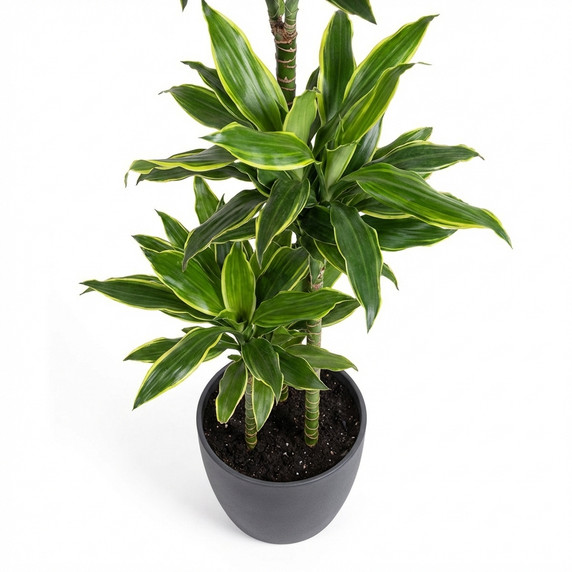
Add instant height and greenery with Dracaena fragrans—one of the most reliable indoor plants for modern spaces. Its cane form and full leaf rosettes create a clean, premium look in receptions, meeting rooms, and living areas. With simple watering and adaptable light needs, it’s an ideal choice for anyone who wants a beautiful plant without high-maintenance care.
1. Basic Identification
Common Name: Corn Plant, Mass Cane, Dracaena
Botanical Name: Dracaena fragrans
Arabic Name: دراسينيا
Plant Variant: Standard
Plant Color: Multicolor (Deep green with chartreuse or yellow variegation)
Family: Asparagaceae
2. Taxonomy & Classification
Dracaena fragrans belongs to the kingdom Plantae, order Asparagales, and family Asparagaceae. Within the genus Dracaena, it is one of several species known for its woody stems and lily-like foliage. It was previously categorized under the family Liliaceae or Agavaceae before modern molecular phylogenetics placed it in Asparagaceae.
3. Origin & Distribution
Native to tropical Africa, Dracaena fragrans is naturally found across a wide range including Sudan, Ethiopia, Ivory Coast, Angola, and Mozambique. It grows in upland forest regions and has since become a staple ornamental plant in tropical and subtropical climates worldwide, as well as a popular houseplant in temperate regions.
4. Visual Characteristics
The plant features thick, woody stalks (canes) topped with rosettes of long, arching, sword-shaped leaves. The leaves are typically glossy and can reach up to 3 feet in length. Many popular cultivars, such as 'Massangeana', feature a broad central stripe of yellow or lime green against dark green margins.
5. Size & Dimensions
Indoors, the Dracaena fragrans usually reaches a height of 4 to 6 feet, though it can grow taller in high-ceilinged spaces. The leaf rosettes can span 2 to 3 feet in diameter. In its native outdoor habitat, it can reach heights of up to 50 feet.
6. Light Requirements
This plant is highly adaptable. It thrives in bright, indirect light but is well-known for its ability to tolerate low-light conditions, making it perfect for offices and hallways. Avoid direct afternoon sun, which can scorch and bleach the leaves.
7. Watering Needs
Water moderately, allowing the top inch or two of soil to dry out before watering again. It is relatively drought-tolerant. Dracaena species can be sensitive to fluoride and salts in tap water, which may cause brown leaf tips; using filtered or distilled water is recommended.
8. Soil & Potting
Use a loose, well-draining potting mix rich in organic matter. A mix of peat moss, pine bark, and perlite or coarse sand is ideal to ensure the roots do not sit in water, which can lead to decay.
9. Temperature & Humidity
Prefers consistent temperatures between 16°C and 24°C (60°F–75°F). It should be protected from cold drafts and temperatures below 10°C (50°F). While it tolerates average indoor humidity, it appreciates occasional misting or being placed in a slightly humid environment.
10. Fertilization
Feed with a balanced, water-soluble liquid fertilizer once a month during the growing season (spring and summer). Do not fertilize during the winter months when growth naturally slows down.
11. Maintenance & Care Level
The maintenance level is low. Regular care includes wiping the broad leaves with a damp cloth to remove dust and maintain their shine. Pruning is only necessary if the plant becomes too tall; the cane can be cut at any height, and new rosettes will sprout from below the cut.
12. Growth & Propagation
It is a slow-growing evergreen. Propagation is most commonly achieved through stem cuttings or by "air layering." Cuttings taken from the canes can be rooted in either water or moist soil fairly easily.
13. Common Problems
The most common issues are brown leaf tips due to low humidity or tap water chemicals. Overwatering can lead to root rot and soft canes. Occasional pests include spider mites, scale, and mealybugs, which can be treated with neem oil or insecticidal soap.
14. Benefits & Uses
Dracaena fragrans is renowned for its air-purifying qualities; it was featured in NASA’s Clean Air Study for its ability to remove indoor toxins like formaldehyde, benzene, and trichloroethylene. It is widely used in interior landscaping for its architectural form and durability.
15. Toxicity & Safety
Dracaena fragrans contains saponins, which are toxic to cats and dogs. If ingested, it can cause vomiting (occasionally with blood), salivation, and dilated pupils in cats. It is generally not considered toxic to humans, though ingestion may cause minor stomach upset in children.

Dracaena fragrans
Add instant height and greenery with Dracaena fragrans—one of the most reliable indoor plants for modern spaces. Its cane form and full leaf rosettes create a clean, premium look in receptions, meeting rooms, and living areas. With simple watering and adaptable light needs, it’s an ideal choice for anyone who wants a beautiful plant without high-maintenance care.
1. Basic Identification
Common Name: Corn Plant, Mass Cane, Dracaena
Botanical Name: Dracaena fragrans
Arabic Name: دراسينيا
Plant Variant: Standard
Plant Color: Multicolor (Deep green with chartreuse or yellow variegation)
Family: Asparagaceae
2. Taxonomy & Classification
Dracaena fragrans belongs to the kingdom Plantae, order Asparagales, and family Asparagaceae. Within the genus Dracaena, it is one of several species known for its woody stems and lily-like foliage. It was previously categorized under the family Liliaceae or Agavaceae before modern molecular phylogenetics placed it in Asparagaceae.
3. Origin & Distribution
Native to tropical Africa, Dracaena fragrans is naturally found across a wide range including Sudan, Ethiopia, Ivory Coast, Angola, and Mozambique. It grows in upland forest regions and has since become a staple ornamental plant in tropical and subtropical climates worldwide, as well as a popular houseplant in temperate regions.
4. Visual Characteristics
The plant features thick, woody stalks (canes) topped with rosettes of long, arching, sword-shaped leaves. The leaves are typically glossy and can reach up to 3 feet in length. Many popular cultivars, such as 'Massangeana', feature a broad central stripe of yellow or lime green against dark green margins.
5. Size & Dimensions
Indoors, the Dracaena fragrans usually reaches a height of 4 to 6 feet, though it can grow taller in high-ceilinged spaces. The leaf rosettes can span 2 to 3 feet in diameter. In its native outdoor habitat, it can reach heights of up to 50 feet.
6. Light Requirements
This plant is highly adaptable. It thrives in bright, indirect light but is well-known for its ability to tolerate low-light conditions, making it perfect for offices and hallways. Avoid direct afternoon sun, which can scorch and bleach the leaves.
7. Watering Needs
Water moderately, allowing the top inch or two of soil to dry out before watering again. It is relatively drought-tolerant. Dracaena species can be sensitive to fluoride and salts in tap water, which may cause brown leaf tips; using filtered or distilled water is recommended.
8. Soil & Potting
Use a loose, well-draining potting mix rich in organic matter. A mix of peat moss, pine bark, and perlite or coarse sand is ideal to ensure the roots do not sit in water, which can lead to decay.
9. Temperature & Humidity
Prefers consistent temperatures between 16°C and 24°C (60°F–75°F). It should be protected from cold drafts and temperatures below 10°C (50°F). While it tolerates average indoor humidity, it appreciates occasional misting or being placed in a slightly humid environment.
10. Fertilization
Feed with a balanced, water-soluble liquid fertilizer once a month during the growing season (spring and summer). Do not fertilize during the winter months when growth naturally slows down.
11. Maintenance & Care Level
The maintenance level is low. Regular care includes wiping the broad leaves with a damp cloth to remove dust and maintain their shine. Pruning is only necessary if the plant becomes too tall; the cane can be cut at any height, and new rosettes will sprout from below the cut.
12. Growth & Propagation
It is a slow-growing evergreen. Propagation is most commonly achieved through stem cuttings or by "air layering." Cuttings taken from the canes can be rooted in either water or moist soil fairly easily.
13. Common Problems
The most common issues are brown leaf tips due to low humidity or tap water chemicals. Overwatering can lead to root rot and soft canes. Occasional pests include spider mites, scale, and mealybugs, which can be treated with neem oil or insecticidal soap.
14. Benefits & Uses
Dracaena fragrans is renowned for its air-purifying qualities; it was featured in NASA’s Clean Air Study for its ability to remove indoor toxins like formaldehyde, benzene, and trichloroethylene. It is widely used in interior landscaping for its architectural form and durability.
15. Toxicity & Safety
Dracaena fragrans contains saponins, which are toxic to cats and dogs. If ingested, it can cause vomiting (occasionally with blood), salivation, and dilated pupils in cats. It is generally not considered toxic to humans, though ingestion may cause minor stomach upset in children.