


Asparagaceae
Dracaena marginata 'Colorama'
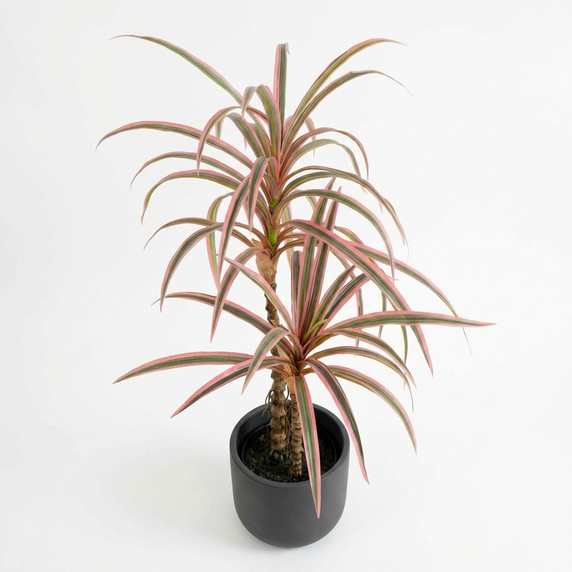
Create instant height and color with Dracaena marginata 'Colorama'—a sleek, architectural dragon tree that thrives on simple care. Its pink-red striped foliage brightens corners, reception areas, and living rooms while staying tidy and resilient. Give it bright, indirect light, water only when partly dry, and enjoy a designer look year-round with minimal effort.
1. Basic Identification
Common Name: Madagascar Dragon Tree, Dracaena Colorama
Botanical Name: Dracaena marginata
Variety: Colorama
Arabic Name: دراسينا
Family: Asparagaceae
Color: Multicolor
2. Taxonomy & Classification
Dracaena marginata 'Colorama' belongs to the Asparagaceae family. While formerly categorized under the genus Pleomele, it is now widely accepted as part of the Dracaena genus. The 'Colorama' variety is a mutation of the 'Tricolor' cultivar, specifically bred for its intensified red-pink pigmentation.
3. Origin & Distribution
The parent species, Dracaena marginata, is native to Madagascar. Because of its popularity as a robust and visually striking ornamental plant, it is now distributed and cultivated in tropical and subtropical regions worldwide, primarily as a high-end indoor foliage plant.
4. Visual Characteristics
The 'Colorama' cultivar is distinguished by its long, slender, sword-like leaves that grow in a rosette pattern. The leaves feature a central green stripe flanked by cream and vivid pinkish-red margins. As the plant matures, it loses its lower leaves, exposing a thin, greyish-brown woody cane that adds to its architectural, palm-like appearance.
5. Size & Dimensions
Indoors, this plant can grow between 6 to 10 feet in height, although it is a slow grower. The individual leaves typically measure 12 to 18 inches in length. In its natural habitat or in tropical gardens, it can reach heights of up to 15 feet or more.
6. Light Requirements
This plant performs best in bright, indirect sunlight. While it can tolerate lower light levels, its growth will slow, and the vibrant pink variegation may become less pronounced or fade to green. Avoid direct afternoon sun, which can cause unsightly scorch marks on the thin leaves.
7. Watering Needs
Water moderately and allow the top 50% to 75% of the soil to dry out before watering again. Dracaena marginata is sensitive to fluoride and chlorine often found in tap water, which can cause brown leaf tips; using filtered or distilled water is recommended.
8. Soil & Potting
Use a well-draining, loose potting mix rich in organic matter. A mixture of peat moss, pine bark, and perlite is ideal to ensure proper aeration and drainage, preventing water from sitting around the roots.
9. Temperature & Humidity
It thrives in standard household temperatures between 65°F and 80°F (18°C - 27°C). It can tolerate average indoor humidity but will benefit from increased levels, such as occasional misting or the use of a humidifier, especially in dry winter months.
10. Fertilization
Feed with a balanced, water-soluble fertilizer diluted to half-strength once a month during the active growing season (spring and summer). Avoid fertilizing in the fall and winter when the plant's growth naturally slows.
11. Maintenance & Care Level
The maintenance level is low, making it ideal for beginners. Care involves wiping the leaves with a damp cloth to remove dust and maintain photosynthesis. If the plant becomes too tall, the top can be cut off, which will stimulate the cane to sprout new heads of foliage below the cut.
12. Growth & Propagation
Growth is slow to moderate. Propagation is most successful through stem cuttings or air layering. Cuttings can be rooted in either water or soil, provided they are kept in a warm, bright environment.
13. Common Problems
The most common issues are brown leaf tips caused by low humidity or chemicals in tap water. It can be susceptible to spider mites, mealybugs, and scale if conditions are too dry. Overwatering typically leads to root rot and soft, drooping canes.
14. Benefits & Uses
Beyond its aesthetic appeal, it is recognized as an effective air-purifying plant. According to NASA studies, Dracaena species help remove toxins such as formaldehyde, benzene, and trichloroethylene from indoor air. It is frequently used by interior designers to add vertical interest and color to modern office and home interiors.
15. Toxicity & Safety
Dracaena marginata is toxic to pets, particularly cats and dogs, if ingested. It contains saponins which can cause vomiting, salivation, and dilated pupils in cats. It is generally not toxic to humans, though ingestion may cause mild stomach upset in children.

Dracaena marginata 'Colorama'
Create instant height and color with Dracaena marginata 'Colorama'—a sleek, architectural dragon tree that thrives on simple care. Its pink-red striped foliage brightens corners, reception areas, and living rooms while staying tidy and resilient. Give it bright, indirect light, water only when partly dry, and enjoy a designer look year-round with minimal effort.
1. Basic Identification
Common Name: Madagascar Dragon Tree, Dracaena Colorama
Botanical Name: Dracaena marginata
Variety: Colorama
Arabic Name: دراسينا
Family: Asparagaceae
Color: Multicolor
2. Taxonomy & Classification
Dracaena marginata 'Colorama' belongs to the Asparagaceae family. While formerly categorized under the genus Pleomele, it is now widely accepted as part of the Dracaena genus. The 'Colorama' variety is a mutation of the 'Tricolor' cultivar, specifically bred for its intensified red-pink pigmentation.
3. Origin & Distribution
The parent species, Dracaena marginata, is native to Madagascar. Because of its popularity as a robust and visually striking ornamental plant, it is now distributed and cultivated in tropical and subtropical regions worldwide, primarily as a high-end indoor foliage plant.
4. Visual Characteristics
The 'Colorama' cultivar is distinguished by its long, slender, sword-like leaves that grow in a rosette pattern. The leaves feature a central green stripe flanked by cream and vivid pinkish-red margins. As the plant matures, it loses its lower leaves, exposing a thin, greyish-brown woody cane that adds to its architectural, palm-like appearance.
5. Size & Dimensions
Indoors, this plant can grow between 6 to 10 feet in height, although it is a slow grower. The individual leaves typically measure 12 to 18 inches in length. In its natural habitat or in tropical gardens, it can reach heights of up to 15 feet or more.
6. Light Requirements
This plant performs best in bright, indirect sunlight. While it can tolerate lower light levels, its growth will slow, and the vibrant pink variegation may become less pronounced or fade to green. Avoid direct afternoon sun, which can cause unsightly scorch marks on the thin leaves.
7. Watering Needs
Water moderately and allow the top 50% to 75% of the soil to dry out before watering again. Dracaena marginata is sensitive to fluoride and chlorine often found in tap water, which can cause brown leaf tips; using filtered or distilled water is recommended.
8. Soil & Potting
Use a well-draining, loose potting mix rich in organic matter. A mixture of peat moss, pine bark, and perlite is ideal to ensure proper aeration and drainage, preventing water from sitting around the roots.
9. Temperature & Humidity
It thrives in standard household temperatures between 65°F and 80°F (18°C - 27°C). It can tolerate average indoor humidity but will benefit from increased levels, such as occasional misting or the use of a humidifier, especially in dry winter months.
10. Fertilization
Feed with a balanced, water-soluble fertilizer diluted to half-strength once a month during the active growing season (spring and summer). Avoid fertilizing in the fall and winter when the plant's growth naturally slows.
11. Maintenance & Care Level
The maintenance level is low, making it ideal for beginners. Care involves wiping the leaves with a damp cloth to remove dust and maintain photosynthesis. If the plant becomes too tall, the top can be cut off, which will stimulate the cane to sprout new heads of foliage below the cut.
12. Growth & Propagation
Growth is slow to moderate. Propagation is most successful through stem cuttings or air layering. Cuttings can be rooted in either water or soil, provided they are kept in a warm, bright environment.
13. Common Problems
The most common issues are brown leaf tips caused by low humidity or chemicals in tap water. It can be susceptible to spider mites, mealybugs, and scale if conditions are too dry. Overwatering typically leads to root rot and soft, drooping canes.
14. Benefits & Uses
Beyond its aesthetic appeal, it is recognized as an effective air-purifying plant. According to NASA studies, Dracaena species help remove toxins such as formaldehyde, benzene, and trichloroethylene from indoor air. It is frequently used by interior designers to add vertical interest and color to modern office and home interiors.
15. Toxicity & Safety
Dracaena marginata is toxic to pets, particularly cats and dogs, if ingested. It contains saponins which can cause vomiting, salivation, and dilated pupils in cats. It is generally not toxic to humans, though ingestion may cause mild stomach upset in children.