


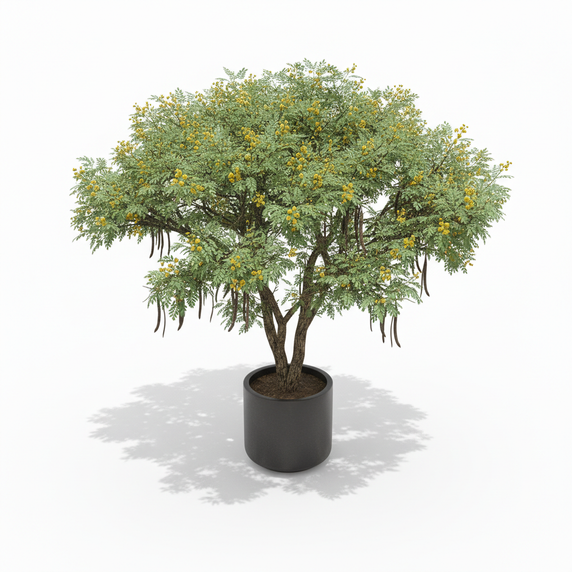





Transform your landscape with the majestic Egyptian Acacia. A symbol of resilience and beauty, this Vachellia nilotica is renowned for its feathery foliage, fragrant yellow blossoms, and incredible drought tolerance. Ideal for creating natural shade and a serene atmosphere, this hardy tree thrives in full sun and requires minimal care once established. Bring a piece of the Nile's legacy to your garden today and enjoy its timeless appeal for decades to come.
Common Name: Egyptian Acacia, Gum Arabic Tree, Babul
Botanical Name: Vachellia nilotica
Arabic Name: اكاسيا
Plant Variant: Standard
Plant Color: Natural
Plant Country: Egypt
Family: Fabaceae
Kingdom: Plantae
Clade: Tracheophytes
Order: Fabales
Family: Fabaceae
Genus: Vachellia
Species: Vachellia nilotica
Native to Africa, the Middle East, and the Indian subcontinent. It is widely distributed across the Nile Valley in Egypt, where it has been culturally and economically significant for millennia.
This species is a medium-sized tree with a dense, spreading crown. It features delicate, feathery bipinnate green leaves and pairs of thin, straight thorns at the base of the leaf stalks. It produces attractive, spherical, bright yellow flower heads that are intensely fragrant.
The Egyptian Acacia typically reaches heights of 5 to 20 meters. Its canopy can spread wide, providing significant shade, often reaching a width comparable to its height in open landscapes.
Requires full sun. It thrives in bright, direct sunlight and should be planted in an open area where it can receive at least 6 to 8 hours of sun daily.
Highly drought-tolerant once established. Young trees require regular watering to develop a deep root system, but mature specimens are well-adapted to arid conditions and need very little supplemental irrigation.
Adaptable to a wide range of soil types, including sandy, loamy, and heavy clay. It can tolerate saline soils and alkaline conditions. Due to its size and extensive root system, it is best grown in the ground rather than in pots.
Thrives in hot, dry climates. It is well-suited to Mediterranean and desert temperatures but is sensitive to heavy frost, especially when young. It prefers low to moderate humidity levels.
As a member of the Fabaceae family, it is a nitrogen-fixing plant that improves soil quality. Generally, it does not require regular fertilization, though a balanced organic fertilizer can be applied in early spring to boost growth.
Low maintenance. Care primarily involves occasional pruning to remove dead or crossing branches and to maintain the desired shape. Caution is advised when handling the tree due to its sharp thorns.
A relatively fast-growing tree. Propagation is typically done via seeds, which benefit from scarification or soaking in hot water before planting to break their hard dormancy.
Generally pest-resistant, though it can occasionally be affected by wood borers or leaf-eating insects. Root rot may occur if the plant is situated in areas with poor drainage or over-saturated soil.
Widely used for providing natural shade, windbreaks, and soil stabilization. It is the primary source of Gum Arabic and has been used traditionally for its medicinal properties and high-quality timber.
The plant itself is not generally considered toxic to humans or pets through contact, but its long, sharp thorns pose a significant physical hazard. Use caution when planting near high-traffic areas or walkways.
Transform your landscape with the majestic Egyptian Acacia. A symbol of resilience and beauty, this Vachellia nilotica is renowned for its feathery foliage, fragrant yellow blossoms, and incredible drought tolerance. Ideal for creating natural shade and a serene atmosphere, this hardy tree thrives in full sun and requires minimal care once established. Bring a piece of the Nile's legacy to your garden today and enjoy its timeless appeal for decades to come.
Common Name: Egyptian Acacia, Gum Arabic Tree, Babul
Botanical Name: Vachellia nilotica
Arabic Name: اكاسيا
Plant Variant: Standard
Plant Color: Natural
Plant Country: Egypt
Family: Fabaceae
Kingdom: Plantae
Clade: Tracheophytes
Order: Fabales
Family: Fabaceae
Genus: Vachellia
Species: Vachellia nilotica
Native to Africa, the Middle East, and the Indian subcontinent. It is widely distributed across the Nile Valley in Egypt, where it has been culturally and economically significant for millennia.
This species is a medium-sized tree with a dense, spreading crown. It features delicate, feathery bipinnate green leaves and pairs of thin, straight thorns at the base of the leaf stalks. It produces attractive, spherical, bright yellow flower heads that are intensely fragrant.
The Egyptian Acacia typically reaches heights of 5 to 20 meters. Its canopy can spread wide, providing significant shade, often reaching a width comparable to its height in open landscapes.
Requires full sun. It thrives in bright, direct sunlight and should be planted in an open area where it can receive at least 6 to 8 hours of sun daily.
Highly drought-tolerant once established. Young trees require regular watering to develop a deep root system, but mature specimens are well-adapted to arid conditions and need very little supplemental irrigation.
Adaptable to a wide range of soil types, including sandy, loamy, and heavy clay. It can tolerate saline soils and alkaline conditions. Due to its size and extensive root system, it is best grown in the ground rather than in pots.
Thrives in hot, dry climates. It is well-suited to Mediterranean and desert temperatures but is sensitive to heavy frost, especially when young. It prefers low to moderate humidity levels.
As a member of the Fabaceae family, it is a nitrogen-fixing plant that improves soil quality. Generally, it does not require regular fertilization, though a balanced organic fertilizer can be applied in early spring to boost growth.
Low maintenance. Care primarily involves occasional pruning to remove dead or crossing branches and to maintain the desired shape. Caution is advised when handling the tree due to its sharp thorns.
A relatively fast-growing tree. Propagation is typically done via seeds, which benefit from scarification or soaking in hot water before planting to break their hard dormancy.
Generally pest-resistant, though it can occasionally be affected by wood borers or leaf-eating insects. Root rot may occur if the plant is situated in areas with poor drainage or over-saturated soil.
Widely used for providing natural shade, windbreaks, and soil stabilization. It is the primary source of Gum Arabic and has been used traditionally for its medicinal properties and high-quality timber.
The plant itself is not generally considered toxic to humans or pets through contact, but its long, sharp thorns pose a significant physical hazard. Use caution when planting near high-traffic areas or walkways.
Take 20% off your first order
Enter the code below at checkout to get 20% off your first order