


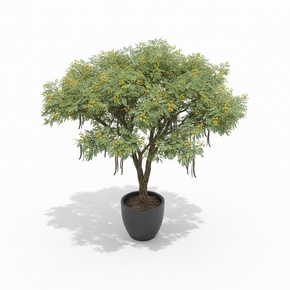



Transform your landscape with the vibrant and resilient Golden Wreath Wattle! The Acacia saligna is your go-to solution for creating a fast-growing privacy screen or a stunning garden centerpiece. Imagine your garden bursting into a cloud of brilliant yellow flowers each spring, attracting bees and birds. Exceptionally drought-tolerant and easy to care for, this tree is perfect for busy homeowners who want maximum impact with minimum fuss. Plant it, watch it grow, and enjoy the natural beauty and shade for years to come. Order yours today and bring a piece of the Australian sunshine to your home!
Common Name: Golden Wreath Wattle, Orange Wattle, Blue-leafed Wattle
Botanical Name: Acacia saligna
Arabic Name: اكاسيا
Plant Variant: Standard
Plant Color: Natural
Plant Country: Spain
Kingdom: Plantae
Order: Fabales
Family: Fabaceae
Subfamily: Mimosoideae
Genus: Acacia
Acacia saligna is native to Western Australia but has been widely introduced to various regions including South Africa, the Mediterranean basin (such as Spain), and parts of the Middle East due to its hardiness and rapid growth.
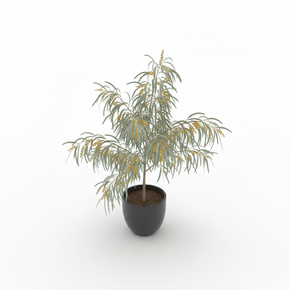
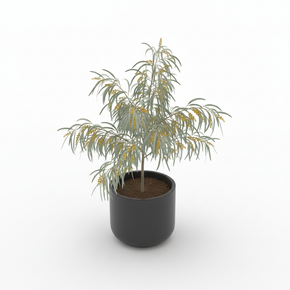
This species is characterized by its weeping habit and pendulous branches. Instead of true leaves, it develops phyllodes that are blue-green to dark green, linear to lanceolate in shape. In late winter and spring, it produces a profusion of bright, golden-yellow globular flower heads that occur in axillary racemes.
Typically growing as a small tree or large shrub, it reaches heights of 3 to 8 meters (10 to 26 feet). It has a wide, spreading canopy that can extend nearly as wide as the tree is tall.
It requires full sun to thrive and bloom profusely. While it can tolerate very light shade, it becomes leggy and produces fewer flowers in lower light conditions.
Highly drought-tolerant once established. For young plants, water regularly until the root system is deep. In mature stages, it generally relies on natural rainfall, though occasional deep watering during extreme droughts is beneficial.
Adaptable to a wide range of soil types, including sandy, loamy, and clay soils. It performs exceptionally well in well-draining, poor, or sandy soils and is tolerant of soil salinity.
Thrives in warm temperate, Mediterranean, and semi-arid climates. It is hardy to temperatures as low as -7°C (19°F) and handles high summer temperatures and low humidity very well.
Requires little to no fertilization as it is a nitrogen-fixing plant. If necessary, a low-phosphorus fertilizer formulated for native or woody plants can be applied in early spring.
Low maintenance. Pruning should be done after the flowering season to maintain shape, remove dead wood, or control its size. It is a vigorous grower that requires minimal intervention.
Fast-growing species. Propagation is primarily achieved through seeds, which require scarification (nicking the seed coat or soaking in hot water) to stimulate germination. It can also be propagated via cuttings, though seeds are more common.
Generally pest-resistant, but can occasionally be affected by gall rust or scale insects. In some regions, its fast growth and high seed production can make it invasive if not managed.
Excellent for soil stabilization, windbreaks, and privacy screens. It is widely used in landscaping for its ornamental yellow flowers and as a shade tree. It also serves as a source of pollen for bees and habitat for birds.
Acacia saligna is generally considered non-toxic to humans and pets. However, like many flowering trees, its abundant pollen can be a trigger for seasonal allergy sufferers.
Transform your landscape with the vibrant and resilient Golden Wreath Wattle! The Acacia saligna is your go-to solution for creating a fast-growing privacy screen or a stunning garden centerpiece. Imagine your garden bursting into a cloud of brilliant yellow flowers each spring, attracting bees and birds. Exceptionally drought-tolerant and easy to care for, this tree is perfect for busy homeowners who want maximum impact with minimum fuss. Plant it, watch it grow, and enjoy the natural beauty and shade for years to come. Order yours today and bring a piece of the Australian sunshine to your home!
Common Name: Golden Wreath Wattle, Orange Wattle, Blue-leafed Wattle
Botanical Name: Acacia saligna
Arabic Name: اكاسيا
Plant Variant: Standard
Plant Color: Natural
Plant Country: Spain
Kingdom: Plantae
Order: Fabales
Family: Fabaceae
Subfamily: Mimosoideae
Genus: Acacia
Acacia saligna is native to Western Australia but has been widely introduced to various regions including South Africa, the Mediterranean basin (such as Spain), and parts of the Middle East due to its hardiness and rapid growth.
This species is characterized by its weeping habit and pendulous branches. Instead of true leaves, it develops phyllodes that are blue-green to dark green, linear to lanceolate in shape. In late winter and spring, it produces a profusion of bright, golden-yellow globular flower heads that occur in axillary racemes.
Typically growing as a small tree or large shrub, it reaches heights of 3 to 8 meters (10 to 26 feet). It has a wide, spreading canopy that can extend nearly as wide as the tree is tall.
It requires full sun to thrive and bloom profusely. While it can tolerate very light shade, it becomes leggy and produces fewer flowers in lower light conditions.
Highly drought-tolerant once established. For young plants, water regularly until the root system is deep. In mature stages, it generally relies on natural rainfall, though occasional deep watering during extreme droughts is beneficial.
Adaptable to a wide range of soil types, including sandy, loamy, and clay soils. It performs exceptionally well in well-draining, poor, or sandy soils and is tolerant of soil salinity.
Thrives in warm temperate, Mediterranean, and semi-arid climates. It is hardy to temperatures as low as -7°C (19°F) and handles high summer temperatures and low humidity very well.
Requires little to no fertilization as it is a nitrogen-fixing plant. If necessary, a low-phosphorus fertilizer formulated for native or woody plants can be applied in early spring.
Low maintenance. Pruning should be done after the flowering season to maintain shape, remove dead wood, or control its size. It is a vigorous grower that requires minimal intervention.
Fast-growing species. Propagation is primarily achieved through seeds, which require scarification (nicking the seed coat or soaking in hot water) to stimulate germination. It can also be propagated via cuttings, though seeds are more common.
Generally pest-resistant, but can occasionally be affected by gall rust or scale insects. In some regions, its fast growth and high seed production can make it invasive if not managed.
Excellent for soil stabilization, windbreaks, and privacy screens. It is widely used in landscaping for its ornamental yellow flowers and as a shade tree. It also serves as a source of pollen for bees and habitat for birds.
Acacia saligna is generally considered non-toxic to humans and pets. However, like many flowering trees, its abundant pollen can be a trigger for seasonal allergy sufferers.




Take 20% off your first order
Enter the code below at checkout to get 20% off your first order